
We have received our first firewood delivery following my firewood holder project.
Aside from the need to store the wood neatly and out of the rain, I was also curious as to if future wood deliveries would be true to measurement. When they dump a pile of loose wood in the driveway, there’s a lot being taken on faith. Now, I can measure exactly if what was advertised and paid for matches up.
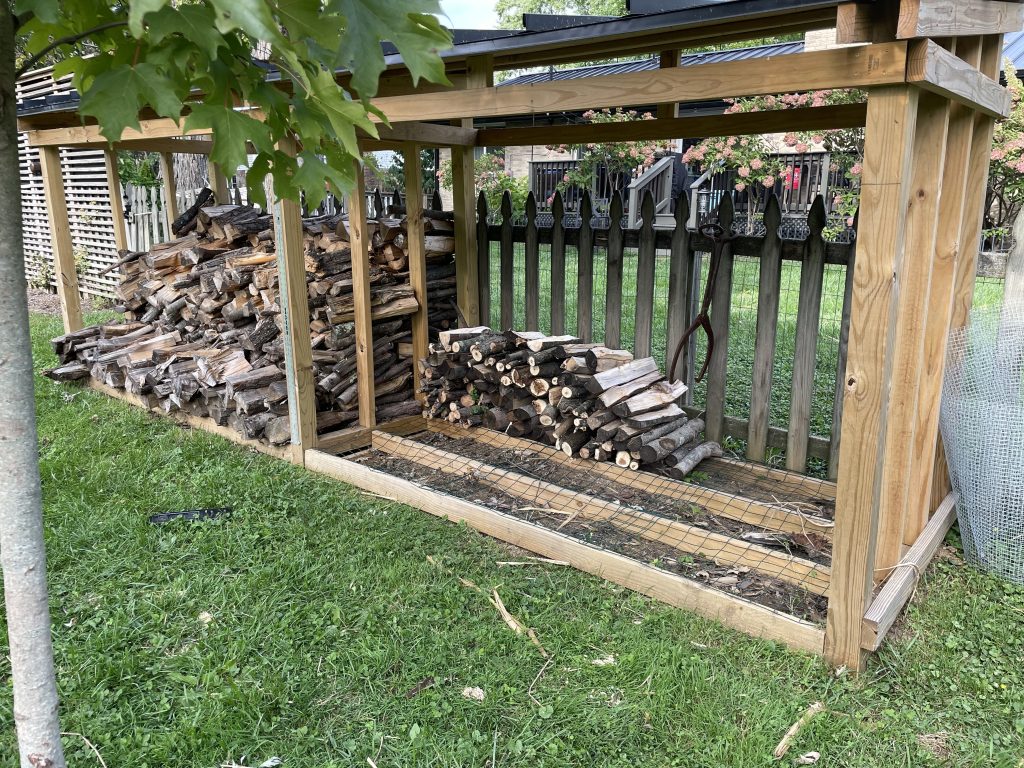
We ordered a cord and a half, based on how much wood should fit taking into consideration how much wood was already stored. It should have maxed out our storage. Instead, this was the end result:
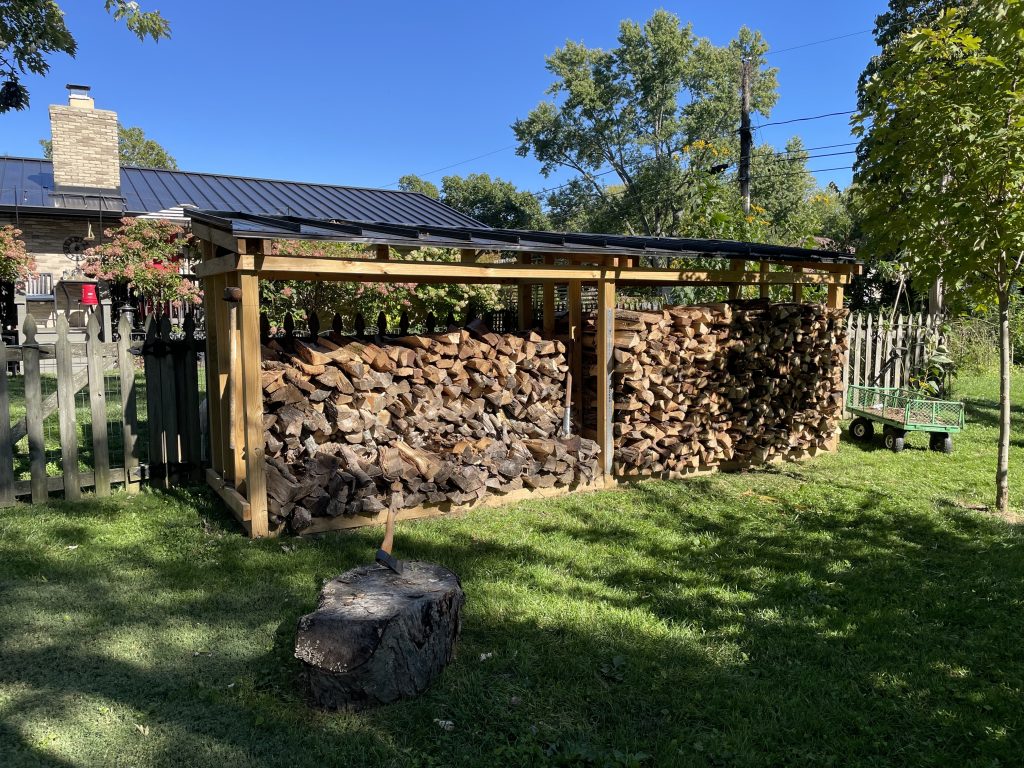
Granted, some was stored on the front porch, but I estimate this deliver to be about a cord and a quarter. For shame, internet firewood guy who delivers to our area! What would the state have to say about this deception?
If you’re asking about Ohio, the law is quite specific about selling firewood by volume.
A legal cord is 128 cubic feet of wood when “ranked and well stowed”—meaning the pieces are placed in rows, generally parallel and touching, and stacked compactly.
A conventional stack measuring:
is therefore one cord. But 4×4×8 isn’t mandatory; any stacked dimensions totaling 128 cubic feet qualify. For example, with 16-inch logs, three rows measuring 4 ft high × 8 ft long give approximately one cord.
Selling it legally in Ohio
If you’re advertising or selling ordinary loose firewood by volume, Ohio permits “cord” and fractional parts of a cord (or cubic meters). Importantly, you cannot advertise or sell it using terms such as “face cord,” “rick,” “rack,” “pile,” or “truckload.” Those aren’t legally defined quantities under the Ohio rule.
So these are appropriate:
1 cord — $300
½ cord — $175
¼ cord — $100
Whereas “one truckload — $150” or “one face cord — $100” isn’t an acceptable way to represent the quantity of firewood being sold in Ohio.
If you sell packaged firewood, the package is instead labeled by volume in cubic feet (including fractions) or cubic meters. There are separate rules for very small packages, single logs, pellets/chips, and sales by weight.
Measuring a cord
For ordinary split wood, stack it reasonably tightly and measure:
The result must be 128 ft³ for a cord, 64 ft³ for ½ cord, 32 ft³ for ¼ cord, etc. The 128 ft³ includes the normal air spaces between properly stacked pieces—it does not mean 128 solid cubic feet of wood.
Ohio specifically defines the wood as “ranked and well stowed,” so simply estimating the volume of a loose heap or pickup bed isn’t equivalent to measuring a cord.
For a nonpackaged firewood sale, Ohio also requires the seller to provide a delivery ticket or sales invoice. County guidance lists the relevant information as the seller and purchaser, delivery date, amount delivered, quantity on which the price is based, description of the wood, and total price.
Ohio’s general weights-and-measures law additionally prohibits selling less than the represented quantity or representing quantity in a misleading manner.
So if you’re thinking about cutting firewood from your property and selling it locally, you don’t need a special 4×4×8 container. The straightforward method is to stack it, measure the stack, advertise it as a cord or fraction thereof, and issue the required sales documentation.
I received no sales documentation either! This is unprecedented, unacceptable! And…probably pretty reasonable for a guy dumping a truckload of wood in my driveway for a cash payment. It was close, but caveat emptor. It’s still cheaper than heating with gas, even if I was overcharged $92.50 per market rate. And it was delivered.
But still, it’s interesting to see how close it came to measurement. I’m curious how close future deliveries will be.
–Simon