Mushrooms (Part 5)

AI does not like to identify mushrooms. Mushrooms are difficult to identify, so I get it, but I’m also a 90s kid who saw playground equipment removed from schools and warning labels applied to coffee cups. I suspect that AI could give a probable identification, but doesn’t want the responsibility of someone poisoning themself if the identification were incorrect. So alas, despite my curiosity with this kingdom of lifeforms, I can’t fully catalog them.

But I can photograph them! Here’s some more from Easement Acres:

Hopus lionus (I hope this is the Lion’s Man I inoculated into this stump earlier this year).
Schizophyllum commune?
I know this one, because I seeded it! Stropharia rugosoannulata
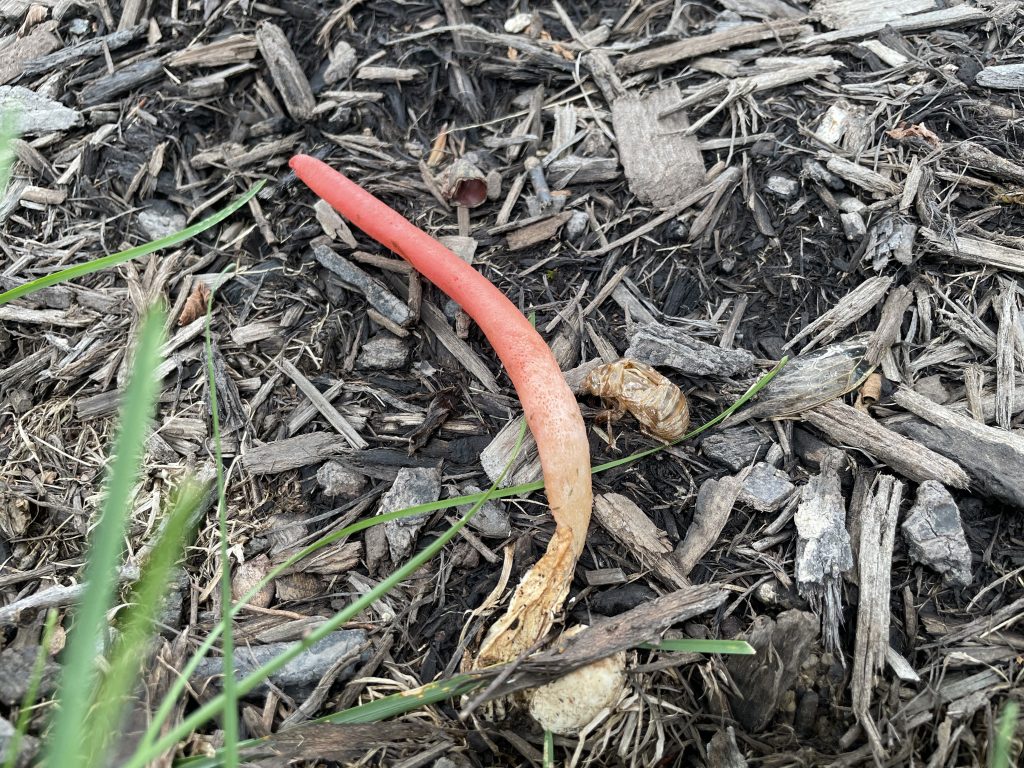
Galerina marginata? AKA Funeral Bell. Might be Desarmillaria tabescens, but I’m not going to try eating them.
Some form of Crepidotus

Lots of rain bringeth lots of mushrooms. Don’t eat them, or at least don’t blame AI if you do and die.

–Simon

More Foliage!

Southwest Ohio is naturally a woodland. Suburbia fights this for what I gather are a few reasons: 1) Trees make mowing more difficult, 2) Tall canopy trees don’t make much in the way of pretty flowers, 3) Homeowners are paranoid about falling branches, 4) Trees interfere with utilities, 5) Trees create yard waste. 6) Trees shade out grass. Etc., etc….

But they’re a natural aesthetic and blocker of the merciless summertime UV death rays! So I will continue working with nature for the perks, instead of focusing on the negatives. I also want to expand the hosta patch, and that requires more shade. So I present to you, the Japanese maple:

Okay, maybe it’s not a true native, but neither are the honeysuckle. It’ll work. I speak for the trees, dammit!

–Simon

Nature will Try to Kill You, or Sometimes Just Want Fed

Of course, sometimes it will try to kill you because it wants food. Other times, however, it will ask nicely.

Take a gander

Such was the case when, doing some gardening, I was approached by a trio of ducks who then sat down and stared at me expectantly. But as I don’t normally walk around with duck chow in my pocket, I had to disappoint. Sensing a lack of forthcoming food, they wandered off.

But then they found my sump drainage line. More a retaining pool than anything, it had remained full with the amount of recent rain. And conveniently located next to that is the bird feeder, which always has seed beneath it, dropped by their messier cousins.

Satiated, they bed down for an afternoon nap.

We now have a flock of neighborhood ducks who, after being fed, decided this was a good neighborhood to live in. This is now The Year of the Duck.

Conversely, it’s also The Year of the Bees. I haven’t been stung in years, but a honey bee must have got itself stuck in my boot. Here’s the part where nature will also try to kill you.

Beware nature.

–Simon

Mushrooms (Part 4)

In what appears to be a mushroom theme as of late, here’s a newcomer I haven’t seen before. AI has made identification significantly easier now, taking some of the fun out of the search. Can’t stop what’s coming, I suppose.

Anyway:

Peziza vesiculosa

They grow in nutrient-rich mediums, such as this layer of mulch.

They’re also apparently inedible. Oh well.

–Simon

Eight-spotted Forester

Here’s a cool bug I haven’t seen before in the yard: an eight-spotted forester.

Apparently a native and unremarkable species, this moth lives at the edges of forests and open fields, with their caterpillars feeding on, among other things, virginia creeper. It was, in fact, spotted resting upon a dormant virginia creeper vine at the edge of my yard.

Noteworthy only because it was the first time I’ve seen one.

–Simon