
When I was a child, I had the credit score of a child. Now that I’m grown, I see through an iPhone darkly. Because it was in night mode. I was also squinting angrily in frustration.
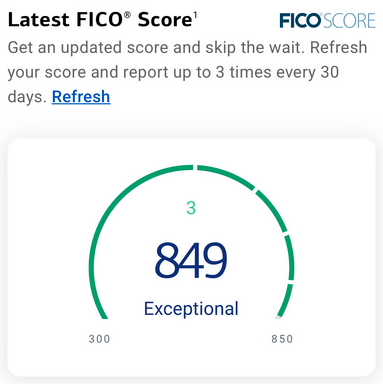
One friggin point from maximum? That hardly matters, but it’s taunting me simply from an OCD standpoint.
As one with years in the credit industry, I’m very familiar with peoples’ delusions about their own credit worthiness. Underwriting for the mass public, especially in the retail credit realm, is telling. Most people are either largely ignorant or completely lacking self-awareness. The number of times “I have perfect credit!” was shouted at me from someone with a FICO in the 300s was disturbingly common. So common that it became a meme amongst my call center cohorts.
Fortunately I’ve moved on from customer-facing roles. And in the interim, a number of governmental regulations have been implemented that force additional transparency for the consumer. So I hope that the confused masses are taking opportunities from the present availability of information to better understand their own credit scores.
Still though, even as one associated with the industry, the scoring model remains mystical. So naturally, I consulted AI. Here’s what it had to say:
If your credit score is one point below the maximum (for example, 849 instead of 850 on many FICO models), it’s usually because the scoring model has found some tiny imperfection or simply because the algorithm doesn’t hand out the absolute maximum very often.
Common reasons include:
- You still have active credit accounts. Oddly enough, having and using credit perfectly can sometimes score a point or two lower than having an idealized profile.
- One inquiry in the last year or two. A recent mortgage, auto loan, or credit card application can shave a few points.
- A non-zero balance reporting. Even if you pay cards in full every month, one card may report a small balance before the statement closes.
- Credit mix isn’t mathematically perfect. The model may prefer a certain combination of revolving and installment accounts.
- Average age of accounts. Even excellent profiles can be a point or two shy if some accounts are relatively newer.
- Model quirks. Credit scores are statistical models, not grades. Sometimes two nearly identical consumers will differ by a point or two for reasons that aren’t obvious.
In conclusion, it would appear that a perfect credit score is nearly impossible to achieve. So it is with much regret that I must say to all my former interlocutors in consumer credit that, unfortunately, it’s unlikely that you ever had, or ever will have, perfect credit.
But I’m close!
–Simon
Dear Sir,
I hope this message finds you well. You don’t allow the functionality for me to show you my 850.
You suck.
That is all.
Dear ma’am, your lack of IP address obfuscation renders your anonymity rather moot. Keep up with those roofing payments to maintain that score.
-Husband