
Being a parent is no easy task. Once a child has been instilled with an ethical code (a monumental task in itself), the next primary objective is to teach one how to succeed in life. Ethics has been studied ad nauseam. I know this. I’ve taken so many philosophy courses that I too feel the pull to strip naked and babble incoherently in the street. But regardless the particular ethical practice one chooses, we’ve all kinda sorta agreed on what is and isn’t ethical behavior at a societal level. Being a good person doesn’t require the depth of study that professors and lawyers argue over. With a basic code of honor, learned early, we can interpret the rest.
Success, however, can be cruelly elusive. And how is success defined? Money? Power? Self-sufficiency? No. I would argue that success is defined by personal performance and overall enjoyment of life while also obtaining society’s acknowledgment. Much in the way that manhood can’t be entirely gifted to oneself, neither can success. Others must bestow the title too. Success requires prestige. And in this present society, our identities are tied primarily to our professions. Therefore, our success – and prestige – is defined by our professional achievements.
To quantify prestige, I’ll reference a set of survey data that I stumbled upon one day and held onto. It had an impact on me. By seeing how the general population ranks their perceived professional prestige, it gives meaningful insight into how we judge ourselves by what society values. They are the NORC scores for occupational prestige:
http://ibgwww.colorado.edu/~agross/NNSD/prestige%20scores.html
Our collective problem, however, is assigning prestige directly to success. How many times as kids were we asked “What do you want to be when you grow up?”? I hated that question, because there was no way to know with the limited experience I possessed at that point in my life. So I answered how most of us probably answered, with a prestigious occupation. A scientist. A teacher. A firefighter. A doctor. It all varied based on who was asking and how I was feeling that day, but the goal was the same: give the right answer and gain prestige. Giving the wrong answer, however, yielded disapproving looks and snide remarks.
And none of these answers took into account what I was suited for or enjoyed. I answered how I was expected, and even pursued some of these paths in my studies. Until the world collapsed around me.
It turns out that achieving success requires more than the prestige. It also requires aptitude for and enjoyment of its pursuit. Here is what I propose:
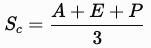
Aptitude + Enjoyment + Prestige, divided by 3 = Level of Societal Success
Variables defined as follows:
Aptitude = how good you are naturally at an action with relation to the Prestige.
Enjoyment = how much pleasure you derive from pursuing the Prestige.
Prestige = the achievement; the goal; the career.
Each variable, to remain consistent with the NORC scores, is assigned a value of 0-100. The formula is:
(A+E+P)/3 = Sc
Aptitude failure
Let’s look at an anecdotal example. A personal one. As a kid I was physically underdeveloped, malnourished, skinny, short, late to puberty, and almost a year younger than peers of my grade. This meant that for sports, despite me having some level of enjoyment with them, I possessed very little aptitude. Let’s say 10/100. Enjoyment, I’ll assign 70/100. Rounded up, NORC gives a professional athlete a prestige score of 65.
This equates to a Success Score of 48
That’s an F grade. Had I pursued a career playing sports, I would have had a low level of success in society’s eyes.
Note that each of these factors becomes a limiting variable. If any is assigned the minimal value, Success is reduced to a maximum of 67. I could be the greatest man alive to sample dog food, and enjoy dog food more than anyone in history, but I have yet to hear a positive story of people lauding such a profession, so societal success is limited.
Conversely, someone with no aptitude but high enjoyment will never achieve high success in a high-prestige pursuit. Enjoyment will never overcome inability. And aptitude will not overcome lack of enjoyment – that just causes burnout.
Enjoyment is a requirement
Why the equal treatment for enjoyment? Because willpower alone is not inexhaustible. It’s easy to apply oneself to a pursuit out of pure enjoyment. It’s no testament to hard work when the work itself is fun. Therefore, high achievers are lucky enough to enjoy a pursuit for which they have aptitude, in a field that is also high prestige. These are the names we know and worship as Capitalistic success stories, even though luck itself in how someone’s brain is wired had significant influence.
The lesson
My advice, then, is not to pursue a career based on aptitude and prestige alone. Nor should one blindly pursue their passion. We can’t be whatever we want to be. All factors must be equally weighed when considering the future.
So where do I rank today?
To assign numerical values to my present position, I looked to the American academic grading scale. Here’s what the internet provided me:
| Letter Grade | Percentage Range | Description |
|---|---|---|
| A+ | 97-100% | Excellent |
| A | 90-96% | Excellent |
| A− | 87-89% | Very Good |
| B+ | 83-86% | Good |
| B | 80-82% | Good |
| B− | 77-79% | Satisfactory |
| C+ | 73-76% | Satisfactory |
| C | 70-72% | Satisfactory |
| C− | 67-69% | Needs Improvement |
| D+ | 63-66% | Poor but Passing |
| D | 60-62% | Poor but Passing |
| D− | 57-59% | Minimum Passing Quality |
| F | 0-56% | Failure |
The description helps me identify a ranking by gut reaction. Here’s what I came up with:
Aptitude = 88. I’m very good at wrangling people and capturing project requirements, formulating process flows, and communicating proposals for tollgate approvals and developer intake. I don’t feel I’m excellent, however. There’s always the occasional mistake.
Enjoyment = 71. To be honest with myself, I’d consider my current work within the base tier of satisfactory. I’d prefer work that was more technical – with data, investigation, and coding. I can’t complain, but it’s not yet a perfect match. I miss these technical components from my former positions. Careers are a journey.
Prestige = 61. This is a predetermined value from the NORC survey results. Although it’s difficult to pinpoint the exact position. Plugging in my job title and LinkedIn experience, AI pairs me with “Management Analyst”:
Your work is primarily product/functional management of authentication capabilities, rather than actually performing systems analysis or software/computer science work. The old classification is based on occupation, not the prestige implied by an AVP title.
The closest matches on the Nakao–Treas list are:
| 1980 Census occupation | Prestige | How well it fits |
|---|---|---|
| Management analysts | 61 | Best functional match |
| Managers & administrators, n.e.c. | 51 | Good alternative if emphasizing your AVP/management role |
| Computer systems analyst/scientist | 73.70 | Too technically oriented |
| Financial managers | 59 | Banking fits, but your function isn’t primarily financial management |
(88+71+61)/3=73
That’s a C+. Society sees me as a C student level of success, with potential for achieving the next grade. That’s fairly encouraging. I can’t do anything about the NORC score, but I could improve my work performance, find a better functional match, or seek out additional areas that benefit my work that I would enjoy more. I could cap out at this job with an 87 – an A-. Not bad.
In conclusion
I’ve suffered a lifetime of boomer BS. No one ever encouraged me to enjoy work. In fact, fun was interpreted by my elders to mean not learning or striving. Aptitude was an irrelevancy – hard work could overcome any deficiency. The only thing that mattered was that end career result. What kind of life is that?
We can’t escape the prestige ranking of a career. It may shift over time, but it’s primarily fixed by current societal values. What we can do is identify our aptitudes and be of present mind. It requires a lot of self-honesty, which can be uncomfortable, but only because we’ve been conditioned to embrace misery and disavow our weaknesses. Extreme suffering isn’t admirable. I’d even go so far as to claim that these false ideals are the underlying causes of American angst and violence (but this is already quite enough philosophy for one post (no naked ranting in the streets today)).
And remember, all values for the stated variables can, and probably will, change over time. This will require regular reassessment. Also remember that the prestige value may not yet be something obtained. It can simply be the goal. And just like the career, the goal’s pursuit may reveal a personal lack of aptitude or enjoyment which may not have been originally obvious. Trial and error is to be expected.
Find joy and personal strengths. You’ll achieve more success. And society will thank you. What’s not to like?
–Simon