
FICO U

When I was a child, I had the credit score of a child. Now that I’m grown, I see through an iPhone darkly. Because it was in night mode. I was also squinting angrily in frustration.

One friggin point from maximum? That hardly matters, but it’s taunting me simply from an OCD standpoint.

As one with years in the credit industry, I’m very familiar with peoples’ delusions about their own credit worthiness. Underwriting for the mass public, especially in the retail credit realm, is telling. Most people are either largely ignorant or completely lacking self-awareness. The number of times “I have perfect credit!” was shouted at me from someone with a FICO in the 300s was disturbingly common. So common that it became a meme amongst my call center cohorts.

Fortunately I’ve moved on from customer-facing roles. And in the interim, a number of governmental regulations have been implemented that force additional transparency for the consumer. So I hope that the confused masses are taking opportunities from the present availability of information to better understand their own credit scores.

Still though, even as one associated with the industry, the scoring model remains mystical. So naturally, I consulted AI. Here’s what it had to say:

If your credit score is one point below the maximum (for example, 849 instead of 850 on many FICO models), it’s usually because the scoring model has found some tiny imperfection or simply because the algorithm doesn’t hand out the absolute maximum very often.

Common reasons include:

  • You still have active credit accounts. Oddly enough, having and using credit perfectly can sometimes score a point or two lower than having an idealized profile.
  • One inquiry in the last year or two. A recent mortgage, auto loan, or credit card application can shave a few points.
  • A non-zero balance reporting. Even if you pay cards in full every month, one card may report a small balance before the statement closes.
  • Credit mix isn’t mathematically perfect. The model may prefer a certain combination of revolving and installment accounts.
  • Average age of accounts. Even excellent profiles can be a point or two shy if some accounts are relatively newer.
  • Model quirks. Credit scores are statistical models, not grades. Sometimes two nearly identical consumers will differ by a point or two for reasons that aren’t obvious.

In conclusion, it would appear that a perfect credit score is nearly impossible to achieve. So it is with much regret that I must say to all my former interlocutors in consumer credit that, unfortunately, it’s unlikely that you ever had, or ever will have, perfect credit.

But I’m close!

–Simon
Age and Economics

385 words, 2 minutes read time.

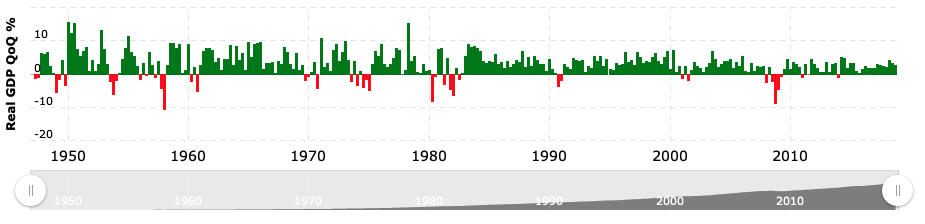
Now that I’m 40, I’ve done some reflecting. In all, I don’t have too many complaints when I really think about it. I mean, America’s golden age – at least in recent history and the era we still seem to consider the gold standard (hehe) – was the 1950s and 60s, and a time in which the war and postwar generations saw large economic growth.

Just look at those GDP spikes, compared to 2007, when I entered the workforce full time! Sure there were some recessions, and the Boomers still whine about how bad interest rates were in 1980 (and how so many of them were almost drafted for The Vietnam War), but look at the growth recovery following each of those events, compared to the 2008 Great Recession.

Recession of 1953

Inflation and rising interest rates:

https://en.wikipedia.org/wiki/Recession_of_1953

Recession of 1958

Sinking car and house purchases:

https://en.wikipedia.org/wiki/Recession_of_1958

Early 1980s recession in the United States

Inflation and oil energy dependency:

https://en.wikipedia.org/wiki/Early_1980s_recession_in_the_United_States

2007–2008 financial crisis

Unsustainable and predatory financial lending practices:

https://en.wikipedia.org/wiki/2007%E2%80%932008_financial_crisis

And studies which I won’t bother to cite because you have a search engine too have long mockingly laughed at my generation’s plight, as those who enter the workforce in a recession are doomed to never make much money. And yet, here Liz and I sit, apparently as 12%-ers. And also apparently I’ll be a multi-millionaire at retirement according to projections. And like most of my generation, I normally don’t discuss my financial situation, because we just don’t want to get into it with a boomer. But sometimes I think it’s healthy to brag about one’s accomplishments and this one in particular is contrary to everything I was told was going to happen, thanks to boomer generational masturbatory article headlines (“Your kids are lazy and won’t get a job and they’re moving back home to take your money”).

But I started off on a tangent. I meant to post some cheap laughs at becoming older, but I’m apparently so adversarialy positive about my situation that I got distracted with everything good that’s happened on my journey to becoming middle-aged.

Oh well. Fodder for my next post I suppose, since I’m almost hitting 400 words here! Next time – how long it takes to grow out a damaged fingernail! Woo!

–Simon

Overcoming

I’ll begin with an oft-repeated nugget of bullshit wisdom: “Money doesn’t buy happiness.”

And I’ll say that’s true, except no money also can’t buy happiness. The phrase isn’t that money can’t buy happiness, but that it doesn’t necessarily. So I think that a better version would be: “Money doesn’t necessarily buy happiness, but it’s a prerequisite.”


I began tracking my annual income in relation to yearly inflation and the American median per capita income a few years back, using my historical W-2s. Alas I didn’t save them all, and employer data retention limits their own historical records, but I can go back as far as 2011, and prior to that I can infer some pretty measly wages. So, after a 16+ year career (when I began working full time), this is what I discovered:

The Median

First off, the median per capita is, by definition, the income that most people have. It is therefore the income at which point you can survive with proper budgeting, since most people do so. It is also not something that happens with entry level jobs, and requires years of experience and some promotions to achieve. In my case, it was 7 years of working full time to achieve this median.

Inflation

Failure to increase wages will return a net loss as inflation chips away at real income value, so if your annual raises do not outpace inflation, you will lose actual worth. This drags out the process.

Transition

For the next 4-5 years following this introductory period, the promotions with job changes were decent but not enough to significantly alter my station. I’ll call this the transition stage: the point at which sufficient skills are acquired to warrant higher pay, but the opportunity has to present itself. It was the most competitive period of my career.

Overcoming

The following 5-6 years have since seen me significant compensation growth, I think because at this point I have acquired a very broad skillset but with pointed areas of expertise, which are in demand. Individually I broke into the 20%er bracket during this timeframe, which was the point at which I began to notice my purchasing power had significantly changed in relation to my younger self and the world around me.

Conclusion

In the spirit of this site’s ethos, these are my observations and interpretations of being an elder Millennial, by age:

  • 0-21: No job in this age range will return a livable wage due to lack of knowledge, experience, education, and an employment system that greatly restricts job availability.
  • 21-28: Any job in this age range will be limited in both responsibilities and salary.
  • 28-33: A job in this age range will begin to see greater salary returns, probably due to experience gained while in the prior age range.
  • 33+: A job in this age range can encompass a wide range of pay scales and opportunities.

Sooooo, anything before turning 30 is a wash. It’s the period of life that requires working hard for low pay while building skills and experience needed to compete for the higher-paying jobs. This pretty closely checks out with published salary by age reports, although I can’t personally confirm the next stages. Supposedly salary caps out in the 45-54 age range, so hopefully I have that to look forward to.

I admit, it’d be kind of depressing as a young person, and appears constant across developed nations. The postwar Baby Boomer period was anomalous, with its influx of unskilled high pay industrial jobs, followed by unsustainable financial policies to unsuccessfully maintain that growth. But a generation that lacked financial burden also proved to lack compassion and character, so there’s an upside to the struggle, for those who make it that long. (Also, money.)

–Simon