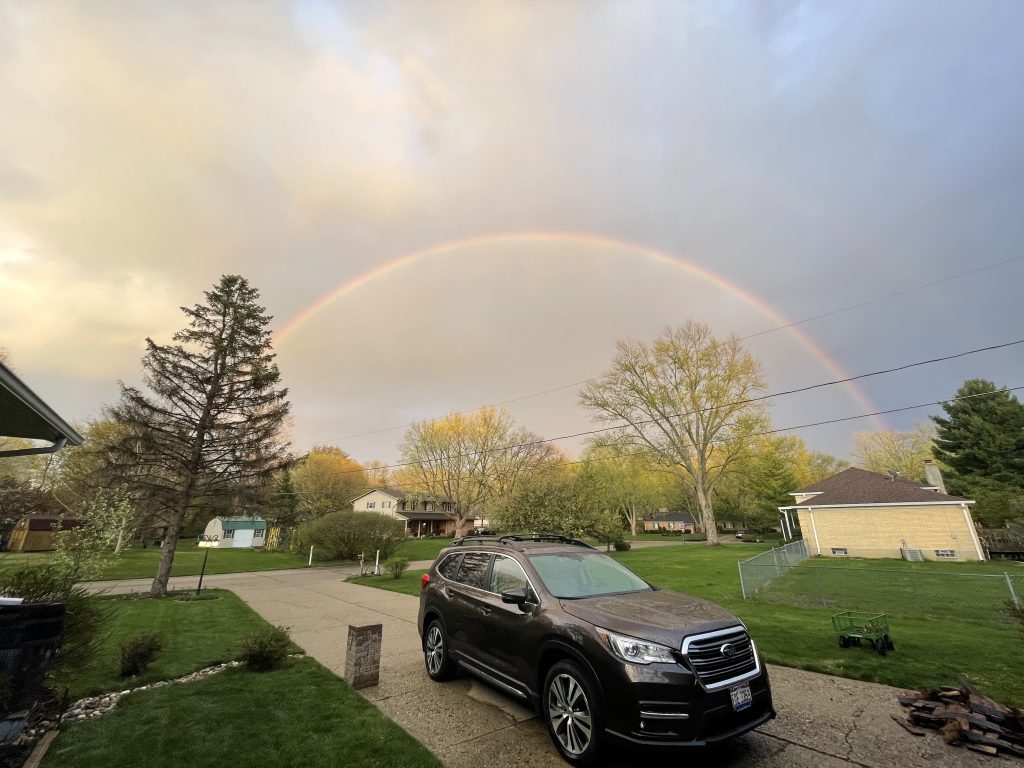
We got an early one this year. It’s faint, but it’s a double.

–Simon

Tales from Easement Acres
We got an early one this year. It’s faint, but it’s a double.

–Simon
As the only one of my family (my childhood family, to be clear) with a humanities degree, and the only one in a business management position, family conversations can be a little stilted. General banal discussion is normal enough, provided everyone agrees on the political/ethical stance of the topic, but informational discussions take a somewhat different direction, however predictable. I’ll explain:
With so many scientists available in a group chat, I would be remiss to not tap that collective knowledge. But as they’re family, it’s a no-holds-barred bargain. Here’s the typical discussion format:
Me: “Hello family, I have a science question about [insert something science-y]. Could one of you provide some information on said topic of interest?”
First Person to Respond: “Of course, the information is simply [page 1 Google search results answer, which I’ve already read].” Condescending inferences to my poor judgment in academic/career choices may follow.
Next Person to Respond: [Directed at First Person to Respond] “I concur. Let us now wax scientific in a mutual ego-stroking session, lauding our superior academic/career choices, yet making sure that Simon stays present in the conversation so he can bask in our greatness.”
Third Person to Respond [only if a Parent]: “Well, you know how bad Simon is at math.” [This comment occurs regardless of mathematical relevance to the initial question]
So why would I subject myself to this? That’s a good question. Here’s the answer:
It is an effective tactic, but comes with a price. It reinforces my family’s belief that I’m an idiot who made bad life choices, as well as reinforcing their own arrogance, all the while giving the false impression that anyone not in the sciences knows nothing of the natural world they inhabit. A bargain with the devil, I suppose.
(Also: why always the math thing? I struggled with Calculus, but I had a 80-something percentile on my GRE math score. I knew math better than the vast majority of graduates taking the test over a 3-year period, regardless of major. Does anyone remember that?)
Information might have been democratized, but that doesn’t stop people from feeling smug about what they know.
–Simon
The fear of cutting wood at heights
Also: Phobia Quotient!

The neighbors rented a boom.
(A tangent here–I don’t think I’ve ever created a name for these neighbors, probably because they’re nice and reasonably normal. I’ve just called them by their first names: Brian and Kelly. Let’s change that now. I shall call them the Busybees. Because they’re always rather busy.)
Anyway, they hate trees. Well, to be fair, all Ohioans hate trees. Almost as much as they hate dressing appropriately for the weather. Liz is a prime example. She also hates trees. Here’s a typical conversation:
Statement: “This tree looks a little brown.”
Response: “Cut it down!”
Statement: “This branch looks dead.”
Response: “Cut it down!”
Statement: “This tree isn’t perfectly erect.”
Response: “‘Erect’…*teehee….Cut it down!”
But this year the trees in question really did look dead, and so I agreed after much insistence to cut them down. Liz, the Ohioan, had already been convinced.
Cut it down!
So after this roundabout lengthy preamble, I arrive at the point of my post: I don’t like heights. Never did. Figured those who do are idiots or showoffs. Of course, in my youthful egocentric stubbornness, I forced myself to endure them. Indoor rock climbing, rappelling, mountain hiking, amusement parks–been there; done that. And while being young grants a greater allowance for risk in the face of death, probably due to the amount of testosterone that was oozing out of my every orifice, approaching middle age has forced a more practical approach to death–like fearing things that cause it.
Consequently, my parasympathetic nervous system now strongly advises me that death should be avoided and doing certain things increases its risk potential.
But damned if I didn’t try. I went up there twice and cut branches, though in the end, Liz did the bulk of the work.
So this got me thinking. Is my phobia truly debilitating, or just a common healthy fear of death, albeit somewhat too strong? Internet time!

I didn’t vet this information at all, but it seems sound. Let’s see how I stack up:
My total score: 1/12. But, these are weighted based on commonality, so I will use sketchy math to quantify this.
I’ll take the inverse of each item (only counting the “very afraid” numbers, because really, most of us are probably “a little afraid” of many of these, which does not a phobia make), multiplying by 100, and excluding #3, the total equals 169.9. This is the total max sissy quotient, which I’ll set as the baseline of 100% total sissy.
I posses #2, inverse of which is 4.2. Then to scale it with the baseline, that’ll be 4.2*100/169.9, which equals 2.5%. I am a 2.5% sissy.
But where is the median sissy? I really don’t know, because I don’t see these as cumulative probability, so let’s take a nice midpoint in the range: 5+((32-5)/2)=18.5. 1/18.5*100=5.4. 5.4*100/169.9=3.2% sissy. So I’m lower than baseline, according to my questionable math from unvetted sources.
I guess I’m pretty normal after all.
But you’re a total sissy if you fear blood.
–Simon
The ramblings of Boomers
I’m amused by the extreme nostalgia Boomers have for their youth. I’m amused because, in their pining for a time lost, they fail to understand the irony of the supposedly better conditions of a time period that preceded their own attainment of power and influence. And yet, stubbornness prevents them from accepting blame for the results of their decades long scorched earth policy, instead choosing to enjoy the benefits of such exploitation while mentally lapsing into the times governed by their parents, all the while accusing the younger generations of laziness and motivational want despite the rather clear historical evidence that these younger generations acquired significantly higher debt to achieve the educational requirements for comparable wages of their older coworkers, if they were fortunate to even find such a job available.
A forced audience isn’t captivated
Such attitudes especially annoyed me during my college years. Not the professors themselves–no, they at least understood the consequences of unchecked Capitalism. At least, that was the case in my humble Arts and Sciences education. (Liz has a different opinion of her professors, having attended Business school, unsurprisingly.) Rather, it was the clientele with whom I regularly interacted while working those unskilled labor jobs in the service industry to make ends meet. The self-important 5PM rush of office jockeys, in a great hurry to acquire their expensive steak cuts and head home, in so much of a hurry that they couldn’t hang up their cell phones before trying to place an order, yet never so much in a hurry that they couldn’t complain endlessly about the service they received. The service that, in their mind, was unquestionably declining with the youth of present day, completely unlike how they themselves treated customers in their own pre-college graduation days of employment. I received lectures, free of charge for my own benefit no doubt, on my attitude in these instances where my thoughts weren’t perfectly hidden from my conduct. It was one of the rare occasions that a cell phone was actually put away, and inevitably led to the lamenting monologues about the good ol’ days.
Your favorite memories of childhood were things you never let your own kids do
During these good ol’ days, kids walked to school and played unsupervised. Kids had dangerous playgrounds and dangerous toys. Kids had access to nature and undeveloped land. Kids learned character through tough love and that prepared them with resilience for the workforce.
These were the general points incensed Boomer orators would espouse upon their involuntary audiences (me). Yet with time their captive Millennial audiences could no longer be forced, since as they advanced in their careers, many no longer found themselves in the positions of entertaining Boomers under the threat of being fired. So instead, the Boomers have taken to the internet to lament on the changing world.
After overhearing a Boomer at the hardware store commenting on the background music and how much better the music was in their day (another favorite Boomer conversational topic), I took to some internet trawling. Topics I wouldn’t normally search for. Modern takes on “You can’t go home again.” A topic that turned out to be Boomer clickbait gold. And like all clickbait–hundreds of articles with the same content.
So I offer you now, Boomers, without delving into the literary etymological origins of the phrase, the solution to your dilemma, for your benefit. You can’t go home again because:
The point:
Meanness is the social result of an insecurity. Every time you wax nostalgic to someone younger who didn’t experience your idolized timeframe, you are attempting to make that person feel bad (because nostalgia is itself a falsified version of events, and therefore not academically historical–not a history lesson as you seem to think it is). You are insecure because on some level you realize that what was lost is the result of your own actions, and you can’t mentally settle that.
So roll a joint, put on some Beatles, and shut up.
–Simon
Luck is fine and all. As is wealth. But luck, wealth, and longevity? Hell yeah.

I’ll be a gold-digger’s dream when I’m old.
–Simon