So many required school readings are assigned at the wrong age. Their impact is muffled beneath the page grind for the sole purpose of absorbing just enough so as to pass any potential quizzes the next day. Furthermore, when taught at such a young age, the pupils don’t question the teacher’s authority, and so are limited to the teacher’s summary review of the story, even if it’s wrong.
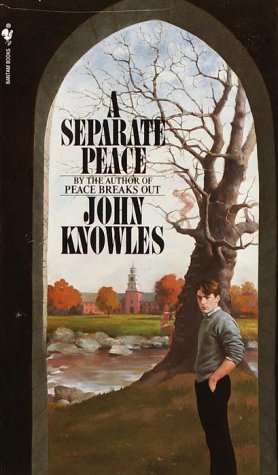 For me, one such example is the novel A Separate Peace. If you haven’t read it, then consider this the spoiler notice.
The story distills down to an event: a boy causes his friend to fall out of a tree and break his leg, ultimately proving fatal; and the core theme: why did he do that? The protagonist revisits the series of events, as well as the scene, years later, to try to understand his prior actions.
And so we are led through the journey of a boy’s loss of innocence, stemming from an inferiority complex and jealousy (with the looming War in the background, to drive home the “loss of innocence” part). The event, ultimately it is judged, was not an accident. That was the conclusion of his peers, and it was the matter-of-fact conclusion of my teacher (I’ll note here that I did indeed dare to disagree with her on this at the time, but was promptly shot down). So that was the lesson: make peace with yourself before you lash out (and don’t argue with your teacher over literature, I guess).
But it’s also wrong, or at least incomplete. A simple lesson, fit for an adolescent.
We act out of our own insecurities, sure. But while those actions might be visceral responses, they don’t necessarily reflect our desires. They also begin a chain of unanticipated causality which leads to consequences we never wanted. We blame ourselves for our mistakes, but also give ourselves huge allowances of forgiveness. Time heals wounds because we both forget and minutely alter memories in our favor, and at some point the recollection of a life event is too corrupted to ever again realistically represent the truth.
The protagonist never achieves peace with what he did, and he understands that he never will. It isn’t peace, but closure. And sometimes that’s all we can hope for. It’s enough to move on.
***
I stabbed a kid in high school.
Okay, that was dramatic. But it brought me back to this book.
One particular day during band class, the various instrumental sections broke out into individual practice sessions, as was the norm. Adjacent to the main room were a series of green rooms. No, really. Well, maybe changing rooms is more accurate–small partitions illuminated with those cinematographic Art Deco mirrors surrounded in spherical incandescent light bulbs (most of which were burnt out).
The goal, I suppose, was to allow each section to focus on their individual parts of the symphony. In reality, I think the band instructor just wanted an extra hour break time. He was a terrible instructor, but that’s another story.
Of course, during these sessions, most of the students just took a break themselves. I played trumpet. This is important because, as other band nerds might be aware, trumpet players as a whole are largely dicks. So, irrespective of my own debatable magnitude of dickishness, I was stuck in a small room with several other dicks. And dicks, locked in a room with other dicks, engaged in the expected assortment of dickish dickery directed towards other dicks. A real dickfest, it was.
On this day, one of the dicks grew weary of the usual intellectual discourse. Unexpectedly, he seized a mouthpiece cleaner. This is niche knowledge, but a mouthpiece cleaner is essentially a short and wide pipe cleaner, but much stronger. The bristles are interwoven with a central braid of 14-gauge wire. And the wire, where clipped in manufacturing, was rather sharp. By modern TSA standards, you would definitely not be allowed to take it on a plane.
For whatever reason, said dick decided to throw it at my face. My reflexes, being honed by that point to account for dickish actions, responded adequately, and the implement bounced off the mirror behind me.
A different dick remarked, to his credit, that throwing it wasn’t a good idea as it was sharp. I concurred, after examining it, and promptly threw it back at the face of the first dick, remarking in the process that it was sharp and to not be a dick and throw it at people.
The first dick also dodged and, apparently feeling the need to escalate, threw it back at my face with renewed gusto.
So in an instant, I responded with extreme escalation.
I retrieved the cleaner, held it as a shank, advanced on the first dick, and brought it down in a stabbing motion.
Now, I recall that the action was not meant to follow through, but rather intimidate. Trouble is, I don’t remember for certain, and I think that was just me twisting memory in my favor, because I don’t recall what followed post-adrenaline dump, and things were in grainy tunnel vision. The wire came down, dick put up his hand to block it, and the sharp points dug into his hand severe enough to warrant sutures.
As a post-Columbine high school student accustomed to zero-tolerance policies on violence, I fully expected expulsion, but I never heard about the event again. Apparently, every one in that room had kept quiet. All I can say with certainty is that it was the first time that I felt rage to the point of not understanding my own intentions, acting automatically without good judgement, and not remembering the followup.
It’s a far cry from killing, granted, but the desire was there and I took action counter to my higher cognitive functions, and I remain somewhat conflicted, trying to understand what I was actually going to do in that moment. It was brief, and when he blocked, I stopped attacking. But in that moment alone, had events transpired slightly differently, the results could have been so much more severe.
Did A Separate Peace‘s protagonist intend to kill his friend? Probably not to that extreme, but the action held the violent intent, and we’re not meant to know how conscious or subconscious it was.
And the protagonist, and myself, will never fully know, either.
–Simon