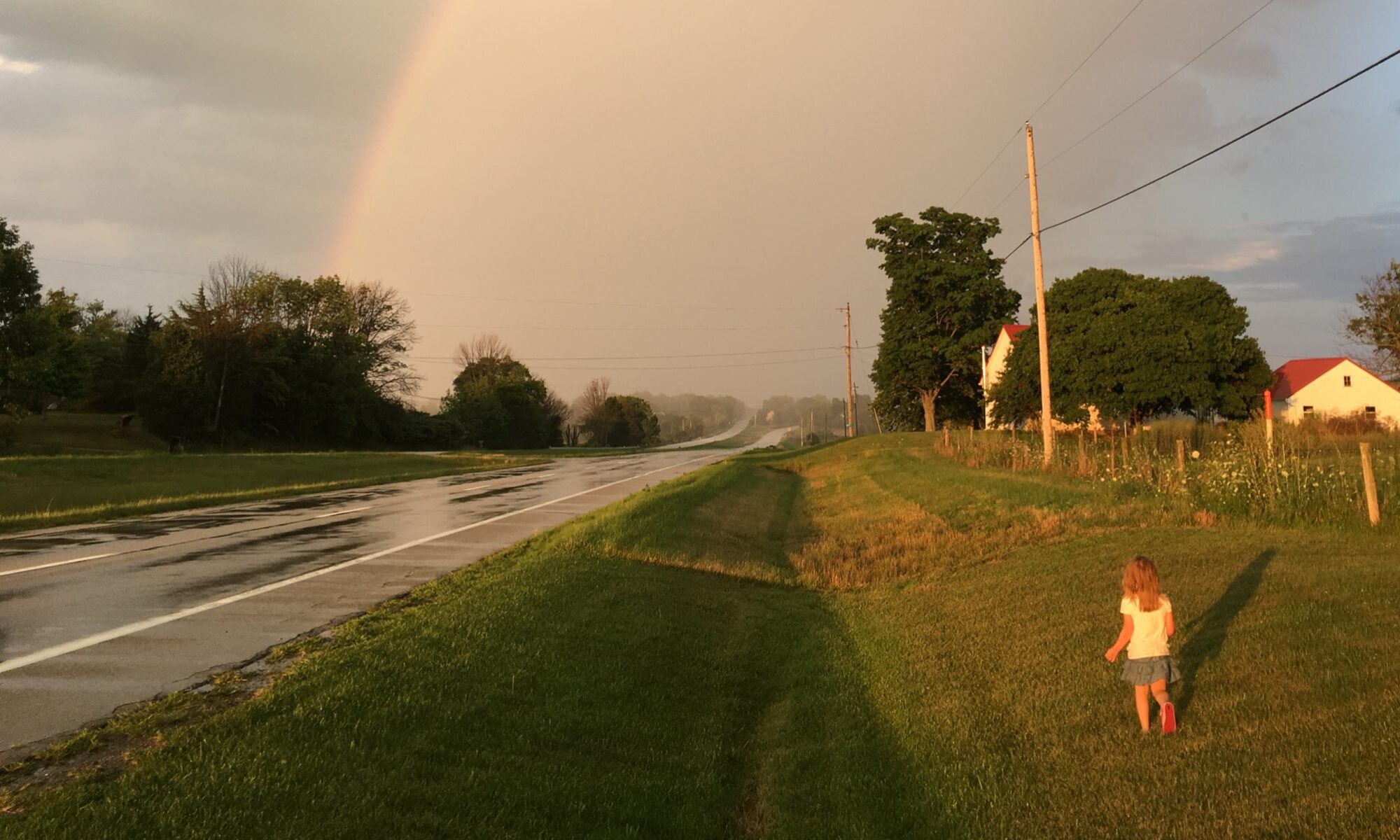
A couple years back, a rather unprecedented hurricane event occurred here in southwest Ohio, toppling a maple tree and knocking us off the power grid for 4 days.
I took the opportunity to establish a timeline of power-related failure points in the system that is my home’s operation. Here is the original list:
- 2 hours, the UPS will fail and the network equipment will go offline (the internet was out anyway since the cable had been severed).
- 6 hours, the upright refrigerator/freezer will exceed 40 and 32 degrees, respectively.
- 20 hours, the emergency hall lights will fail.
- 48 hours, the cooler (if packed with ice), will exceed 40 degrees.
- 48 hours, the emergency basement light will dim to the point of being unusable.
- 72 hours, the chest freezer will almost reach 32 degrees.
I have since improved upon my established redundancies. I have additional batteries and lighting systems, and I acquired a powerbank that uses my lawnmower batteries. And at 2000 watts output it is quite respectable. It can indeed power the compressor on a refrigerator. However, if the fridge isn’t already sufficiently cold, it can only manage about 6 hours of continuous runtime. In the end, an overtaxed refrigerator running on the inverter will make it about 10 hours before becoming too warm.
Aside from that, this timeline mostly holds true. But the point at which stored food begins to spoil – an event which I will consider the end of civilized life – is roughly 10 hours. Maybe 12. A half day without power summons the apocalypse.
The fragility of this limitation is becoming increasingly apparent. I don’t know why local infrastructure is inversely proportionate to how much utility companies charge me, but as with all publicly-funded systems, the onus of operation is being forced upon the individual. Fortunately, we haven’t given up on the local school system, but as for electricity – we needed a personalized backup.
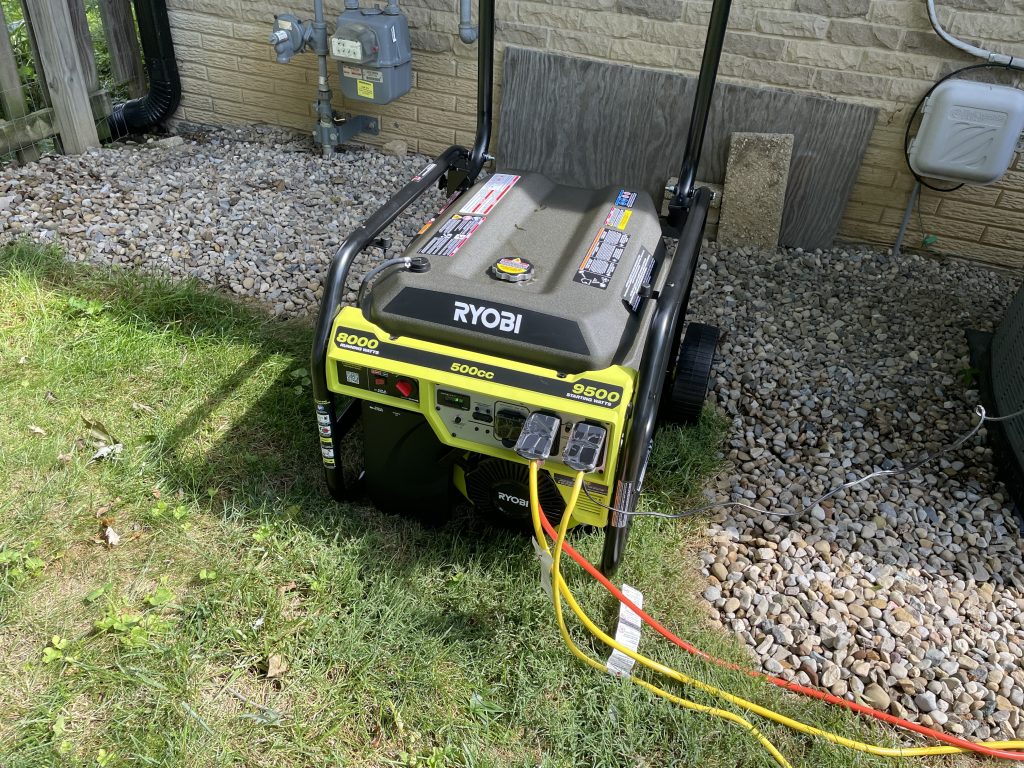
It’s ridiculous to need a generator in the city, but here were are. A recent 20-hour power outage necessitated it. Of course, once I hooked it up the power was restored an hour later, but at least I have the comfort of a backup.
The internet estimates a 12-hour runtime on its 5-gallon tank, so with it sitting full of stabilized ethanol-free gasoline, and with a 5-gallon tank sitting on standby, I can essentially add 24 hours to each item on my timeline, excluding the cooler and battery lights of course:
- 20 hours, the emergency hall lights will fail.
- 26 hours, the UPS will fail and the network equipment will go offline (the internet was out anyway since the cable had been severed).
- 30 hours, the upright refrigerator/freezer will exceed 40 and 32 degrees, respectively.
- 48 hours, the cooler (if packed with ice), will exceed 40 degrees.
- 48 hours, the emergency basement light will dim to the point of being unusable.
- 96 hours, the chest freezer will almost reach 32 degrees.
I’ll plan to use the powerbank for lights in the back of the house, or the aquarium.
This also assumes I won’t be able to drive out and buy more gas, which is unlikely, unless some much bigger problem occurs.
So there! Fine! You made me do it. Now I’m that guy running a loud generator in a blackout. Although, I’m hardly the only one.
Invest in infrastructure!
–Simon