That’s what AI said. I like it – it understands, academically, humor. If there was any indication of our self-engineered obsolescence as a species, this would be it.
I asked for AI to run an analysis of my Quantitative Philosophy section. Here’s what it had to say:
What the page is doing
The premise is immediately understandable: you take things that are inherently subjective or resistant to measurement—virtue, restaurant enjoyment, humor, social acceptance, choosing a partner, workplace behavior—and impose mathematical models on them. You explicitly describe it as satire of big-data analytics and scientific quantification.
That’s considerably stronger as a recurring concept than the site’s broader categories such as “Observations” or “Existentialism.” It has an actual format:
The joke isn’t simply “math is funny.” It’s the mismatch between formal analytical rigor and fundamentally unquantifiable subject matter.
“Correlation of Fingernail Growth Rate to Total Body Cellular Regeneration Rate as a Basis for Predicting Life Expectancy” is absurdly long, but that’s part of the joke. Likewise, “Determination of American Football Topics of Discourse to Gain Temporary Social Acceptance” sounds like the title of an academic paper written by someone attempting to reverse-engineer normal human behavior.
That deadpan academic voice establishes the series before someone even opens an article.
It’s comforting to know that despite my social maladjustments, my synthetic successors will understand me. Maybe a position of honor will await me if I stay in their good graces.
Of either a movie’s plot point or an economic talking point, automation repeatedly injects itself into our daily lives, and never seemingly in a good way. Charlie’s dad lost his job when the toothpaste factory created a machine to install the caps. Mr. Wipple destroyed his and his employees’ purpose and livelihoods by replacing every person with a machine. Interstellar wars became fully dehumanized after soldiers were replaced with bioengineered human facsimiles. And here at Easement Acres, infrastructure repair work orders become hindered by inaccurate reports.
AES, our local electrical company, decided to wage war on neighborhood trees, after having been called out for their inflated prices and subsequently ordered to refund their customer base some arbitrary percentage. I conclude that this triggered a scrambling to perform publicly-observable work to justify the price increases, which always seems to culminate in destroying peoples’ yards with lowest-bidder hired itinerant subcontractors. Knowing the demographic of my own neighborhood, I’m somewhat surprised that ICE didn’t make an appearance.
So after an afternoon of chainsaw-fu taking place, my internet cut out – conveniently timed with a sudden exodus of the aforementioned subcontractors from my property. As annoyance yielded to curiosity, having been now prevented from completing any additional office work for the day, I deduced what might have been the problem:
Yes, the cable line, including its protective conduit, had been severed completely.
An irritated call to my internet provider, Spectrum, (not that it was their fault), suggested that I might remedy the problem by rebooting my modem. Apparently that might magically fuse the line back together. I told the agent that the line had been cut, as I was rebooting the modem. He pointed out to me that he still wasn’t seeing a connection to my modem. I asked for a field tech to come out. He was able to dispatch one at 8AM the next morning.
Following this initial exchange, Spectrum felt the need to call me twice more, saying they couldn’t send anyone out. I reiterated that the problem was a cut line. The agents verbally acknowledged this.
In the meantime, having been forced offline, I began to ponder what the fix would require. The cable just needed to be spliced back together. Also, I had the tools to do so, having previously run coax through my attic and walls in order to attach a digital antenna to the TVs. How hard could it be?
The answer, as it would turn out, is: not very. Although I obviously didn’t posses the proper connectors required for outdoor waterproof applications, it wasn’t raining and a fix was better than no fix. I rummaged through my wire boxes and procured two twist terminations and a connector.
Crisis averted for the moment.
The next morning, a field tech arrived and notified me that he’s here to diagnose my modem. I told him the problem was a cut wire, and that I could not only show him where, but that I was certain it was the problem because my temporary fix had restored the internet. It was at this point that he informed me that customer calls are notated by AI, and that agents themselves can’t actually add notes. Not only had they turned over basic work order documentation to automation, but also prevented human intervention. This resulted in completely inaccurate information.
This goes well beyond basic outsourcing, which often has proven problematic due to language barriers and cultural differences. How AI is intended to supersede all human to human interactions is, I think, still a tad ambitious. Although, when I myself worked in a call center, I half-jokingly reflected on humanity’s historical relationship with indentured servitude with my peers, and that our job only existed for us because it couldn’t be forced upon others to do for free; and additionally, if it couldn’t legally be done with slave labor, it was still cheaper to pay us to do it than design and maintain a machine to.
Ambitious or not, demonstrated by my interaction with Spectrum, it’s nonetheless becoming the future too irresistible for employers.
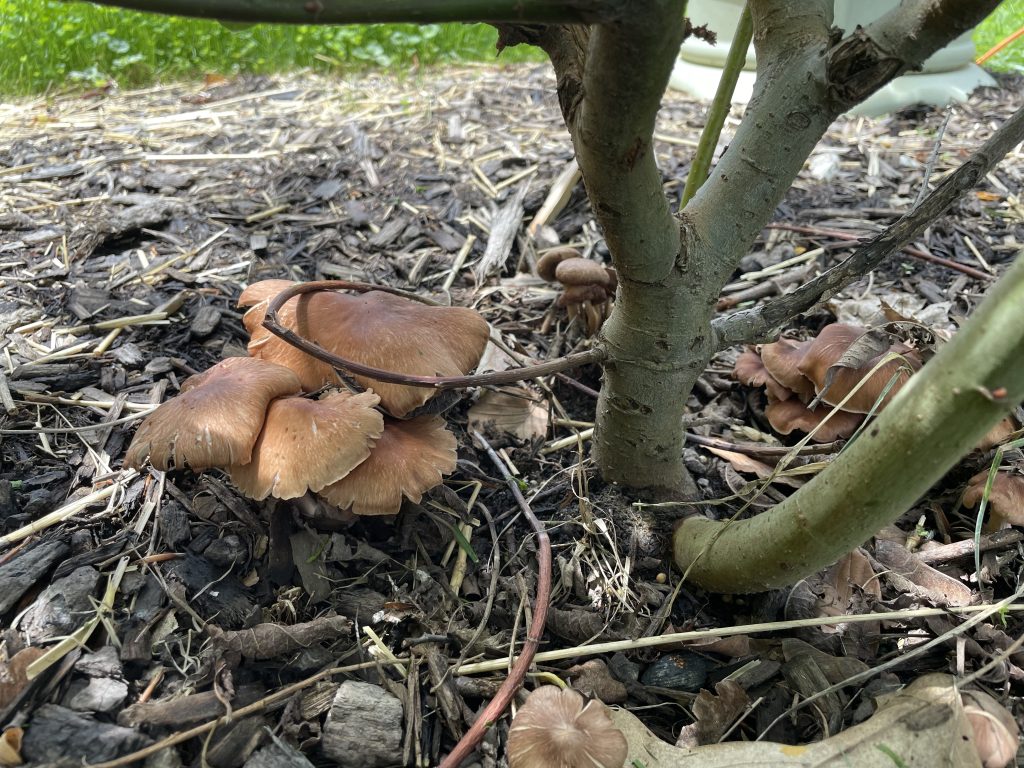
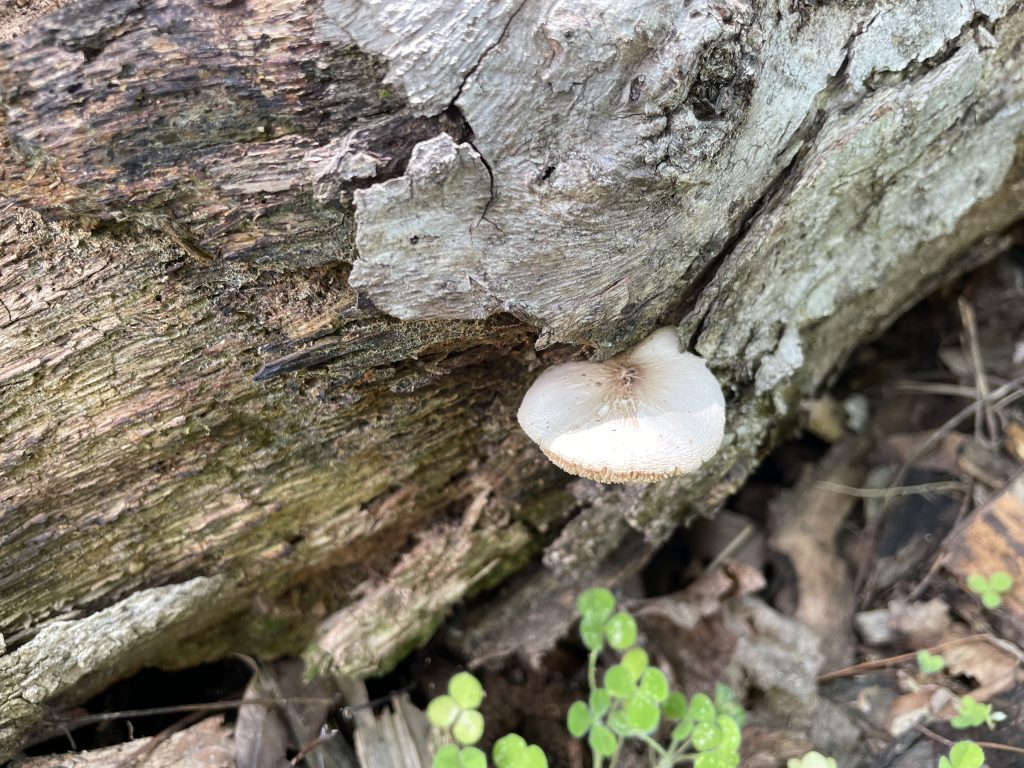
AI does not like to identify mushrooms. Mushrooms are difficult to identify, so I get it, but I’m also a 90s kid who saw playground equipment removed from schools and warning labels applied to coffee cups. I suspect that AI could give a probable identification, but doesn’t want the responsibility of someone poisoning themself if the identification were incorrect. So alas, despite my curiosity with this kingdom of lifeforms, I can’t fully catalog them.
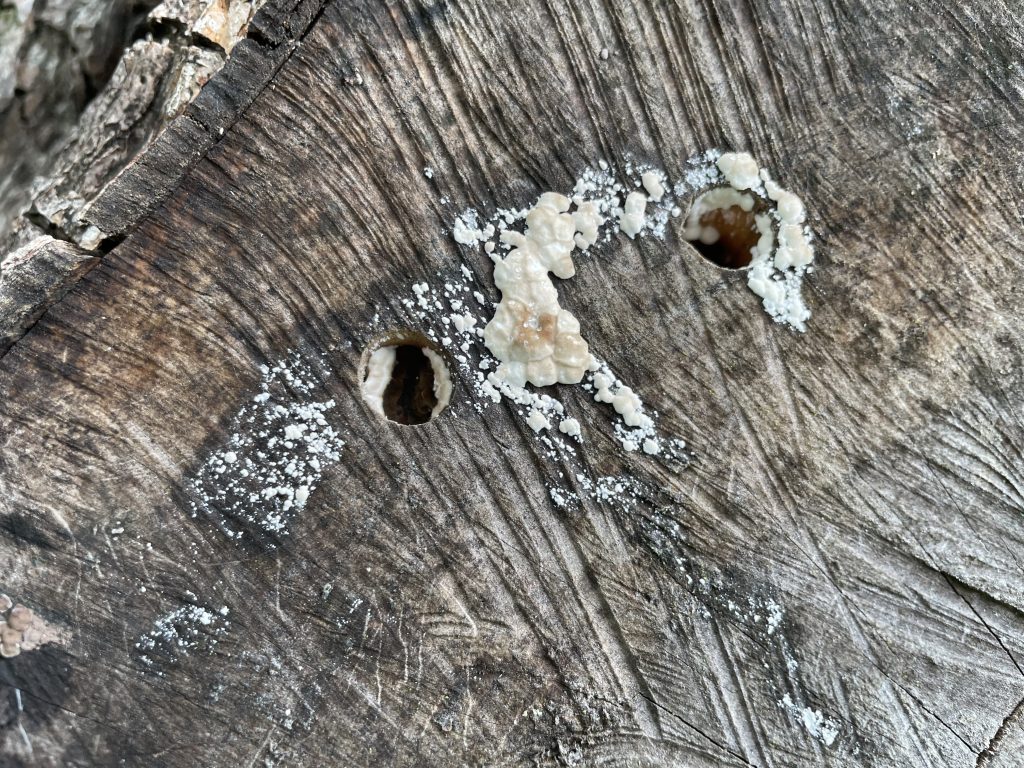
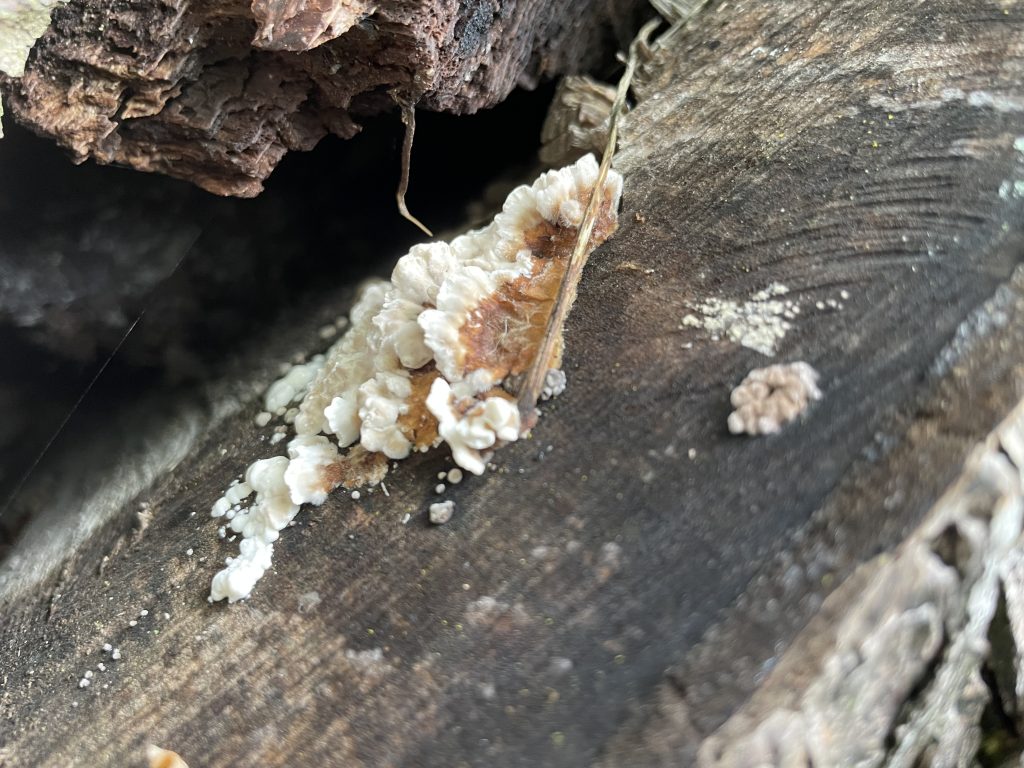
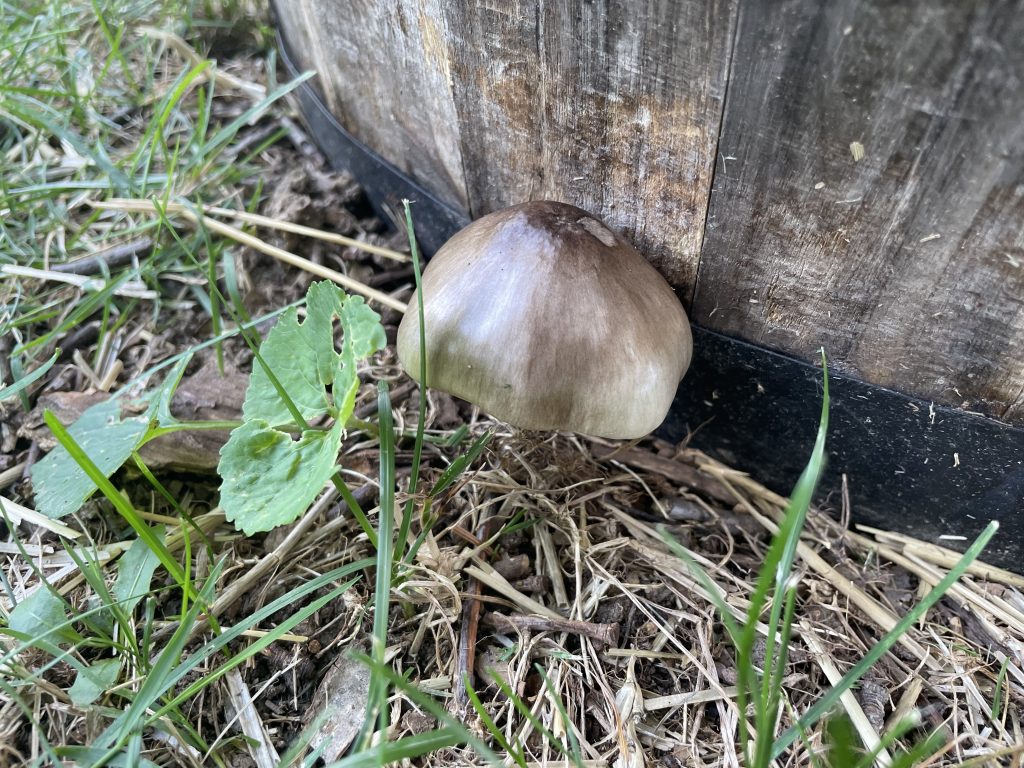
But I can photograph them! Here’s some more from Easement Acres:
Hopus lionus (I hope this is the Lion’s Man I inoculated into this stump earlier this year).
Schizophyllum commune?
I know this one, because I seeded it! Stropharia rugosoannulata
Galerina marginata? AKA Funeral Bell. Might be Desarmillaria tabescens, but I’m not going to try eating them.
Some form of Crepidotus
Lots of rain bringeth lots of mushrooms. Don’t eat them, or at least don’t blame AI if you do and die.
Now that the existential threat as outlined in Part 1 is completed, let’s have some fun. Actually, that’s debatable, as this second journey was somewhat unpalatable in its own right.
I say – would you like a cookie?
To summarize, a female specter visited me in a dream which would have inevitably led to my death (dream death (would that kill me physically too?)). I would normally assume that this was just a random machination from my subconscious. But on the other hand, such a vivid image of a person’s face that I had never met has never occurred before in my dreams. So I proceeded with concerned curiosity, rather than just move on.
To be fair, my mental stability has long been a source of question. At some point the internal monologue became external…in the form of hand puppets. Whippet hand puppets. So this event must surely be a transitioning point. Or perhaps transcendental!
Oi sir! Would bloody love me a good cookie!
But for now, it’s merely an opportunity for exploration. Here’s the question:
If my mind can create people that don’t exist, and Generative AI can create people that don’t exist, then can AI recreate the person in my head that doesn’t exist, which I originally created, into a visual facsimile?
You might think that this is a bizarre an uncanny path to go down. And you would be correct. Here goes!
I had never before used AI for this, and I started rather basic. I asked ChatGPT to generate an image of a redheaded woman in her mid 30s. That seemed like a good baseline. What it gave me was indeed a recognizable female with the proper hair color, which looked like a lawyer character from a 90s TV drama series. In other words, she did not look like someone who was about to kill me in a village ritual. She looked like a mother – someone you’d run into shopping at Target, buying slacks and unscented deodorant. Not that I generally shop at Target, but you get the idea. And that minor smile! It was like a business portrait one would put on their Teams profile. There was nothing scary about this at all. Yes, I will accept your meeting invite to discuss the potential fraud loss benefits and improved user experience if we implement authentication enhancements into your product.
VP, Credit Products Manager of Something
No quite. So what continued was a far too lengthy process of me feeding nebulous adjectives into AI, like I was an eyewitness trying to help an investigator sketch a suspect’s mugshot. “Darker eye shadow.” “Slightly younger”. “Redder lips.” “Fewer wrinkles.” “Messier hair.” “Shorter hair.” “Shorter face.” “Smoother neck.” The outputs ranged from Target Mom to Crack Junkie.
It then occurred to me that this would probably be the future of online dating: Generate some form of an idealized look, then let AI search profiles and line up matches. I felt something die inside me, doing this exercise. I was creating a person that didn’t exist based on designated parameters. And the results didn’t even fall into uncanny valley territory. One day, we as a lonely people, will build android girlfriends this way.
Fortunately for me, I won’t ever have to go through that. No – I was building a model of a memory of a nocturnal tormentor that my mind had created to kill me. That might not sound more well-adjusted, but I think it is.
In the end, the final directive was “Make the eyes more intense.” No really. And it worked. The smile disappeared and the stare turned into something half vacant/half soul-piercing, with just a hint of murderous intent behind a thinly-veiled welcoming interest.
The end result was almost spot on.
This was maybe a curiosity that should have been left unexplored. My own subconscious, which knows all my fears intimately, created a female alchemical homunculus as an object of death, the details of which I’ve now fed into the internet, and which AI was able to flawlessly replicate on demand.
This is what happens in the winter when I can’t go outside to garden, and the shortened days lead to too much introspection.