
Transferable skills are not always met with enthusiasm once employed outside their initially-intended realm. However, resistance does not negate their usefulness. In the context of a home, estates are, in fact, businesses that old money maintains. The revenue stream must continue, and so must the maintenance. And without careful management of assets, the estate will fall into disrepair.
I do not own a large estate, and neither am I from old money. My quaint half acre “estate” must rely upon family income, but even so, I too must take care to not exceed that which is available. I also am not in the possession of a butler’s services, nor his accompanying staff. Any work done here must be at the hands of those who reside therein. Neither of these resources are inexhaustible.
Therefore, I have applied my project management background, specifically Agile; or more specifically, Scrum Agile; into managing the eternal backlog of estate-oriented projects. It was not initially well-received by the family, but we need a system.
So I present to you: Estate Agile! Here’s the breakdown:
- A time period is defined. I chose a month because that’s generally how financial plans align with recurring bills.
- Each member of the family agrees to a personal time investment for the period, in hours, per week, because most projects are accomplished on weekends.
- The investment is multiplied by the number of weekends in the time period. This becomes the individual’s total time pool.
- A financial allocation is defined for the time period.
- Projects are groomed for priority, personal time investment, and cost estimate.
- Projects withdraw from each available time pool and the total financial resource pool.
- Priority is defined as: High = health hazard, structural issue, or otherwise time sensitive, Medium = research required, potential long-term financial/structural/health issue, Low = cosmetic/home repair.
- If the grooming cannot fully define all parameters, then it is not considered DOR (definition of ready). It is reduced in scope until it can be defined as DOR.
- Projects are added to the commitment plan based on priority, followed by cost, then personal time commitment. The goal is to maximize the total number of projects for the time period without exceeding either the financial or time pools. If a project does exceed one of the allocations, then the next available project is selected until no more projects can be added to the time period. Unused time and finances do not carry over to the next time period.
- Anyone can add a project to the backlog for future grooming.
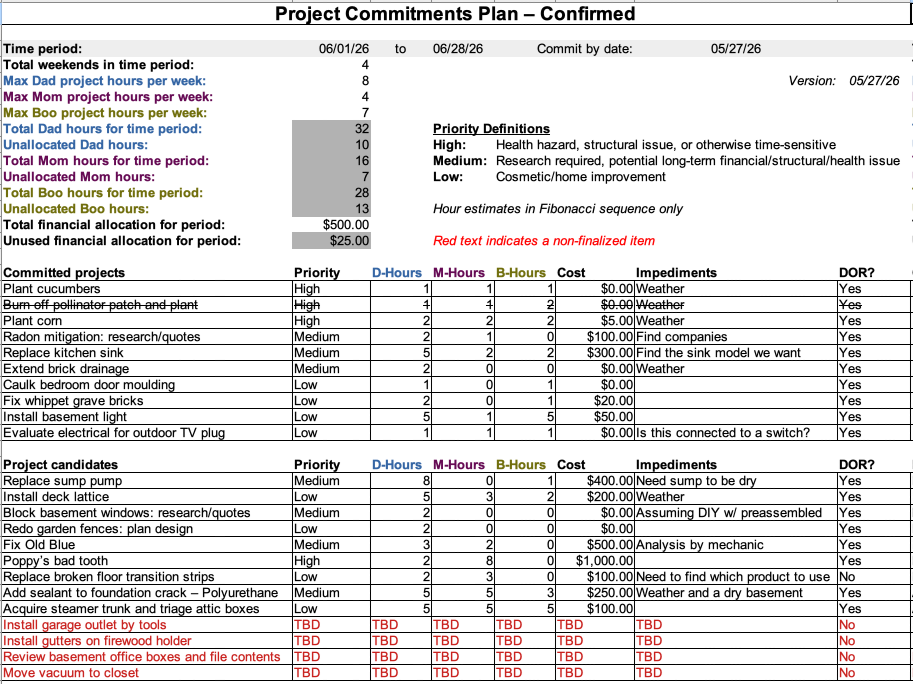
We shall see how successful this is. So far it has, at the very least, curbed the insanity into manageable goals. Rather than forcing myself into project schedules, I can approach actionable items as defined by reasonable time and financial investments. If sanity is all I get out of this, then I’ll consider it a win.
–Simon