Earlier this year I wrote about the shortcomings of on-board car diagnostics and how I was searching for a computer-reader that would provide more information in the event of a problem. Like a fire extinguisher, it’s something that I had hoped to never need to use.
But I had to use it. And I’m glad I had it.
Less than a year after purchasing the CR-V, it died in a grocery store parking lot. I, being at work, dutifully responded to my wife’s texts in a most timely manner–an hour later–and was off to save the day…cursing and muttering the entire way.
The vehicle, refusing to start, notified me of such by informing me that the parking break was malfunctioning, as well as the antilock breaks, and the electronic break stabilizers, and the gate lift mechanism, and a number of other systems. It was disconcerting, but not very helpful.
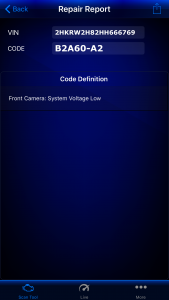
So I plugged in the OBDII device and waited while it ran a diagnostic. It then informed me that two systems had insufficient voltage to operate. I cleverly deduced that voltage insufficient to operate the breaking mechanism probably meant the starter wouldn’t work. I’m a real mechanic I am.
So I jumped the car and it started, and it promptly died when it got home. Presumably the battery was bad, but that seemed unlikely given how new it was.
AAA agreed, once they came out and tested the electrical system. Surely the battery was fine, and something was drawing power when the vehicle was off.
Then the Village Elder came over and gave us a charger, and after manually giving the battery a full charge, I tested it an hour later and it had already been drained. Ultimately, a replacement battery seems to have fixed the problem, though we’re still left wondering why the original died so quickly. Maybe it was just a lemon.
I’m also left with the nagging irritation at Honda’s dash alerts. While telling me that every electrical system was malfunctioning was technically accurate, it wasn’t very practical information, especially considering the error codes themselves had the information we needed.
Oh well, at least the computer reader proved its worth. I can finally give it a solid recommendation now.
It’s interesting to me how obstinately we refuse to take basic network security precautions. Usually, introducing the topic for conversation is met with contempt for nerds, as if I were attempting to discuss comic books and card games with high school jocks (neither of which have I associated in my adult life). But concern for such trivialities is gradually waning in light of big news’ headlines (Russia!), so people are now at least acknowledging that infosec is something we might casually entertain (though only in outrage that our government isn’t protecting us).
But elsewhere, in the tech community, network technology itself is becoming increasingly under fire–specifically, consumer-grade NAT routers. I had previously covered my recent transition to a more commercial-class router, the Ubiquiti Edgerouter X, and I had been pleased with its performance for the time I used it. Alas, a botched firmware upgrade left the device bricked, so I was forced back to my old D-Link while I considered options. The experience had taught me a lesson: I wanted the security and features of a commercial grade router, with the hand-holding of a consumer grade one. But that seemed an unfilled niche.
Eventually, I went back to my NAS’ manufacturer, Synology. Their NAS management software has proven incredibly robust, with timely and automatic patches immediately following a CVE disclosure. They had formerly tried to introduce a router but had discontinued it. But now they were trying again with a new model. It was hard to find an expert review on the device, as most of the Amazon community’s comments boiled down to “It’s fast and doesn’t drop connections”–something I consider to be bare minimum requirements for $200 piece of network equipment. Still, I discovered enough information elsewhere that compared its router management software to that of its NAS products, so I decided to bite.
RT2600AT
I could go on at length, exulting its software, but for the sake of keeping this post within the casual Internet-peruser’s attention span, I’d like to call attention to its simple and effective firewall.
Configuring a firewall shouldn’t be difficult, but until now I had never owned a router that managed to balance simplicity with effectiveness. I was delighted with the level of customization. For example, I decided to block all inbound connections from geolocated Russian and Chinese IPs. I was disturbed to find out that two days later, 1800+ connection attempts from these regions had been blocked. I suppose it’s mostly just Internet noise–passive scanning–but it’s still disconcerting.
Next up–a particularly troublesome IP range that my ISP uses to perform DNS and reverse-DNS queries. To be clear, I don’t want my ISP messing with my DNS traffic, but as DNS is largely unencrypted, there’s not much I can do to stop them. I specified my preferred DNS servers, but they appear to be bypassed when the lookup returns a 404, and my ISP serves me a “helpful” page of suggested results.pithy
Fortunately, their DNS servers appear to be static, and using a Whois service I pithynarrowed down the IP range and blocked it outright. The router has since blocked 48 connection requests to these IPs, so while I might not be able to prevent my ISP from intercepting my DNS queries, I don’t have to look at what they decide to serve me back.
Lastly, and equally unsettling, was my cable modem’s hard-coded internal IP: 192.168.100.1–the address used by the majority of modem manufacturers. In reality, there is no reason that a LAN-side device should need to contact the modem (that’s the router’s job), other than the remote possibility that the modem might need some user administration. But that’s a stretch.
And the modem lacks any form of user authentication. While there isn’t much someone could mess around with (apart from rebooting and resetting it), I still don’t think it should be open to anything on the LAN. So, just no. I blocked all traffic to its IP. I didn’t count on anything trying to access it regularly, but the router counts 48 attempts now. I’d really like to know what was trying to access it and why, but the conventional logs don’t provide that level of detail. Oh well.
In conclusion, my router upgrade has increased my network security at the cost of equal paranoia.
I’d end with something pithly snarky, but I just realized I’m out a aluminum foil.
…but usually not seriously, unless it’s by Bethesda or Bungie. But let’s back up…
The family computer was originally some variant of the Macintosh Classic–an all-in-one machine with a black and white display. The first game I played, and one my mother was obsessed with, was Crystal Quest.
Of course everyone else had Windows machines, and so knew nothing about the games I played. They played Doom, Fallout, and Quake; I played Marathon, Myth, and Avernum. Consequently, I learned that my gaming background would simply be forever different than that of most peoples’.
But I also learned that games are diabolical abominations of coding, and that the mere effort to get them to even operate on a computer was, if not a feat of engineering, then one of extreme patience.
So after years of gaming on computers and their multitude of problems, I bought an Xbox–a machine designed for the sole purpose of gaming (despite Microsoft’s ongoing attempts to make it a social platform). But some games simply cannot be played effectively on a console, and as I’m completely unwilling to use Windows unless I have to, I’ve been eying Valve’s Steam.
For those who don’t know, Steam is an online distribution and DRM platform. I hadn’t considered computer gaming in years, due to my lack of a dedicated machine and desk (and the lingering memories of technical difficulties), but with the completion of my recent command center, and with the Ubuntu computer working admirably, it seemed like a good time to try.
I visited their website, found the Linux installer, and completed the installation. And it didn’t work. Turns out that Ubuntu has its own distro of Steam, which I was able to install rather simply from the command line. It lacks the happy GUI, but that was of minor consequence. I created an account, found a free game, and downloaded it. And it worked!
The downside of attempting to turn a Linux machine into a gaming platform was the obvious lack of game choices available. I had hoped they’d be more prevalent, but a cursory preview only yielded a handful of anime adventures (most of which turned out to be pornography). So it’s a success in that it works, but a failure in that its catalog so far contains nothing of interest.
Ah well, it’s not like I need to spend more time gaming anyway. I guess that, for now, I’ll have to game socially in my living room like a normal person.
Bloggers (and YouTubers) have a misguided perception that anyone cares what they have to say. I know this intrinsically as I write, and am well aware that few, if any, will ever read these words.
Regardless, most content “creators” operate under this fallacy, assuming that not only do people as a whole have the remotest semblance of interest in their thoughts, but that they should be paid for their troubles. Enter advertising.
But this is not commentary on the economic model of capitalism. This is commentary on ego–the way we use the word now, not the Freudian definition. In short: arrogance. I find it increasingly difficult to find web content devoid of advertising, regardless of the content’s apparent quality. And we are enabling this trend by democratizing ads–companies that provide advertising scripts freely–in a sense…adsense…as it used to be called.
The argument is old, that commercializing art devalues it. That may be true, but it doesn’t prove that that art is absent entirely. In fact, I would go so far as to say that exists in the same quantity as it always has, and now we have to tools to enjoy it without distraction.
For those who have yet to embrace ad-blocking, for whatever reason, a tool exists which goes beyond–element blocking. Yes, it is possible to selectively block any part of a web page that I find detracts from the quality of the article itself. For example, on one particular blog I frequent, I have blocked 19 superfluous and unsightly banners, ads, and columns promoting the site’s other content. One might argue that doing so is messing with the designer’s intended creation, but that’s nonsense, for the alternative is not viewing his content at all.
So really this is just an overly wordy recommendation of the browser plugin uBlock Origin.
Also check out Privacy Badger, NoScript, and Cookie AutoDelete.
Take back the web and enjoy it for what it should be: artistic and intellectual content.
Dogs pee in the house. It’s an inevitability, despite their willingness to please their human masters. Bladders are small, and days are long. Ergo, dogs pee in the house.
A myriad of devices exist which attempt to deal with this problem. And indeed, the pee can be extracted, but residual proteins remain. And these proteins stink! So, a myriad of products exist which attempt to neutralize them. And…none of them work.
So I was left with a choice: kill the dog and burn the carpet, or live with the smell. Neither seemed ideal. But then I remembered the final invoice I received from our last apartment. In it, a specific deduction was itemized from our deposit: an ozone treatment for the dog smell. Faye had a tendency to pee in the second bedroom.
At the time, I considered this bizarre procedure to be limited to a specialized commercial application, and therefore necessitating expensive equipment. But they say smell is the sense most strongly linked to memory, and when walking down the hallway one day, the stench wafted into my nose and my hippocampus short-circuited.
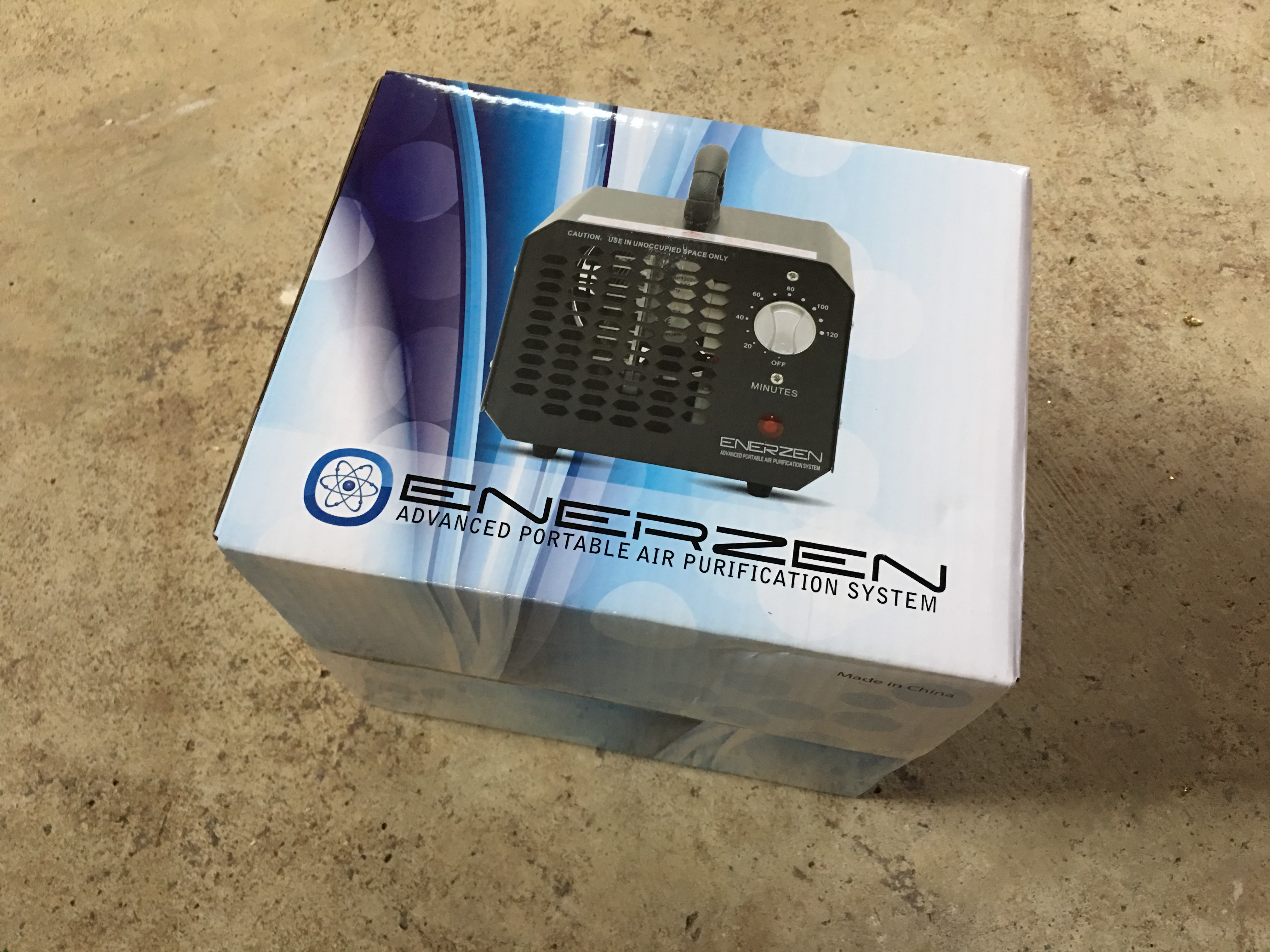
A quick search through Amazon revealed many affordable products. So, as I normally do, I made a selection based on recommendations and ordered the Enerzen ozone generator.
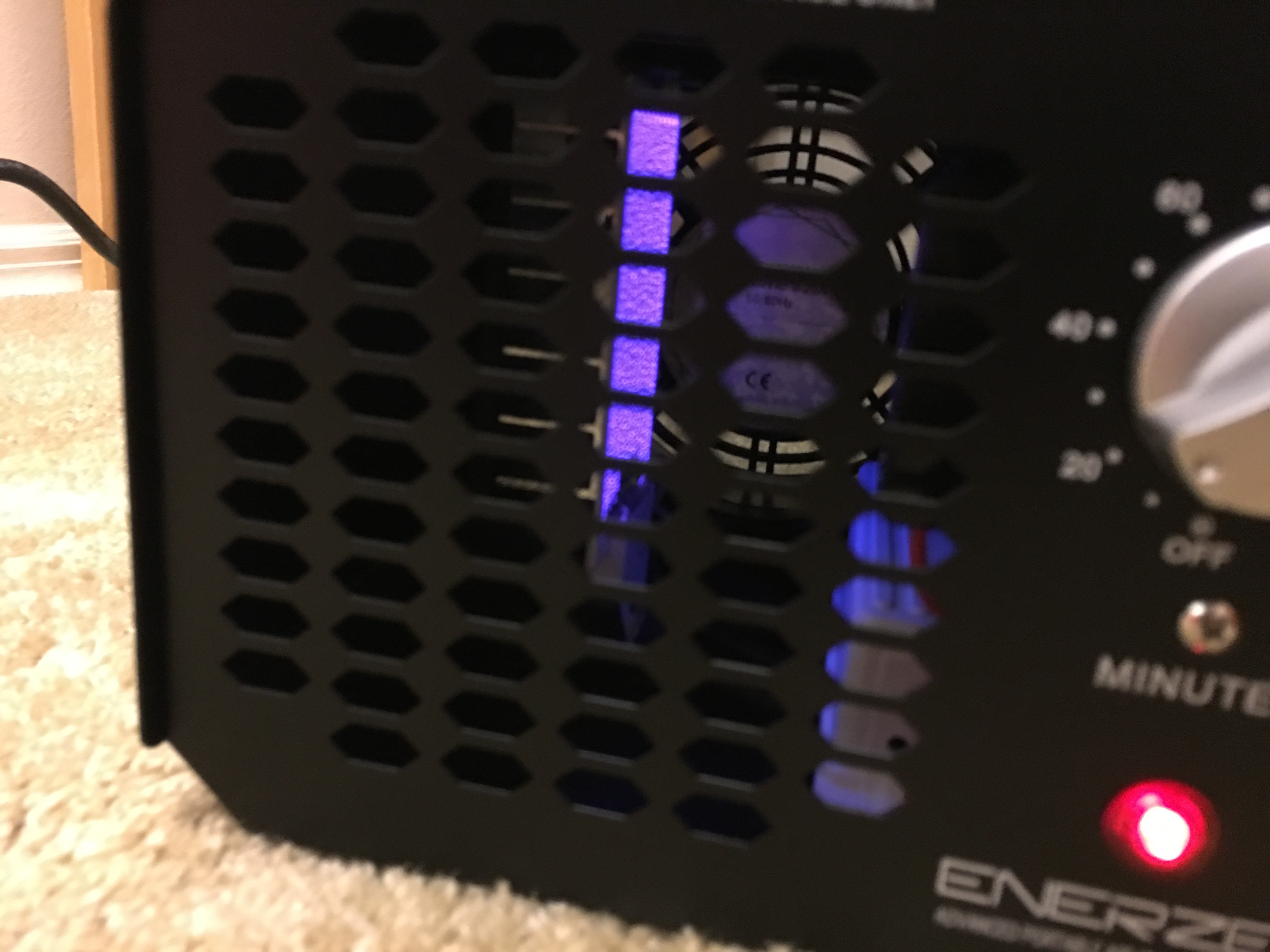
Excitedly, I unboxed it as soon as it arrived. I concluded that the best place to test it would be the bathroom, since if anything went wrong, the room already had ventilation. I set it for a modest 20 minutes, plugged it in, then immediately ran away as its insides glowed purple. An overreaction, perhaps. But I’ve seen enough post-apocalyptic movies to not be disconcerted at the color (even if it’s oxidation, not radiation).
I returned an hour later, figuring it had been enough time to dissipate. I figured wrong. In fact, it was 2 days before the ozone smell was finally gone. But, the bathroom no longer held that mild mildewy essence.
Unfortunately for Liz, it triggered memories of her numerous hospital visits and she became nauseous. Turns out that they use these to sterilize surgery rooms.
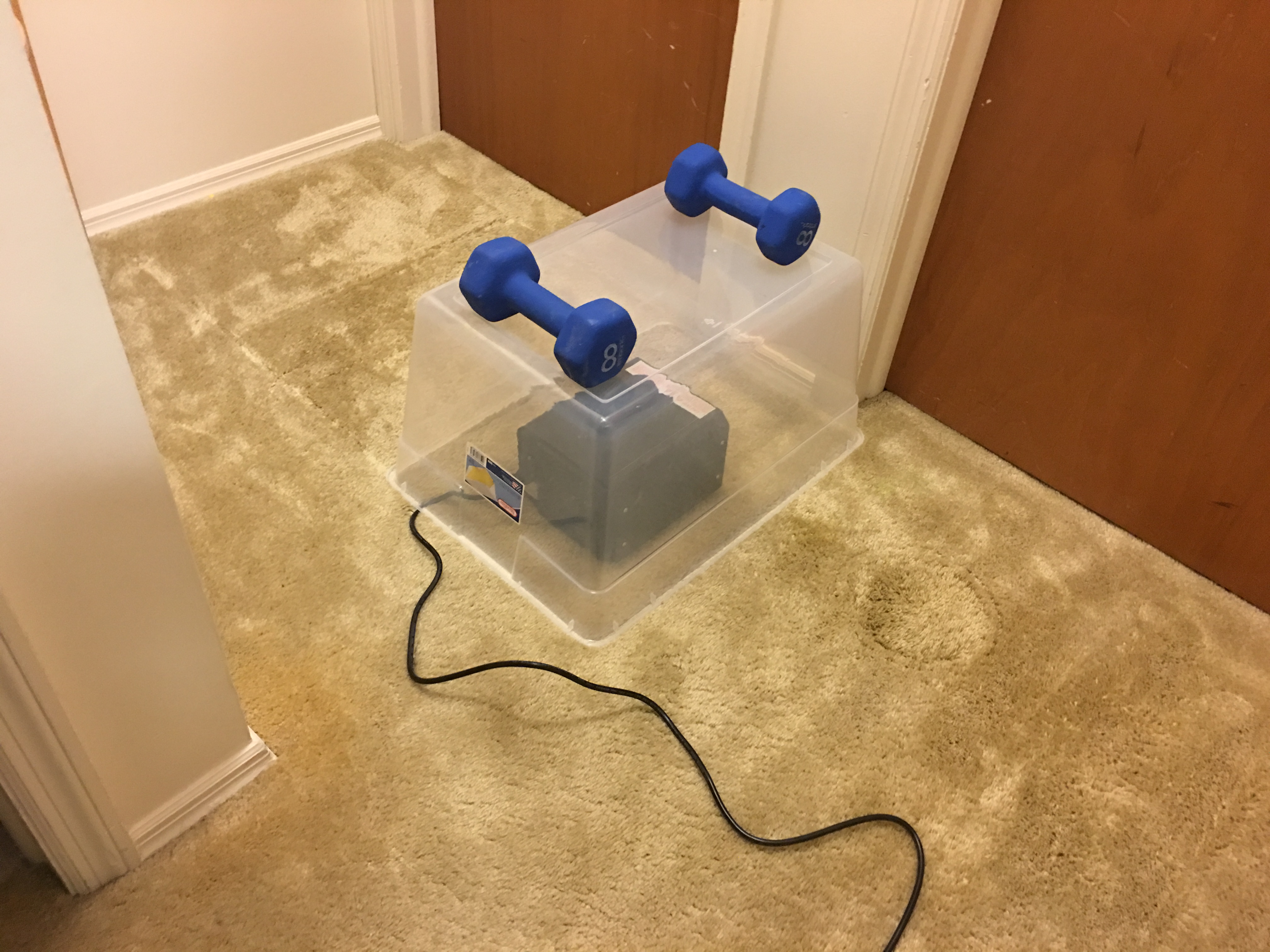
But despite that, it was a preferable alternative to dog pee. I started treating the carpet, cleverly devising a method to trap the ozone under a storage bin so as to avoid flooding the house in painful free radicals:
But as it turns out, an ozone generator can’t keep generating ozone with oxygen (ah hindsight). So the viable output of this method was insufficient to deodorize anything. So now, I’m running it for short bursts in problem areas, which is difficult because I can’t evacuate the house, and too much will kill the houseplants.
So it remains to be seen if this tool is effective, since I have yet to run a proper test. Hopefully the multitude of supporting anecdotes out there will foreshadow my own success. And if not, I can always kill the dog and burn the carpet.



 So after years of gaming on computers and their multitude of problems, I bought an Xbox–a machine designed for the sole purpose of gaming (despite Microsoft’s ongoing attempts to make it a social platform). But some games simply cannot be played effectively on a console, and as I’m completely unwilling to use Windows unless I have to, I’ve been eying Valve’s Steam.