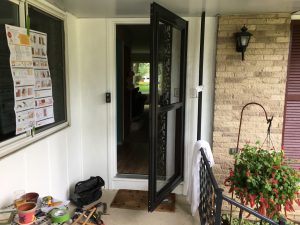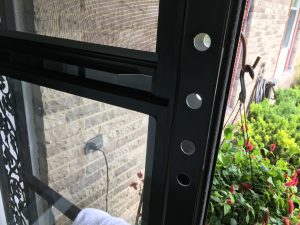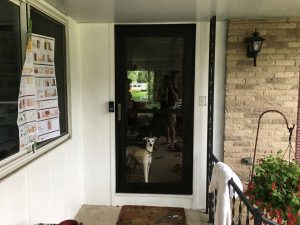
I don’t like connecting odd devices to my home network. A quick Internet search will reveal the problems with doing so–that manufactures have a tendency to never patch them, resulting in a bunch of small computers with large security vulnerabilities serving as network entry points.
But things can still be done right, for those who care. And after years of hearing reviews for the Ring Video Doorbell on my favored information security news podcast (which personally endorses the product), I began to consider it as an exception to my otherwise rather rigid policy.
Then some neighbors began to complain about break-ins. The tactic so often used: perpetrators would announce their presence at the front door to determine if anyone was home, and if so, to scan the interior of the home and come back later–if not, to break in then and there. This was in fact the exact type of scenario for which the Ring was designed. I proposed the option to Liz, who agreed. So we used a collection of Amazon gift card credits and purchased their Video Doorbell 2.
Admittedly, their promotional videos are a little goofy, with actors creating a scene in which a couple guys in black trigger the camera and the homeowner yells at them through the speaker and they go scampering away like deer.
But, I could do that should I choose. Through various settings, the camera and microphone activate from motion, which then records a 30-second clip, or if I acknowledge the video, it keeps recording until I stop it. And of course it activates when someone pushes the button. It’s wired into the existing doorbell circuit, which feeds the battery a trickle charge, and integrates with the old wired chime, and naturally–WiFi. Alerts are delivered as push notifications through their official applications–both desktop and mobile. And at any point I can activate the device to see a live feed, and through another button push, activate my device’s microphone so I can threaten whoever’s on my front porch.
Equally important, it updates its firmware automatically.
So far, it works as advertised, and while the price point was a little steep, they did not cheap out on its manufacture, even having included a variety of hardware/tools/wiring.
I have yet to catch any ne’er-do-wells, but that’s just as well. I do, however, have a collection of riveting videos involving me shoveling the driveway and the car leaving and entering the garage. In all practicality, it’ll probably be most useful when I’m working in the basement and can’t hear the doorbell, or to verify a package delivery, or to one day yell at the kid’s first boyfriend just for fun.
HD, but with the wide angle lens there are limitations on distance
Now that a proper TV stand is in place, I thought it time to revisit the audio setup. I say this because the stand slightly modified the arrangement of some speakers, and music sounded just different enough that I couldn’t let it go. So when the girls went out grocery shopping, I used the rare moment of silence to begin a calibration.
In theory, the measurable amplitudes of a sampling of sine waves across the spectrum of 20Hz to 20kHz should register a similar decibel score. In practice, the physical limitations of speaker drivers prevents this, but settings can be tweaked to reduce the disparity. I lack any sort of professional calibration equipment, but in reality a good sound setting is merely defined as preference by the listener, so I opted to use what I had on hand and simply settle for a mere approximation.
Judge me not for the assortment of bands in the background
iTunes has, through whatever typical obscure Apple methodology, determined the above frequencies to be focal points in the human range of hearing. I’m sure there’s some kind of math behind it, but I didn’t care enough to research it.
So, I YouTubed each of these frequencies for a test tone, played the tone, then measured the decibel level with a free sound meter app on my phone. I’m not sure how accurate this method was, but I aggregated the figures as guidelines (chasing the dogs out of the room in the process as they did not appreciate the test tones above 1kHz):
I noticed an amplitude dropoff at the high and low ranges, which I found satisfying in that I had already adjusted the levels to compensate, based on my hearing alone. I made some minor adjustments.
So my hearing may be getting worse, but I can still identify amplitude variations across the audible spectrum. At least now when I’m forced to watch M*A*S*H reruns, I can at better appreciate the audio balance.
You might notice a paradox here. And therein lies the source of endless frustration. Plainly stated, you can’t install a security update unless you mess with a working system. So what to do?
Well, my personal plan of attack has been to check the patch notes before installing anything, and judge its relevance to my given application. For example, I put off updating my VPN software because the patched vulnerability was an old version of L2TP/IPsec–something I don’t use.
But the growing list of CVEs on my WordPress install started to concern me, some of which were alarming, like broken access restrictions with URL injection. Yikes. Still, I waited, because I really didn’t want to mess with it.
Then my server automatically updated its PHP packages (I thought I had disabled automatic updates), which brought my blog down. So begrudgingly, I used it as an excuse to finally update. I began the install process.
As it turns out, WordPress runs on PHP 5.6 (the scripting language which loads data from the SQL backend)–at least the package I have installed anyway. Other programs I run require PHP 7, so I have both installed. But the automatic PHP upgrade deactivated 5.6 in favor of 7, which not only broke the site, but prevented the install. I manually reactivated 5.6, which then triggered its own update, requiring me to patiently wait another hour while it completed.
PHP updated, I tried to load the installer again, but found out that the MariaDB (the open-source fork of SQL) version, version 5, had been stopped in favor of version 10–very similar to the PHP problem. So I reactivated version 5 and waited patiently while it updated.
These updates collectively maxed the server’s processing power, which then brought down the entire machine. Nothing’s more nerve-wracking than watching an eternally-spinning icon, devoid of any meaningful information like a status bar. But, patience and a lot of burning stomach acid later, the installs completed and the server came back online.
I started the WordPress install, and was prompted for MariaDB 5’s root password. I looked up my complex and randomly-generated password, pasted it in, and continued. Then I was prompted for MariaDB 10’s root password. Curious, why would it need both? Unfortunately, I have yet to find a solid answer, as the WordPress package installations and their associated communities vary widely across the web.
It’s friendly logo hides its true nature
Then I was prompted for my database user account, which I input as well. The installation clocked for several minutes, then advised that I did not have access to the databases. Curious. I knew with certainty what my user password was. I considered that maybe the root password was different. To find out, I installed a database management interface and attempted to log into both databases as root. All attempts failed. So apparently I didn’t know the root’s password.
A brief web search revealed the default password to be blank, which bothered me immensely. Granted, it probably wasn’t as big a problem as I was thinking, since presumably only the localhost would have access to the database, but that still seems like a bit of a security hole, like say if malware made its way into the machine. Also, the management interface I had installed was Internet-facing, which meant that the moment I installed it, my databases were publicly accessible. Nothing private is in there, but still. Ah well, I used the interface to change the root passwords for both databases and reattempted the update with the correct credentials.
The install crashed and the logs said the update failed. I checked the install package, and its version matched the newest. Confused, I consulted the logs again, but this time it said that the install was successful. Finally some good news. I opened up the site.
The site loaded its front page, but without images. I refreshed the page, only to then find that the only data loading was in the browser’s cache. The page wasn’t there anymore. So I checked the web directory’s contents and was dismayed to see that the entire WordPress folder had been purged of data. The update had reinstalled anew, rather than updating.
I had taken the precautions of backing everything up, so I wasn’t completely distraught, but I began to fear that the WordPress package itself was beyond repair. I had previously considered 3rd party hosting solutions, and figured that this would be my final salvation. But first–I would use my automatic backup service to retrieve the last version from my Amazon Drive account, which was timestamped as that morning around 5AM.
The restore took about a half hour. I reloaded my site, and it worked! I admit I was surprised. I had surmised that the site solely operates through a conglomeration of PHP scripts which access the database, but if that were the case, then the file restore would have wiped out the upgrade–which after checking again, it hadn’t. So it was the package itself that got updated, not necessarily the script files.
I admit, I still have a long way to go to understanding this technology, but that was the original point of starting this blog. For now, I’ll remain content that my site is functioning at all.
That statement carries heavy implications, to which family men everywhere shudder from mild PTSD.
Seriously, it’s a lot of effort for such a bizarre holiday decoration. In years past we had opted for an artificial tree, mostly because we lived in rented property, but also because I didn’t want to deal with the mess. That’s when we acquired would would be known thereafter as “The Martha Stewart Tree”, because we bought it at K-Mart (of all places that’s where Martha Stewart had her brand sold at the time), and it looked better than any artificial Christmas tree we had seen elsewhere.
But the tree came with very questionable pre-wiring (which I later removed), and the clipped wires of the tree’s frame were lethally sharp. And the damn thing dropped fake needles everywhere which the vacuum refused to pick up. Fuck that tree.
So we’ve since made the switch to real trees.
Of course, real trees have their own set of problems, but whatever kind we got this year has been especially awful. This one doesn’t have any real branches, just a bunch of fluff that can’t support any weight, so I only have half the lights on it that I would normally. And the sap gave me an allergic reaction.
Plus, the ornaments keep falling off. Look at the kid’s consternation as she debates their placement:
This was a terrible species for a Christmas tree. I sure hope Liz remembers what it was so we don’t get that kind again. I’m about to go Griswold on the neighbor’s spruce.
My father was always pretty handy around the house I recall. He’d change the car’s oil, fix the air conditioner, run speaker wire through the walls…you name it. And it was through this hands-on instruction that I learned my own basic handyman competence and the self-confidence needed to undertake my eventual home projects.
Yet, there’s a price exacted by the animistic spirits of the home, if I understand anything about the supernatural world. A blood price. It’s akin to the Angel’s Share of evaporated bourbon, but more Lovecraftian. The spirits grant the boon of accomplishment, but in turn must be paid a sacrifice.
For my father, this price was quite literally paid in blood. Every time he fixed something, he bled–a hammer to the thumb, a slipped knife to the fingers, a burr on a pipe finding his hand–these are some examples. The project saw fruition, but its culmination always required bandages. At the time, I thought this correlation extremely amusing, the way all kids find grownups getting hurt amusing. Little did I know that the pact would extend to all male heirs. Now I too pay the price.
I was putting up Christmas lights on the roof and a friggin pine needle poked me deep enough to draw an actual stream of blood. I was putting nails into a kitchen drawer to fix a broken slat and I skinned a knuckle. But the biggest price I paid to date at this house was to have a clean oven, and by extension, a properly cooked Thanksgiving turkey. Such was the impact of this lofty goal (impressing in-laws (or showing them up, depending how you want to look at it, wink wink)), that the price needed to be high.
I began cleaning, and noticed that the spray nozzle on the can of oven cleaner was gunked up. I wiggled it, trying to dislodge the blockage, and it popped off. This action released the pressure on the aerosol within that little metal delivery tube. A blast of liquid sodium hydroxide impacted my face, and had I not been wearing my glasses at the time, would have caused ER-worthy damage, for the resultant chemical burn was instantaneous, not to mention painful.
A few seconds of exposure–glad it didn’t hit my eye
Statistics for kitchen injuries during holidays are rather amusing. We might attribute them to alcohol, fatigue, or simply being in the kitchen more. But I say no–it’s that the stakes of our projects are higher and so the sprites can exact a steeper price.