Twisted Metal Black

I reached into my pants and pulled it out. Gripping it firmly, I held it out to the her. She wanted it.

Then she motioned to the contactless tap to pay terminal in front of her. I obliged, bringing my Amazon Prime credit card into RFID range, completing my transaction at Whole Foods and earning 5% back.

It was the first new credit card I had applied to in years, solely on the grounds of the Amazon and Whole Foods rewards rate. It was enough, I had decided, to offset my harsh judgment of private labels, as was the Lowe’s credit card. Unlike the Lowe’s card, however, the Amazon card is a cool steel-grey black and laminated metal. It seemed odd, considering the modern switch to pay methods that induce less physical stress on the material, or no need at all for the physical card itself, for a bank to choose a more durable construction.

The industry shift of course was a direct result of the first metal card, the Amex Centurian card–that invite-only heavy black metal card with no spending limit; mentioned in rap songs and business executive stories involving consort services and cocaine. I admit that I haven’t tried to buy either with my Amazon card, but I’m just not feeling like a badass when I drop down my own heavy metal card.

I was outdone from the start anyway. At a family gathering, my sister-in-law produced her expired Venture card, equally as amused at its metallic nature. But it seems there’s no standard, as her card was significantly heavier. She lamented on how she was to dispose of it – a conundrum I hadn’t yet considered, as my own card was still valid. Up for the challenge, and confident in my beefy commercial-grade shredder at home, I offered to dispose of it for her.

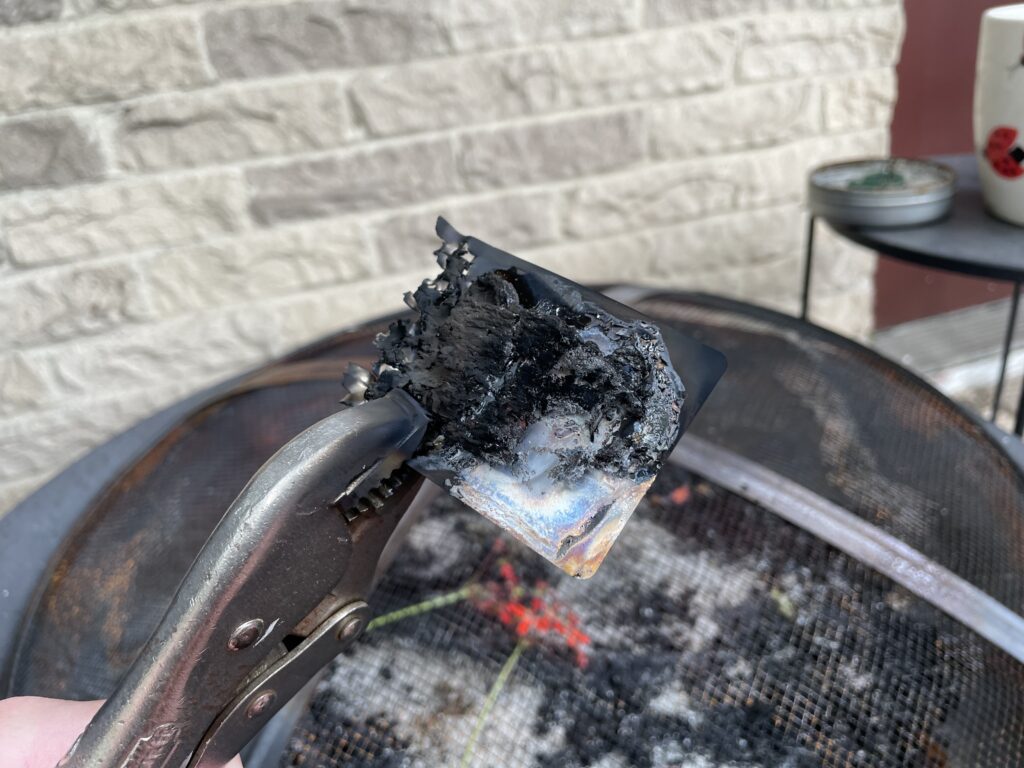
The machine kicked to life and gave it a solid effort, then jammed. I had to employ vice grips and a prybar to, thankfully, save my shredder.

Banks now say to not use shredders. Don’t ignore this advice.

My next attempt what somewhat less graceful: a propane torch.

Cough cough.

That worked, but couldn’t have been very good for me to inhale burning plastic fumes. I suppose I could have used my metal shears, but that strikes me as a little too much effort to forever scatter the printed numbers. So I checked some bank websites for official instructions, and they say to mail the card back to them. That’s even sillier than making a metal card in the first place.

I’m open to other suggestions, but all the disposal methods I can think of involve more work than a shredder. I guess that’s the price we have to pay for trying to feel like millionaires.

–Simon

Hard Bondage

And ye shall the Hebrews from Goshen be freed from their hard bondage and set to the land of milk and honey.

“Let my people go! From hard bondage.”

I am obviously not a scholar of religious text. Nor is the above an actual quote, I don’t think. Nor does Exodus have anything to do with Easter…right?

But I do enjoy MGM’s 10 Commandments. And as I’ve blocked from memory anything previously learned in Bible study, that film has become my scripture go-to. It’s either that or read one of the 4 Bible’s on the bookshelf that we have for some reason. The things we inherit.

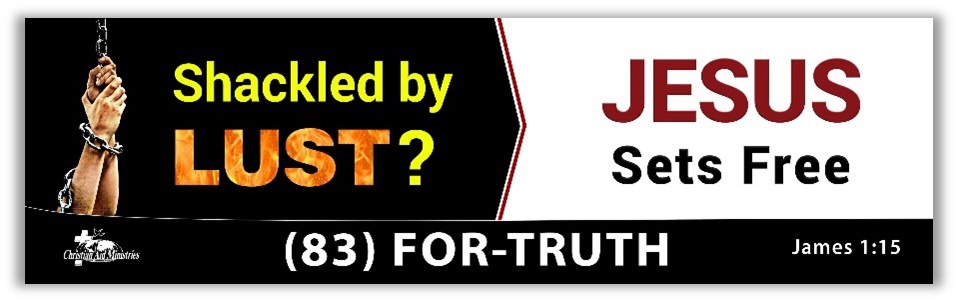
I present to you now this image, seen as a recurring billboard ad throughout the American Midwest. Noticed repeatedly whilst traveling to Wisconsin, and much mocked along the way.

Questions arise.

  • Why the wording choice?
  • Why is this such a bad sin as to warrant the ad’s frequency?
  • Why the BDSM theme?

I assume that the the intent of course is to rouse within those so shackled a desire most loathsome and overpowering that they might be inclined to call for salvation.

Be that the case, then those chains should at least be padded. Amateurs.

–Simon

Cold and Snowy (Part 3)

As per usual, here’s my post-holiday winter post, recapping whatever I was up to in January last year.

Also here’s the first good winter snow of the season

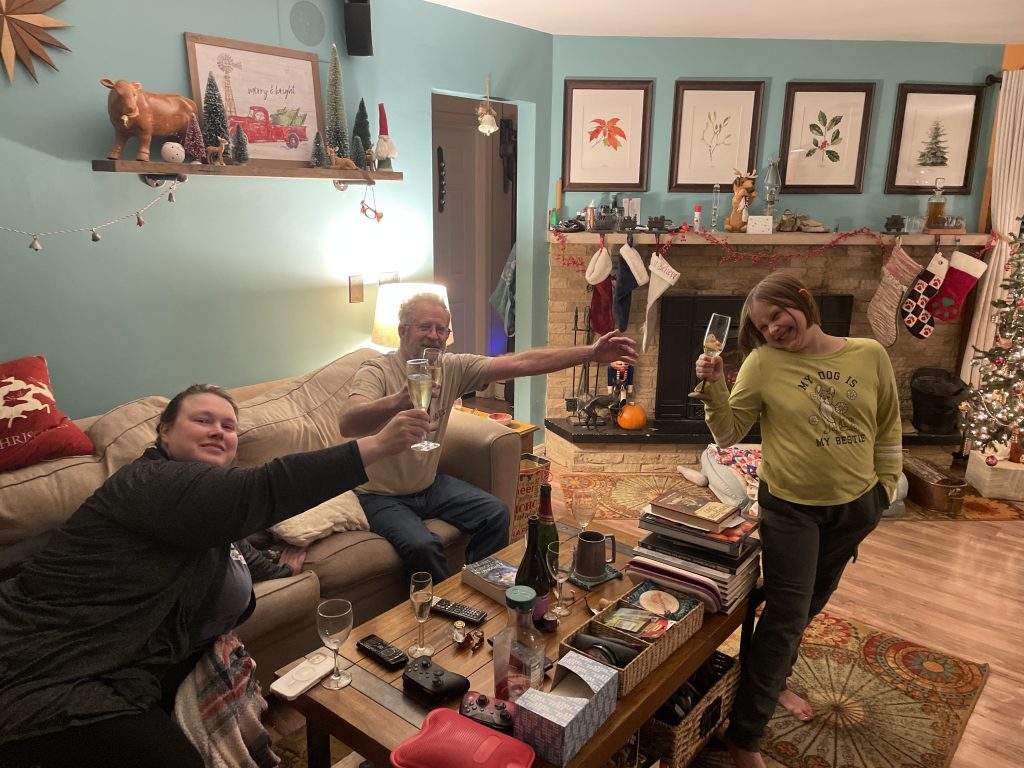
Aside from that, the holidays were stressful as usual and too action-packed for my liking.  So here’s a toast to the new year, and the holidays being concluded once more:

Huzzah!

–Simon

Knife Wielders

Guns are of course a polarizing topic for us Americans.  But unlike guns, knife design has a far less malleable intent of purpose.  Sure, the gun pendants will argue otherwise, that a gun is a tool–but its purpose is always to kill, regardless of the target being animal or human.  A knife, however, may indeed be designed for killing, and it may be multi-purpose say for military or survival applications that might require killing, but it may also be very obviously designed for non-lethal utilitarian tasks.  And the attempt to use the latter for the act of killing would probably bring equal harm to the wielder.

But this is difficult to explain to those whose sheltered lives never necessitated the carrying of a basic blade, for why carry a blade at all when other tools can be acquired to accomplish a blade’s tasks?  And if a blade is indeed required, could it not be readily requisitioned from somewhere other than a person’s clothing?

Is it necessary to carry a knife as regular personal equipment?

This question came to mind recently when, due to my own negligence, I had my daily-carry folding knife confiscated at a Trans-Siberian Orchestra concert.

The concert was pretty awesome though!

As what seems to be the increasing norm at large gatherings, security has tightened to the point of ridiculousness.  Coupled with the wannabe cops that seek this employment, the experience is akin to TSA, minus the wandering hands squeezing my crotch.  Humph–their loss.

But the old guy who caught me was nice (no crotch-squeezing involved), and probably just making some extra money in retirement, so rather than relegate a fine blade to the dumpster, I gave it to him on the spot.  He was openly pleased at the offering, so at least I know that it went to an appreciative new owner and not a douche-bro trying to act ultra-alpha.

But back to the question: why carry a knife at all?  Does its application warrant the irritation of having personal property essentially stolen?  My daughter, who herself has lived an incredibly sheltered life to date, didn’t seem to think so.  Maybe I just have outdated habits based on early experiences of a life I no longer live myself.

So to answer the question, I began documenting every instance where I reflexively reached for and used the knife in my pocket.

Over the course of 3 days I…

  • Opened a cardboard box of making soda
  • Pried a gap in some siding in order to fit a Christmas light mount
  • Opened a letter
  • Opened a box from Amazon
  • Made a quick mark on the ceiling for mounting a decoration hook
  • Opened a computer box
  • Teased some fuzz out of the Roomba’s wheel well

Okay, 3 days isn’t a large sample size, but it was a tedious list to maintain.  Still, it’s enough to make two observations:

  1. Having a knife on my person is incredibly useful…around the house.
  2. I don’t leave the house very often, and when I do, I haven’t needed a knife.

So perhaps it’s time to revise my loadout.  I could always just stash a knife in each of the vehicles in case I’m out and need one, but as I’ve already taken this approach to flashlights and never seem to have one in the glovebox, that might not guarantee knife access.

Or maybe the world just needs to chill the fuck out.

In the meantime, I’ll just carry cheapies.  Fuck you, paranoid world.

Legislation and Compromise

It’s no surprise that here in America, land of the two party political system, much of our legislation is based on simplified dichotomy.  The “us or them” mentality makes identifying threats easier, as we don’t have to waste our precious brain power on trivialities such as long-term consequences; be it financial (Social Security) or environmental (climate change); letting us preserve it instead for more important matters like my fantasy football picks.

There are of course some who over-analyze issues, but you don’t hear much from them because instead of shouting over presumed injustices on the internet, they’re instead locked into quiet introspection.  They might join the online community occasionally, but as their input is based in logic rather than emotion, it’s uninteresting to read.

So defines Premise 1: the loudest people, whether digitally or corporeally, represent those of the most extreme opinions.

However, in order for a technologically-modern large society to exist, the laws of such a society must still seek a general compromise, else all will devolve to total collapse or dystopia (which always leads to a later collapse once the orgies and drugs run out).

Ergo Premise 2: the correct form of legislation is that which lies between the extremes, if the goal is societal preservation.

And here are two recent policy events to drive the point:

  1. Permitless concealed carry of firearms in Ohio.
  2. Rowe v. Wade.

Everyone legally allowed to possess a firearm in Ohio can now carry that firearm concealed without needing to first acquire a permit.  Constitutional open carry is of course already allowed, so this will remove ambiguity when interacting with law enforcement, eliminating a potential felony charge fabricated by our not-so-popular police force, and removing the individual interpretation over personal rights.  Win for the Left, right?

Well no, because it reduced restrictions on guns and any such loosening of gun restrictions is bad.

Okay, well what about the Right then?  Any restrictions on guns is encroaching on constitutional rights–don’t tread on me and such–, so this is good, right?

Nope.  The Right’s mad because it let more people into their club without having to pay.

Conclusion: no one’s happy.

Rowe v. Wade established abortion limitations and guarantees, preventing local legislation from banning it outright, but also restricting allowable timeframes and conditions.  So a state couldn’t prevent an abortion in the early stages, but they could limit later stage abortions to consider the mother’s health, and late stage abortions were more or less prohibited as at this point there was an ethical obligation to carry the child to term.  The Left was happy, since abortion access was now guaranteed.

No, they weren’t.  These were still laws on a woman’s body, and any such laws are a violation of an individual’s autonomy.

And of course the Right wasn’t happy, because any abortion is murder and therefore wrong.

Conclusion: no one’s happy.


In these two examples, no one’s happy.  But since “no one” represents only the extremists (Premise 1), then what they are are truly moderate policies.  And moderate policies, being compromises, are requirements for societal health and longevity–preservation (Premise 2).

Therefore, these two policies, one accused of Right-wing agenda and the other Left, are in fact neither, and good policy decisions.


(The repeal of Rowe v. Wade was neither moderate nor of benefit to society, as it violates this principle.)


And there you have it: my commentary on contemporary political issues, which includes my thoughts on the policies, without actually including my personal beliefs.  Do I feel either of these is wrong?  I’ll never tell, and you shouldn’t know, because that’s the wrong way to govern large populations.

–Simon