Alton Brown had an amusing take on these flat meat diner foods in which he concluded that regional variances render this American staple undefinable. And if you were to try to find agreeable definitions, you would indeed be engaging in folly. Fortunately, I’m never too concerned with being agreeable here, so I’ll happily offer definitions.
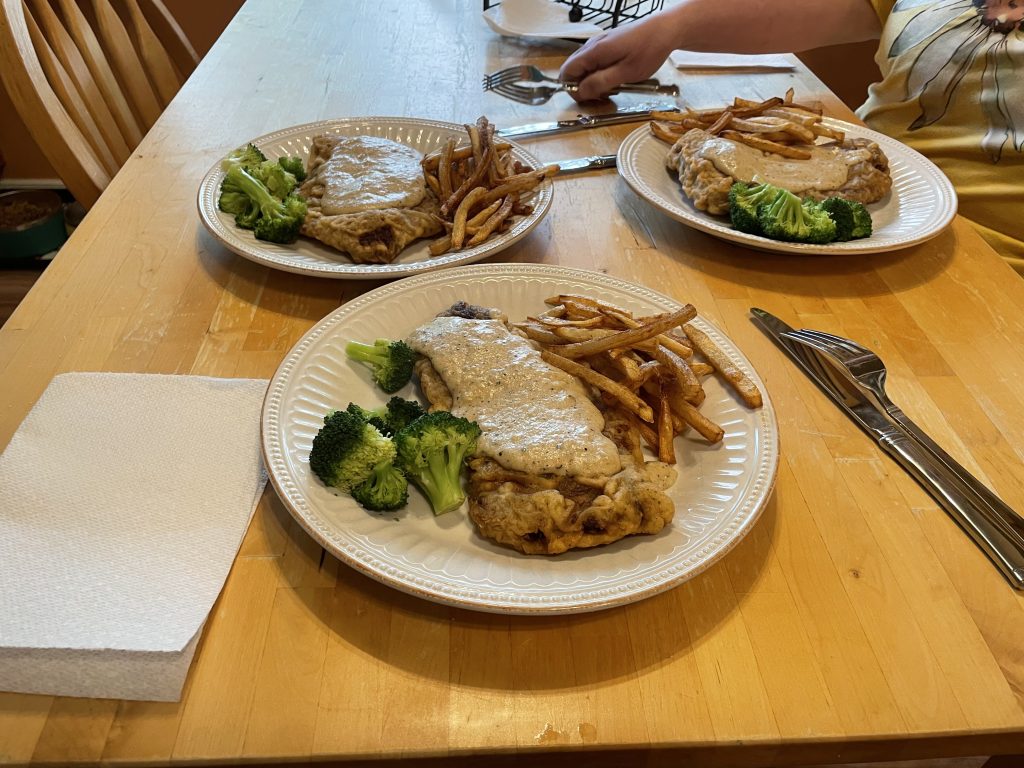
Chicken-fried steak: flattened beef cutlet breaded with flour and deep-fried, then topped with sawmill gravy. Served with fries.
Country-fried steak: flattened beef cutlet breaded with flour and pan-fried, then topped with broth-based brown gravy. Served with fries.
Salisbury steak: cubed beef cutlet breaded with flour and pan-fried, topped with onions and braised in tomato sauce with broth. Served with mashed potatoes or vegetables.
There. I’ve managed to piss everyone off now.
But as for the nostalgia-based reason for this post: I miss chicken-fried steak, which was a staple of my west-Texas childhood. Every restaurant, diner, and cafeteria had it – usually as the first item on the kids’ menu. The Midwest, however, seems to favor country-fried steak. And I don’t remember ever seeing Salisbury steak outside TV dinners. And none of these variations are very common at all now, seeming only to occupy a niche in country home kitchen type restaurants like Bob Evans or Cracker Barrel (neither of which are very good, I’ll add).
But not being terribly culinary difficult, it can be easily made at home. Which I did.
Family reviews indicated that it was “not terrible”, and “not the worst thing I’ve ever had”. So I guess that’s why it doesn’t find its way onto many menus. It’s in actuality cheap food with minimal spices, relying on flavor through caloric addition.
Sometime in the 90s I won a goldfish at one of those rigged carnie games at the county fair. What followed is a very common narrative for new fish keepers: I loved the fish, kept it in a bowl on my nightstand, overfed it, and it died within a few days from a lack of proper equipment and my own ignorance. Some years prior the family had made an attempt at a small aquarium, and the results were similar. I find these outcomes odd, considering my father is an environmental scientist with a specialization in decomposition. I would have thought that an intimate understanding of the nitrogen cycle would have armed him with some background on cycling aquariums, but maybe his experience was limited to the terrestrial variety, or more likely – he was just absent-minded and didn’t care about keeping pets.
Despite the initial failure, my interest was piqued, and so began my lifelong involvement in the hobby. In the beginning, it was mostly trial and error, until I acquired some books on the subject (the early days of the internet didn’t have much to offer), and I finally understood how nitrifying bacteria prevented the water column from going toxic – not to mention the limitations on the total bioload tanks of a certain size could maintain. These are lessons that curiosity and experimentation continually forced me to relearn, but what fun is a hobby that doesn’t allow for constant tweaking?
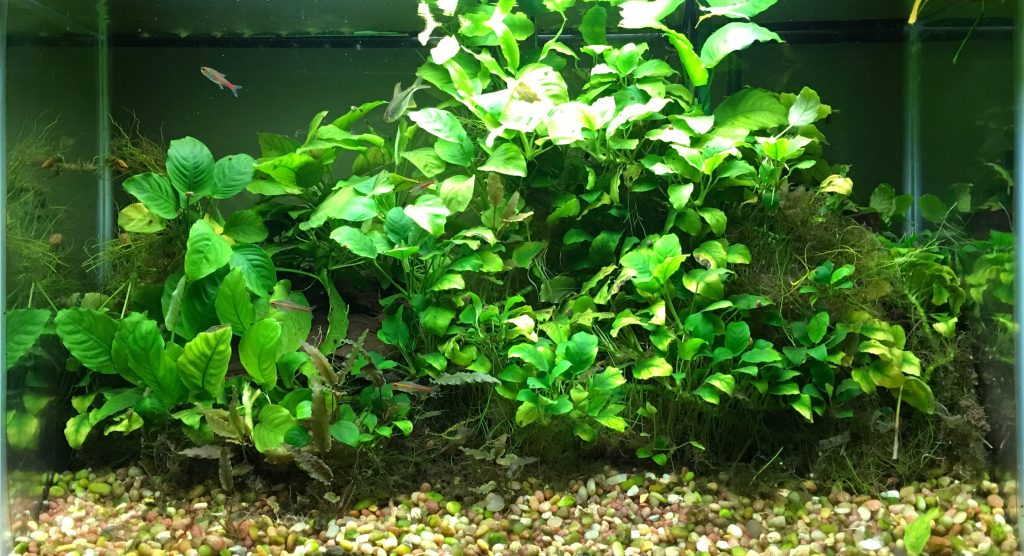
I maintained a 10 gallon tank throughout high school and college, eventually getting a 29 gallon from Liz, which I kept in 4 different apartments and now currently resides in the house. Its size is just big enough to give me options, without being so big that I’d worry about the floor joists (one day I’ll have something huge). It is this tank that I’m documenting here, since it existed in the time of digital cameras and smart phones. So here’s a fun look back in my personal aquarium history of this particular tank:
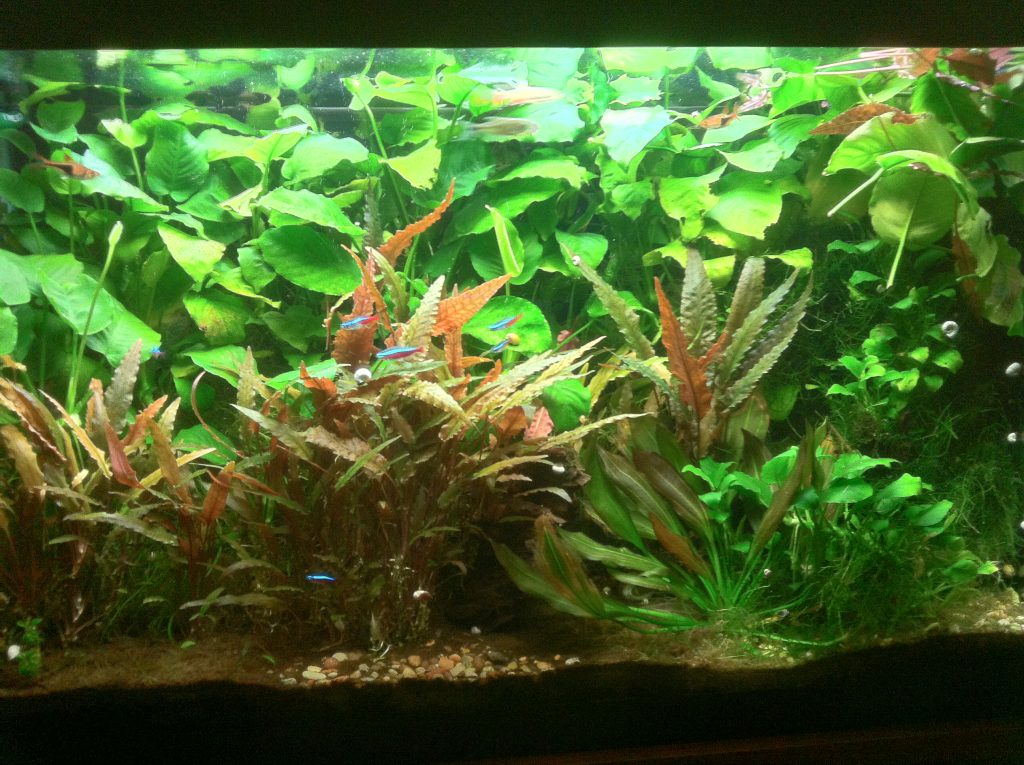
The metadata on this file doesn’t include a timestamp, but I know it’s before the smartphone era. I started off with a jungle theme.
A later photo, from 2014. I always did enjoy the cardinal tetras.
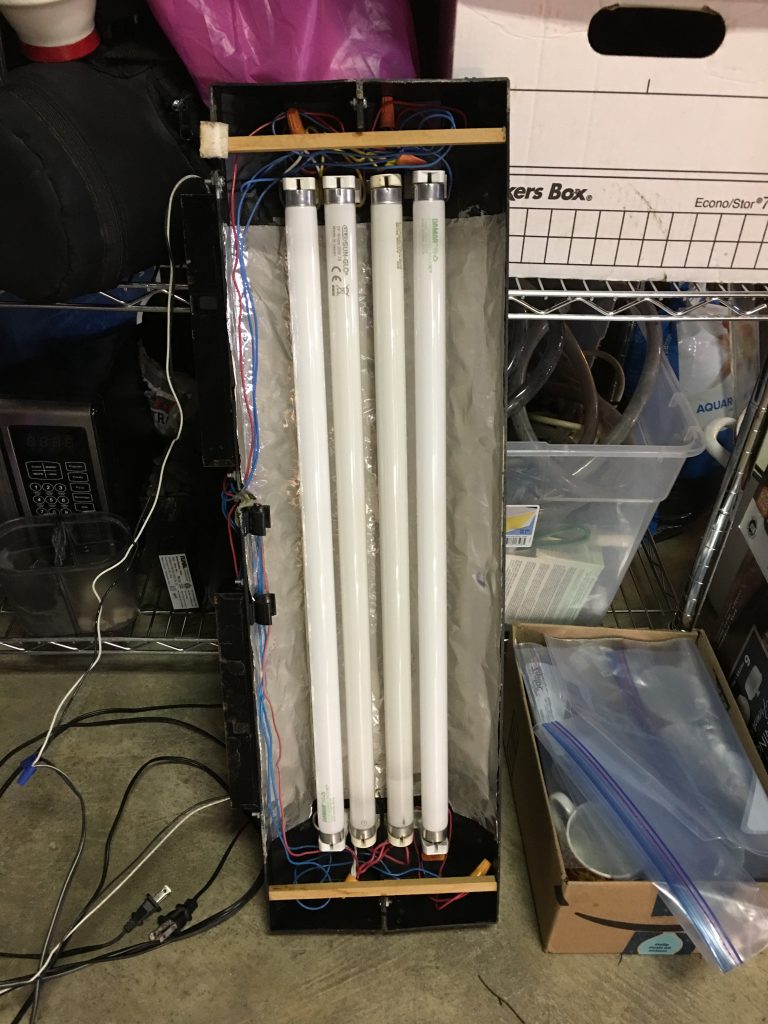
2015. Note the light. Around this time I retrofitted two light housings to fit two T8 fluorescent bulbs each, and bolted them together. I was able to start growing many more plants after that.
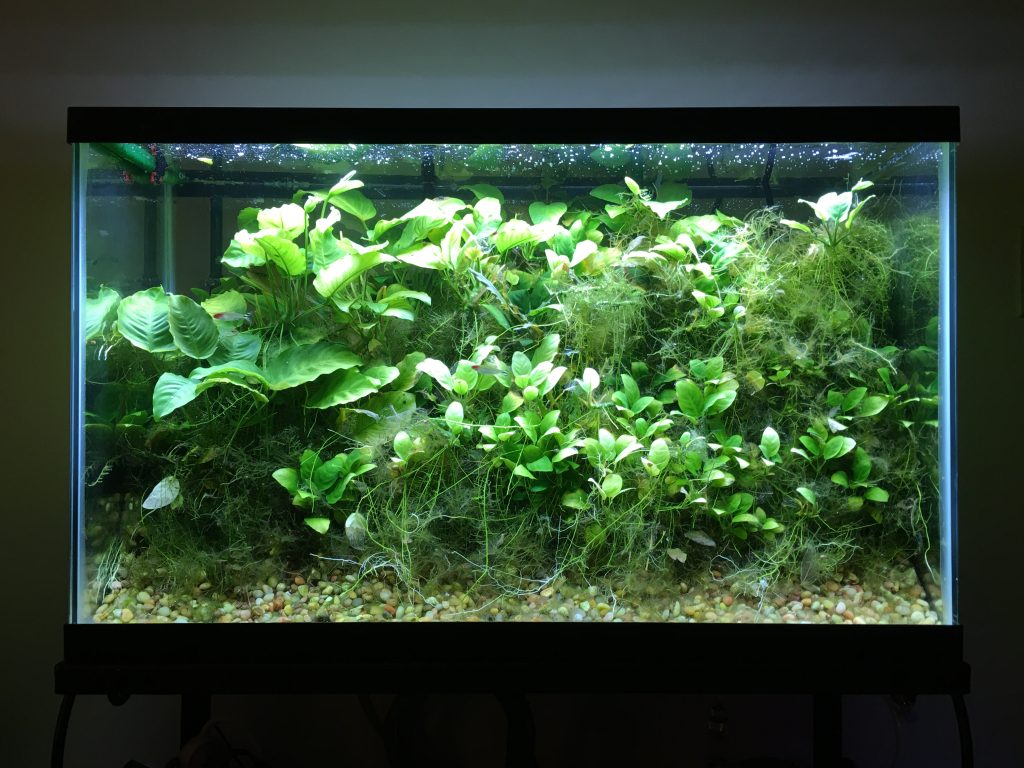
2018. It would appear that I did some pruning. Eventually the plants took over the bulk of the tank and I wanted to give the fish more space. I was probably suffering some algae problems at this point too.
2020. The aforementioned jerry-rigged lighting system that I retired in favor of a modern LED setup. I was pretty proud of this though. I had mounted contacts and ballasts, and those clips were even holding a moon light.
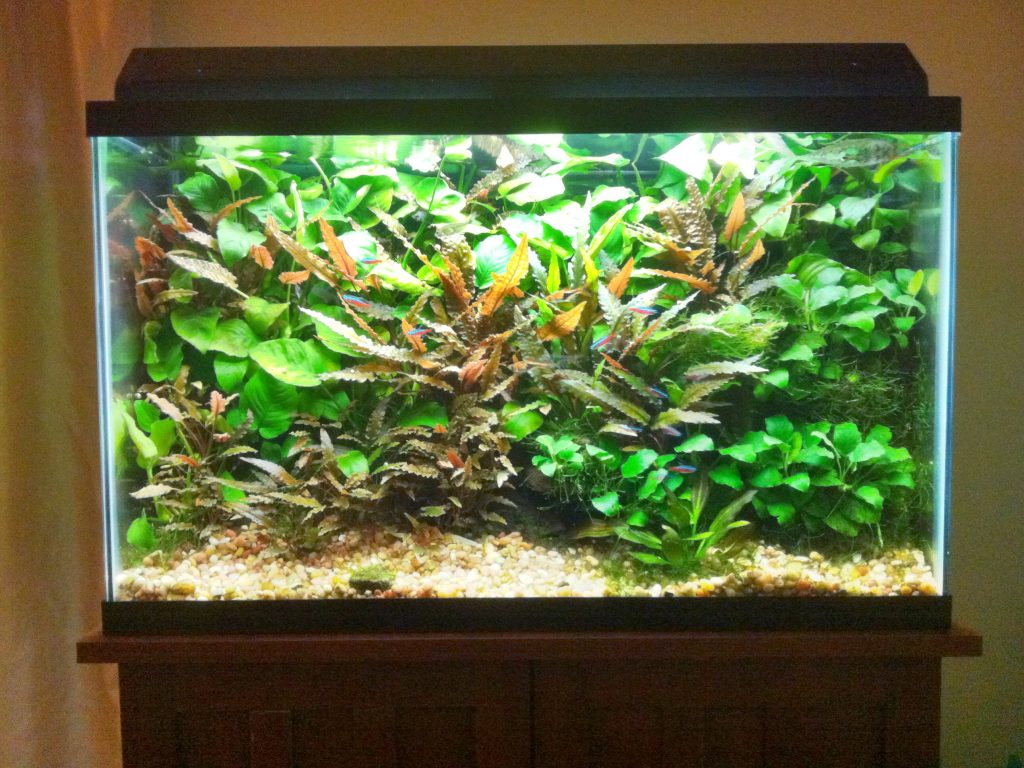
2020. A later shot with the LED lights.
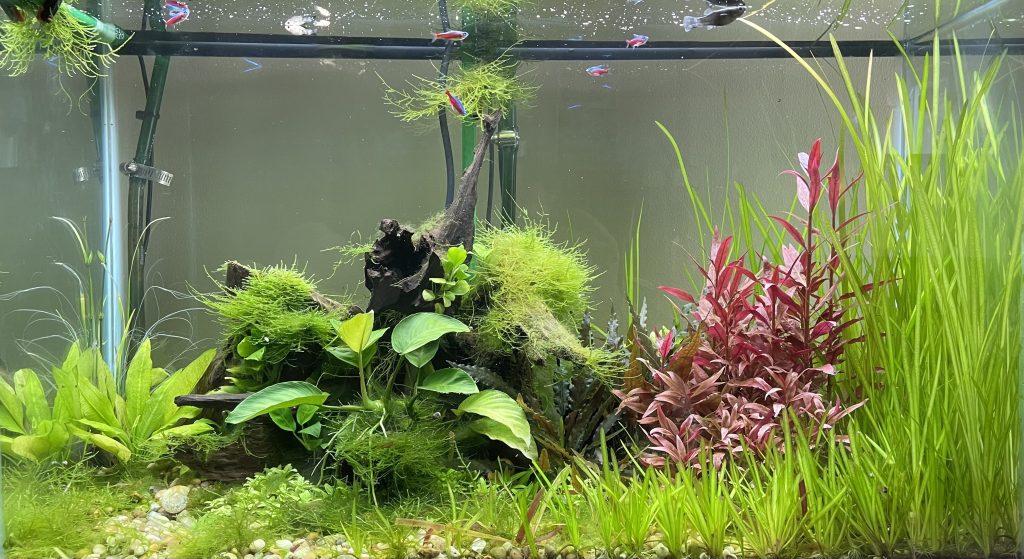
2023. Finally tired of the anubis-centric plantscape, at Liz’s urging, the tank was nearly completely gutted. This is probably the most professional it had ever looked.
And here’s where things went wrong:
I started dosing Flourish Excel (polycycloglutaracetal) to control algae. Excel has algicidal properties, and it worked well for a time at keep algae to a minimum while supplementing the plants with additional carbon, but it turns out that more than just algae is sensitive to it. The moss effectively died off, and the vals melted. I won’t be using it anymore.
We had an extended power outage. A filter not running will turn anaerobic, which meant my tank had to cycle again. I lost fish as a result.
I mistakenly set the needle valve on the CO2 tank too high. This asphyxiated half the remaining fish.
I pulled the dead moss and other dying plants out of the tank, and in the process disturbed the substrate sufficiently as to circulate toxic anaerobic microorganisms and kill off the remaining fish.
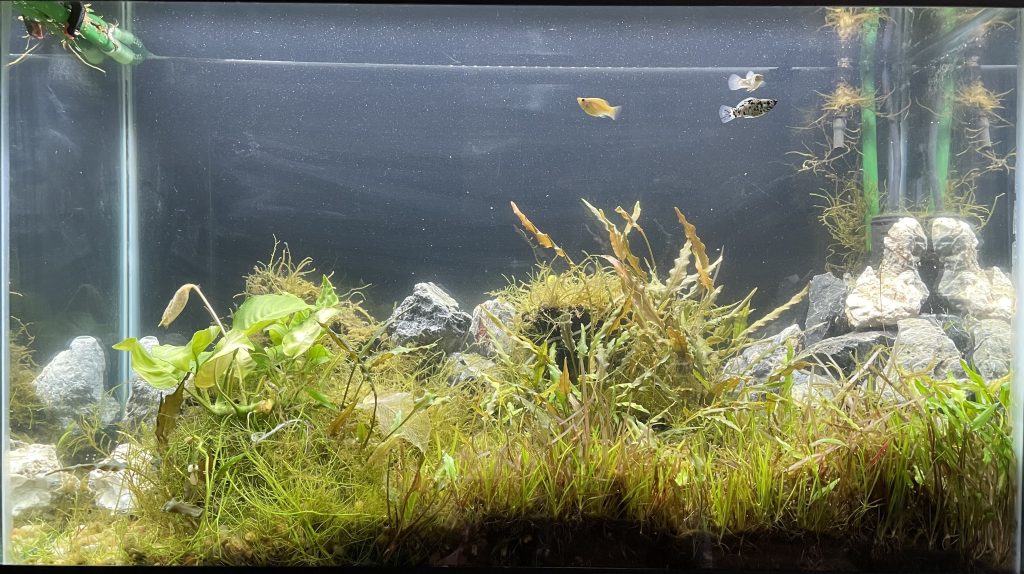
I hadn’t intended to reset the aquarium this year, but events necessitated it. With some lessons learned on caution and chemical dosing, I’m back on track to what will hopefully be once again a pretty tank, this time with mollies!
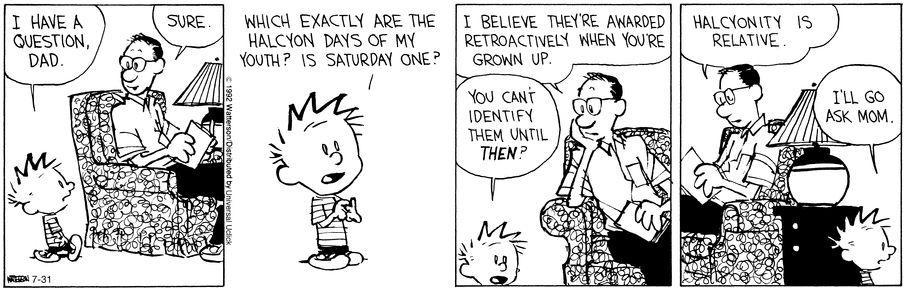
Suicide Month is upon us again, and as a result I begin to contemplate happier times. Nostalgia is dangerous with its filtered remembrance of history. It’s a driving force behind MAGA and the glory of 1950s America, and The Roaring 20s before that. I don’t wish to go back to those time periods, but I do have my own Halcyon Days. The cruelty of which, as Calvin’s dad puts it, are awarded retroactively:
Based simply on the time periods I daydream about, I consider My Halcyon Days, or years rather, to be: 2017-2020.
As nostalgia is purely emotional, I was interested in why I thought these days were so good. Looking back through my personal timeline, here’s my reasoning:
I moved from hourly work to salaried. With that came significantly more work autonomy (better job satisfaction and agency), and money. In fact during this time my household ranged from the 76th to 85th percentile in national income levels. Prior to that we were 66th. If the gold standards for middle class income is the middle 5th, which would be the 40th-60th percentile; or all but the top and bottom 20%, so the 20th-80th percentile (https://en.wikipedia.org/wiki/Middle_class) – then we essentially overcame middle classdom during this time. For people living the standard middle class politician soundbites prior (“X# of families can’t absorb an unexpected $1,000 expense”, etc.), I think this socioeconomic change was significant to my stress level reduction for the first time in my working life.
I started this blog in February 2017. I think this is more a representative corollary than evidence, but if I began an intentional record of my existence, I must have been finally interested in my own continued living, and finally starting paying attention to the moment instead of potential future goals. And looking back through it, it’s apparent that I had the energy for the multitude of hobbies I maintained at that time.
Youth! I achieved the mental maturity to master my own priorities, while also being young enough to bounce back from failure. And I had much better cardio and strength. I just felt physically good.
We bought the house the year prior, and while I wouldn’t go back to an apartment now, as a new homeowner I was still excited with its future, rather than worrying about its ongoing maintenance costs.
I witnessed the kid’s formative years. For better or worse, a parent always looks back on the experiences with a growing kid, once that kid inevitably becomes a teenager. And now I’m once again concerning myself with her future expenses.
This was all just before COVID lockdowns. An irreparable societal change, some consequences of which were certainly for the better, but many of which were not. This coincided with a job promotion, but in the process I lost the camaraderie I had built with my former team and was then denied the opportunity find that same rapport with my new department. It was never the same since, despite the perks of working from home. And while the home office saves me the irritations of cubicle life which I’ve so often criticized before, it replaced that feeling of being a physical embodiment of success. The confidence I felt waltzing into the office lobby wearing khakis and button-down in a sports jacket, then returning home so-attired and parking my sedan in the driveway while checking the mailbox and waving to my neighbor…was all replaced with slipping on cargo pants and a t-shirt and walking down to my basement. The iconic suburban fantasy had ended.
The conclusion? I suppose life just had finally felt fine, and the present was tolerable, and the future held with some optimism. To quote the Wikipedia article:
“The phrase has since come to refer to any peaceful time. Its proper meaning, however, is that of a lucky break, or a bright interval set in the midst of adversity”
Which I’ve now come to identify perfectly with this period in my life, as the current times are anything but peaceful and devoid of adversity. And again, as Calvin’s dad acknowledges, it had to pass for me to be able to know it had happened at all. Those were good days.
During the Lubbock years, my mother was very much the displaced Cincinnati German. Missing the cuisine of her native land-or city, rather-she often sought to recreate it. And in the 1990s, product globalization didn’t extend very far into food, so if you wanted something “ethnic”, it probably wasn’t in the dedicated grocery store isle. Some things we’d consider common today were not ubiquitous then. An example: bratwurst. It seems silly now, but she’d actually pack a carry-on with them on her return trip from visiting family. Brats are delicious.
But what couldn’t be bought pre-packaged left only the option of reverse-engineering. I don’t know if Skyline canned their chili back then, but it certainly wasn’t on shelves in Lubbock, so mom eventually developed a recipe for Cincinnati-style chili-a very bizarre concoction for one living in the heart of Texas. Cinnamon as an ingredient, and no spice? I’m glad she never served it up for any of my native friends (even though it was pretty good in its own right).
And one of her recreations that she didn’t get right, however, was something I’ve only just recently revisited, at the behest of others: goetta. I don’t remember this ever coming in packaged tube form. Instead, they were turned out of those small rectangular metal baking pans. Therefore, they must have been homemade.
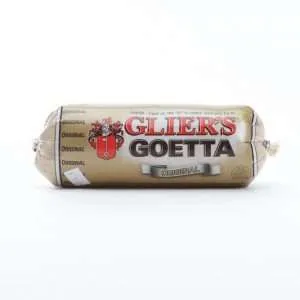
Here are the ingredients, from Glier’s’ website-an apparently popular brand:
A quick reading of that list reveals its obvious origin: more poor people food. Cheap ingredients added to meat in order to extend it, like Hamburger Helper. Plus MSG, naturally. Something that would be created in some fashion by immigrants lacking the means to acquire more expensive food. Something filling and high-calorie. Something that’s an acquired taste.
Mom’s creations slid out of the pans on their own slime, wiggling as they plunked down onto the plate, where they were unceremoniously slathered in Aunt Jemima. A sticky, sweet, slimy loaf. *Shudder*
Glier’s, on the other hand, was…okay. I wouldn’t buy it myself, but I’ll eat it. Slightly crunchy with a nutty taste, it’s a convenient way to get fiber into a meat dish. Beyond making a bigger serving out of a little meat, it appears to have an alternate nutritional function.
Dwelling on the difference in experiences, here’s what I’ve concluded:
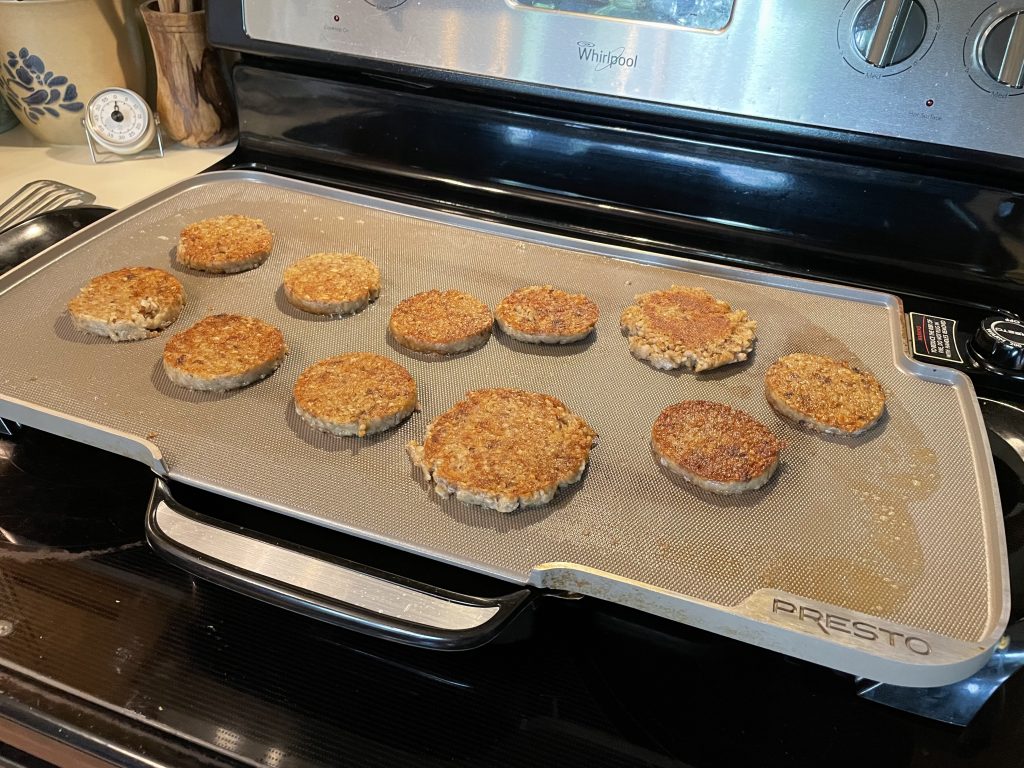
Cooking method. Just as a meatloaf should never be cooked in the pan, neither should goetta. The pan holds the grease, which in large quantities will make anyone feel sick, but also the oats soaked it up. Grease, which is of course greasy by nature, not only coated the end product, but also reacted with the oats to form a wet glue texture that could have been consumed directly through a toothpaste tube. Glier’s, on the other hand, I sliced into patties and fried directly on the griddle. The grease cooked out and the oats toasted, resulting in that nutty crunchy flavor and texture. Pan frying is the way to go. Not baking.
The oats. Oatmeal was a recurring breakfast staple, which I also hated due to its similar glue/slime texture. It was homemade, not instant. This generally calls for rolled oats. Greater surface area = quicker cooking and grain saturation. I very much suspect that mom used these same oats for goetta. This no doubt exacerbated the slime factor as steel cut oats would have retained their crunchier texture better.
Brown and crispy
Conclusion: More and faster grain saturation combined with more of the cooking liquid being fat due to the method of cooking caused over-hydration (fatification?) of the oats, resulting in no crunch and too much grease retention.
Slime.
And the syrup thing was weird, too.
I didn’t notice this at the time, but the packaging does in fact give the proper cooking instructions.
Mom never much appreciated constructive criticism with her cooking, but some minor adjustments would probably have resulted in a much more palatable result. Liking goetta isn’t exactly a life-changing experience for me, but it’s an amusing way to end a decades-long extreme aversion to a particular food product.
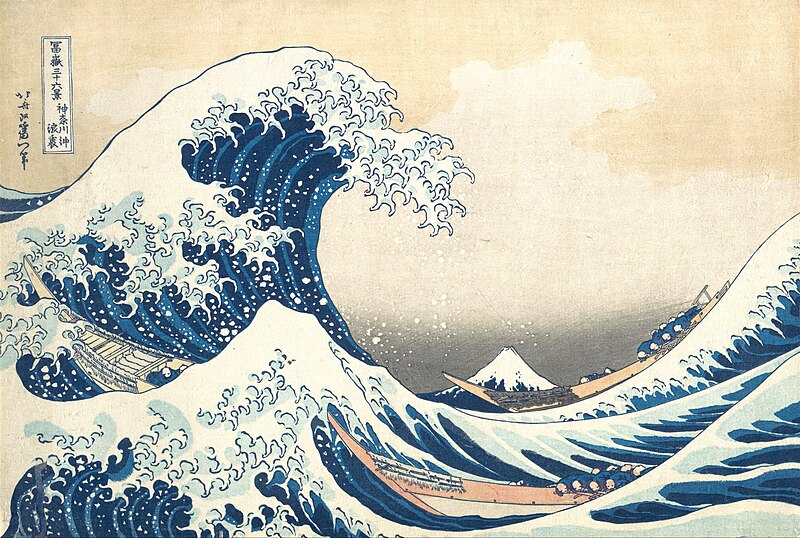
It’s somewhat surprising to me that scientific acceptance of the rogue wave phenomenon only dates back to the mid 1990s. So humanity has colonized every continent and established international shipping lanes for trade and travel, but as a species we never believed stories of big goddamn random waves until recently?
Here there be monsters. I suppose the low survivability of such events kept them in myth, with the occasional eyewitness rendered incoherent from PTSD. But still, the 1990s?
So why was I thinking about rogue waves? I dunno. It was one of those internet rabbit hole kind of days. Because apparently I needed to scare myself away from ever getting on a ship, aside from the more obvious reasoning: trapping myself in the ocean with a bunch of people. No thanks.
But it also triggered a vivid memory. As a kid, I took an interest in natural disasters. Extreme climatology became an independent subject of study for me, perhaps from living in Tornado Alley. What caused these terrifyingly lethal events? And, how does one avoid them? By the end of elementary school, I was well-versed on tornado and tsunami formation, and how to recognize their impending appearance. I had books on the subjects. In 4th grade. Yes.
And on one summer evening I was experimenting with wave formation in the collapsible swimming pool (I had a lonely childhood). It was one of those rubber-bottomed things with semi-rigid sides. Only 2-3 feet deep, though it always slumped slightly and never filled to capacity quite right. But I could push the sides and turn it into a wave pool and simulate the sinking of various objects based on this wave action. Single waves impacted the opposite side and sloshed around the circular perimeter. Rhythmic wave creation caused predictable patterns: sine waves and standing waves. Inconsistent wave creation led to chaotic results. And as I was a kid, a narrative always accompanied my experiments. A fleet of warships encountered a typhoon! An enemy bomber squad appeared overhead! All hands to stations! Abandon ship! And I would dramatically belly-flop into the center.
In this particular experiment, I generated waves in one location, then a few feet away, then back to the first spot, and I noticed a pattern. Waves generated some number of degrees apart converged across the pool. I continued the experiment by generating waves in different locations as I evenly circumnavigated the pool. My thought was that this would create some sort of water displacement in the middle of the pool that would replicate sudden tsunami formation.
Nothing exceptional occurred, and I lost interest. But before I left, and as the water appeared to settle into a waveless pool once again, a single wave rose unexpectedly towards one side of the pool, traversed the diameter, and crashed onto the opposite wall, splashing over the side. Then a second wave appeared in the same spot, and just as before, followed the prior wave’s same path. The waves were of significant height in comparison to the otherwise placid pool of water, and their sudden appearance, in complete contrast to the present equilibrium and without further input on my part, startled me. Actually, the event rather disturbed me, as it lacked any reasonable explanation.
Excited and needing some form of validation, I ran inside to explain the event to my dad, claiming that I had inadvertently created a tsunami in the pool. Of course, without much context to go on, he gave me a generic acknowledgment and that was the end of that. And many times thereafter, when the pool was set up again, I attempted but failed to recreate it. And I always wondered what had happened that day.
Through some form of random and predictable events, I had created a rogue wave situation (hence the name). But as constructive interference is easily explained in basic physics, it didn’t account for why I was able to create what I had by rotating around a circular body of water. Ultimately, I’ve come to accept the Draupner wave event as the explanation – a rouge wave whose empirical documentation led to fluid dynamic studies that ultimately recreated the event. The explanation: nonlinear convergent wave trains in crossing sea conditions (tested at varying angles of intersect). Or more simply: bursts of waves at different angles making big waves when they meet.
The pool had seemingly been still, but my last waves, or perhaps waves reflected from the pool sides, had intersected at just such an angle after I had stopped generating new waves. And the result was those two waves, significantly greater in amplitude than anything that should have been remaining in the settling water, formed from that improbable intersection. It was an odd experience to see the pool come to life on its own, and very difficult to explain sufficiently so that someone else might visualize.
It’s no wonder that sailors were a superstitious lot. No one believed my story either.