Halcyon Days

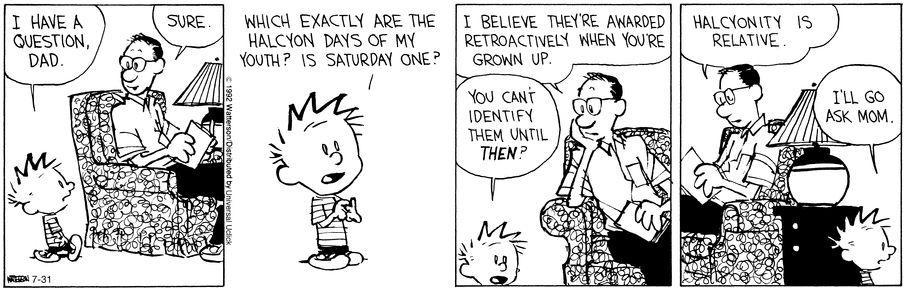
Suicide Month is upon us again, and as a result I begin to contemplate happier times. Nostalgia is dangerous with its filtered remembrance of history. It’s a driving force behind MAGA and the glory of 1950s America, and The Roaring 20s before that. I don’t wish to go back to those time periods, but I do have my own Halcyon Days. The cruelty of which, as Calvin’s dad puts it, are awarded retroactively:

Based simply on the time periods I daydream about, I consider My Halcyon Days, or years rather, to be: 2017-2020.

As nostalgia is purely emotional, I was interested in why I thought these days were so good. Looking back through my personal timeline, here’s my reasoning:

  • I moved from hourly work to salaried. With that came significantly more work autonomy (better job satisfaction and agency), and money. In fact during this time my household ranged from the 76th to 85th percentile in national income levels. Prior to that we were 66th. If the gold standards for middle class income is the middle 5th, which would be the 40th-60th percentile; or all but the top and bottom 20%, so the 20th-80th percentile (https://en.wikipedia.org/wiki/Middle_class) – then we essentially overcame middle classdom during this time. For people living the standard middle class politician soundbites prior (“X# of families can’t absorb an unexpected $1,000 expense”, etc.), I think this socioeconomic change was significant to my stress level reduction for the first time in my working life.
  • I started this blog in February 2017. I think this is more a representative corollary than evidence, but if I began an intentional record of my existence, I must have been finally interested in my own continued living, and finally starting paying attention to the moment instead of potential future goals. And looking back through it, it’s apparent that I had the energy for the multitude of hobbies I maintained at that time.
  • Youth! I achieved the mental maturity to master my own priorities, while also being young enough to bounce back from failure. And I had much better cardio and strength. I just felt physically good.
  • We bought the house the year prior, and while I wouldn’t go back to an apartment now, as a new homeowner I was still excited with its future, rather than worrying about its ongoing maintenance costs.
  • I witnessed the kid’s formative years. For better or worse, a parent always looks back on the experiences with a growing kid, once that kid inevitably becomes a teenager. And now I’m once again concerning myself with her future expenses.
  • This was all just before COVID lockdowns. An irreparable societal change, some consequences of which were certainly for the better, but many of which were not. This coincided with a job promotion, but in the process I lost the camaraderie I had built with my former team and was then denied the opportunity find that same rapport with my new department. It was never the same since, despite the perks of working from home. And while the home office saves me the irritations of cubicle life which I’ve so often criticized before, it replaced that feeling of being a physical embodiment of success. The confidence I felt waltzing into the office lobby wearing khakis and button-down in a sports jacket, then returning home so-attired and parking my sedan in the driveway while checking the mailbox and waving to my neighbor…was all replaced with slipping on cargo pants and a t-shirt and walking down to my basement. The iconic suburban fantasy had ended.

The conclusion? I suppose life just had finally felt fine, and the present was tolerable, and the future held with some optimism. To quote the Wikipedia article:

“The phrase has since come to refer to any peaceful time. Its proper meaning, however, is that of a lucky break, or a bright interval set in the midst of adversity”

Which I’ve now come to identify perfectly with this period in my life, as the current times are anything but peaceful and devoid of adversity. And again, as Calvin’s dad acknowledges, it had to pass for me to be able to know it had happened at all. Those were good days.

–Simon

Goetta Grip

During the Lubbock years, my mother was very much the displaced Cincinnati German. Missing the cuisine of her native land-or city, rather-she often sought to recreate it. And in the 1990s, product globalization didn’t extend very far into food, so if you wanted something “ethnic”, it probably wasn’t in the dedicated grocery store isle. Some things we’d consider common today were not ubiquitous then. An example: bratwurst. It seems silly now, but she’d actually pack a carry-on with them on her return trip from visiting family. Brats are delicious.

But what couldn’t be bought pre-packaged left only the option of reverse-engineering. I don’t know if Skyline canned their chili back then, but it certainly wasn’t on shelves in Lubbock, so mom eventually developed a recipe for Cincinnati-style chili-a very bizarre concoction for one living in the heart of Texas. Cinnamon as an ingredient, and no spice? I’m glad she never served it up for any of my native friends (even though it was pretty good in its own right).

And one of her recreations that she didn’t get right, however, was something I’ve only just recently revisited, at the behest of others: goetta. I don’t remember this ever coming in packaged tube form. Instead, they were turned out of those small rectangular metal baking pans. Therefore, they must have been homemade.

Here are the ingredients, from Glier’s’ website-an apparently popular brand:

Pork & Beef, Pork & Beef Broth, Steel Cut Oats, Pork Hearts, Pork Skins, Onions, Salt, Spices, Monosodium Glutamate.

A quick reading of that list reveals its obvious origin: more poor people food. Cheap ingredients added to meat in order to extend it, like Hamburger Helper. Plus MSG, naturally. Something that would be created in some fashion by immigrants lacking the means to acquire more expensive food. Something filling and high-calorie. Something that’s an acquired taste.

Mom’s creations slid out of the pans on their own slime, wiggling as they plunked down onto the plate, where they were unceremoniously slathered in Aunt Jemima. A sticky, sweet, slimy loaf. *Shudder*

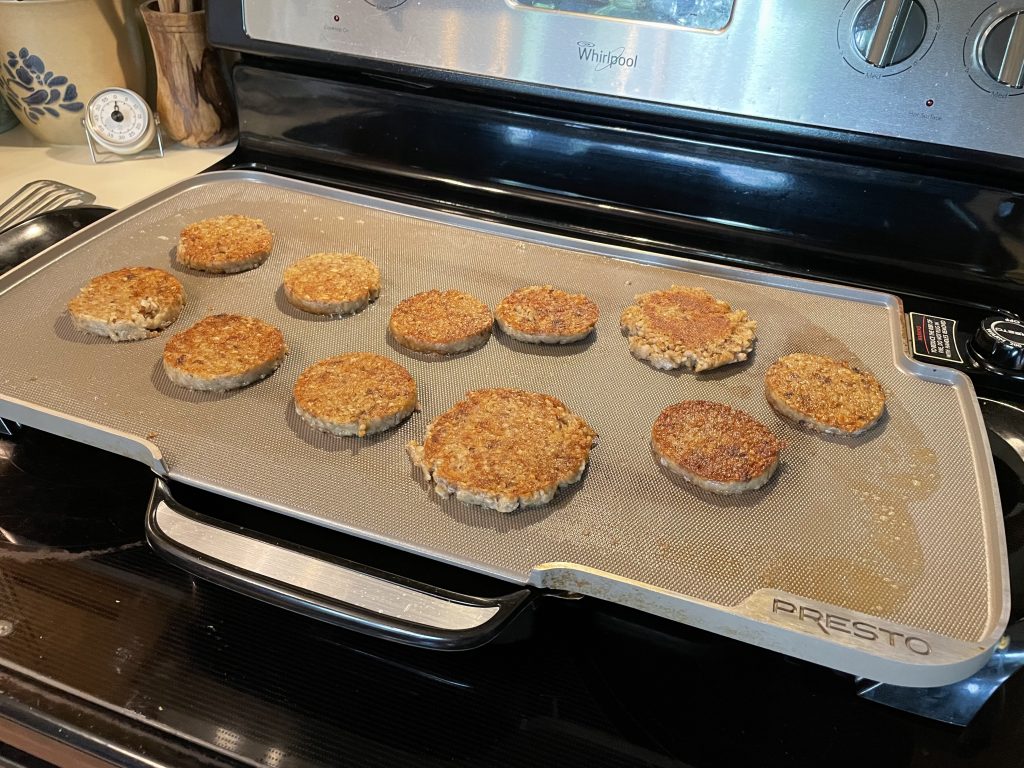
Glier’s, on the other hand, was…okay. I wouldn’t buy it myself, but I’ll eat it. Slightly crunchy with a nutty taste, it’s a convenient way to get fiber into a meat dish. Beyond making a bigger serving out of a little meat, it appears to have an alternate nutritional function.

Dwelling on the difference in experiences, here’s what I’ve concluded:

  1. Cooking method. Just as a meatloaf should never be cooked in the pan, neither should goetta. The pan holds the grease, which in large quantities will make anyone feel sick, but also the oats soaked it up. Grease, which is of course greasy by nature, not only coated the end product, but also reacted with the oats to form a wet glue texture that could have been consumed directly through a toothpaste tube. Glier’s, on the other hand, I sliced into patties and fried directly on the griddle. The grease cooked out and the oats toasted, resulting in that nutty crunchy flavor and texture. Pan frying is the way to go. Not baking.
  2. The oats. Oatmeal was a recurring breakfast staple, which I also hated due to its similar glue/slime texture. It was homemade, not instant. This generally calls for rolled oats. Greater surface area = quicker cooking and grain saturation. I very much suspect that mom used these same oats for goetta. This no doubt exacerbated the slime factor as steel cut oats would have retained their crunchier texture better.
Brown and crispy

Conclusion: More and faster grain saturation combined with more of the cooking liquid being fat due to the method of cooking caused over-hydration (fatification?) of the oats, resulting in no crunch and too much grease retention.

Slime.

And the syrup thing was weird, too.

I didn’t notice this at the time, but the packaging does in fact give the proper cooking instructions.

Mom never much appreciated constructive criticism with her cooking, but some minor adjustments would probably have resulted in a much more palatable result. Liking goetta isn’t exactly a life-changing experience for me, but it’s an amusing way to end a decades-long extreme aversion to a particular food product.

–Simon

Rogue Wave

It’s somewhat surprising to me that scientific acceptance of the rogue wave phenomenon only dates back to the mid 1990s. So humanity has colonized every continent and established international shipping lanes for trade and travel, but as a species we never believed stories of big goddamn random waves until recently?

https://en.wikipedia.org/wiki/Rogue_wave

Here there be monsters. I suppose the low survivability of such events kept them in myth, with the occasional eyewitness rendered incoherent from PTSD. But still, the 1990s?

So why was I thinking about rogue waves? I dunno. It was one of those internet rabbit hole kind of days. Because apparently I needed to scare myself away from ever getting on a ship, aside from the more obvious reasoning: trapping myself in the ocean with a bunch of people. No thanks.

But it also triggered a vivid memory. As a kid, I took an interest in natural disasters. Extreme climatology became an independent subject of study for me, perhaps from living in Tornado Alley. What caused these terrifyingly lethal events? And, how does one avoid them? By the end of elementary school, I was well-versed on tornado and tsunami formation, and how to recognize their impending appearance. I had books on the subjects. In 4th grade. Yes.

And on one summer evening I was experimenting with wave formation in the collapsible swimming pool (I had a lonely childhood). It was one of those rubber-bottomed things with semi-rigid sides. Only 2-3 feet deep, though it always slumped slightly and never filled to capacity quite right. But I could push the sides and turn it into a wave pool and simulate the sinking of various objects based on this wave action. Single waves impacted the opposite side and sloshed around the circular perimeter. Rhythmic wave creation caused predictable patterns: sine waves and standing waves. Inconsistent wave creation led to chaotic results. And as I was a kid, a narrative always accompanied my experiments. A fleet of warships encountered a typhoon! An enemy bomber squad appeared overhead! All hands to stations! Abandon ship! And I would dramatically belly-flop into the center.

In this particular experiment, I generated waves in one location, then a few feet away, then back to the first spot, and I noticed a pattern. Waves generated some number of degrees apart converged across the pool. I continued the experiment by generating waves in different locations as I evenly circumnavigated the pool. My thought was that this would create some sort of water displacement in the middle of the pool that would replicate sudden tsunami formation.

Nothing exceptional occurred, and I lost interest. But before I left, and as the water appeared to settle into a waveless pool once again, a single wave rose unexpectedly towards one side of the pool, traversed the diameter, and crashed onto the opposite wall, splashing over the side. Then a second wave appeared in the same spot, and just as before, followed the prior wave’s same path. The waves were of significant height in comparison to the otherwise placid pool of water, and their sudden appearance, in complete contrast to the present equilibrium and without further input on my part, startled me. Actually, the event rather disturbed me, as it lacked any reasonable explanation.

Excited and needing some form of validation, I ran inside to explain the event to my dad, claiming that I had inadvertently created a tsunami in the pool. Of course, without much context to go on, he gave me a generic acknowledgment and that was the end of that. And many times thereafter, when the pool was set up again, I attempted but failed to recreate it. And I always wondered what had happened that day.

Through some form of random and predictable events, I had created a rogue wave situation (hence the name). But as constructive interference is easily explained in basic physics, it didn’t account for why I was able to create what I had by rotating around a circular body of water. Ultimately, I’ve come to accept the Draupner wave event as the explanation – a rouge wave whose empirical documentation led to fluid dynamic studies that ultimately recreated the event. The explanation: nonlinear convergent wave trains in crossing sea conditions (tested at varying angles of intersect). Or more simply: bursts of waves at different angles making big waves when they meet.

https://en.wikipedia.org/wiki/Rogue_wave#The_1995_Draupner_wave

The pool had seemingly been still, but my last waves, or perhaps waves reflected from the pool sides, had intersected at just such an angle after I had stopped generating new waves. And the result was those two waves, significantly greater in amplitude than anything that should have been remaining in the settling water, formed from that improbable intersection. It was an odd experience to see the pool come to life on its own, and very difficult to explain sufficiently so that someone else might visualize.

It’s no wonder that sailors were a superstitious lot. No one believed my story either.

–Simon

Memories 06 – Six and a Half Guilders per Jew

One of my old memories I can’t seem to shake is of a movie I saw in history class in junior high. Although calling it a “movie” is a stretch, as is using the term “history”. It wasn’t so much a movie as it was a serialized fictional historical docuseries based on Anne Frank’s final days in hiding. And the class wasn’t history per se, as lower American education doesn’t like to present historical facts nearly as much as providing an Americanized historical narrative, i.e. “Social Studies”. And I think this memory resurfaced because for one, it was an unsolved problem that my mind had filed away for future rumination; and two, that the current Israeli-Hamas conflict rekindled my ire for the aforementioned narrative.

The narrative goes something like this: the Jews, long an unfairly hated and persecuted people, became the ultimate victims of Nazi Germany’s “final solution”, wherein they were systematically murdered. America, either ignorant or unbelieving of the genocide, forced the world with Britain’s help to face the truth. Nazi leaders were tried for war crimes at Nuremberg and executed, and the Jews were granted their own nation state of Israel, enforced by western powers.

To question this narrative is to risk accusations of antisemitism.

The problem with this story is that it ends. What’s not taught in American schools is the aftermath: Israeli militarization, persecution of the Palestinians, Israeli-backed political assassinations, Israeli cyber attacks (Stuxnet). Or their ancient history of of violence: Zealots, Sicarii.

To mention this is to risk accusations of antisemitism.

The aftermath revealed more than anything that yes, the Jews are people. But they’re not an overly altruistic people. They’re just people, who now have the upper hand. And people who have the upper hand rarely compromise or forget old grievances. As an American who lived through the entirety of the 20-year Afghanistan War, I see this all too well with my own people.

Did the Americans feel bad for the Jews after World War II and use their influence to finally grant them their own safe harbor, or see an opportunity to exploit Allied sentiment and gain an unconditional friend and forward base with which to secure interests in the Middle East?

And did the Israelis in turn exploit their western backing to rekindle a grievance with old enemies? Did this increased hostility force a backlash and spark the Israeli-Hamas conflict? Some students and faculty at Harvard thought so.

And they were quickly accused of antisemitism.

I’ll leave these thoughts without my own conclusions.

Because I don’t want to be accused of antisemitism.


The movie followed the “adventure” of a neo-Nazi who for some reason visits the Holocaust museum in D.C. alone. I’m not sure who let a skinhead with swastika tattoos into such an exhibit, but whatever. Inside, the exhibitions burst into the surrealistic ether, swirling about Mr. Skinhead, which I presume is meant to indicate a religious experience, further enhanced by a Morgan Freeman-esque character who then appears to explain the error of Skinhead’s ways by sending him to live a simulation as a Jew in hiding with the Franks.

Things don’t work out for him. There’s a “surprising” personality clash and he leaves, gets arrested by the Gestapo, and betrays the Franks who then get arrested. Skinhead feels remorse, thus delivering the heavy-handed message.

The Gestapo captain then tells Skinhead that they normally pay 6.5 guilders per Jew, but where he’s going, he won’t need it; then proceeds to level a Luger at Skinhead’s skinhead before a cutaway. There doesn’t appear to be a historical consensus on who informed on the Frank family, so I guess time-travel isn’t ruled out.

So what’s 6.5 guilders worth? A brief history lesson of the German guilder reveals that its usage was discontinued late 19th century, so I figured this to be creative license. Then I remembered Anne Frank wasn’t living in Germany. She was in the Neatherlands. Turns out the Dutch were still using their own version of the guilder, which still has an active currency code of ANG. So 6.5ANG = 3.63USD. Anne Frank was arrested in 1944, so a little handy inflation calculator tells me that Anne Frank was sold out for $62.56 in today’s money, or $375.36 for the whole family of 6. A nice little sum I suppose?

Closure at last, though I can’t find any reliable account that this was the actual going rate.


And no – there isn’t a conclusion to this post. Just a rambling train of thought based on contemporary events.

–Simon

Memories 05

[A continuation of the series where I write down fragments of my life that exist in my memory as standalone instances, still vivid due to their novel or unusual nature]

School busses of my Lubbock childhood didn’t actually go into neighborhoods. Instead, they traveled between the city’s schools. So in order for me to catch the bus to my Junior High, I had to first go to the High School 2 miles away. It was an odd logistical system, especially since my sisters, due to age spacing, attended other schools, and in order to catch those busses, had to in turn go to other schools in the morning. Because the routing didn’t simply send all busses to just one nearby school. Oh no – too easy. Lubbock’s population density was pretty sprawling, too, so it wasn’t as if mom could have just driven us all to our destination schools. Instead, she drove us all to our point of pickup schools. This of course meant that every morning I was trapped in the Chevy Nova with two sisters and a mom. And since mornings always bring out the best in people, the routine wasn’t exactly enjoyable.

Now, I’m fairly certain that my mother hates all human males. As do my sisters. The verdict’s still out on how much, exactly, but they have a lengthy rap sheet of ex-husbands and ex-boyfriends, sooooo…

It’s easier to overlook youthful arguments with my sisters though, since, you know, sibling children always argue. But with mother I always felt that she was taking out her own childhood issues on me, while also trying to groom me into a…something less masculine. It’s not as if she were trying to make me a woman in the strictest sense of the word, but more like I should behave less man-like. As in, stereotypical masculine-like personality traits were tampered: confidence, competitive drive, too big an ego, etc. Traits my father exhibited regularly.

One of the ways she did this was through extreme belittlement if I ever said something unusual/incorrect or used a word wrong – then constantly bring up whatever I said so no one would ever forget and the experience could constantly be invoked to belittle me further (anyone who had a boomer mom talk extra loud to her own mother one the phone so she could be sure you could hear her would know what I’m referring to).

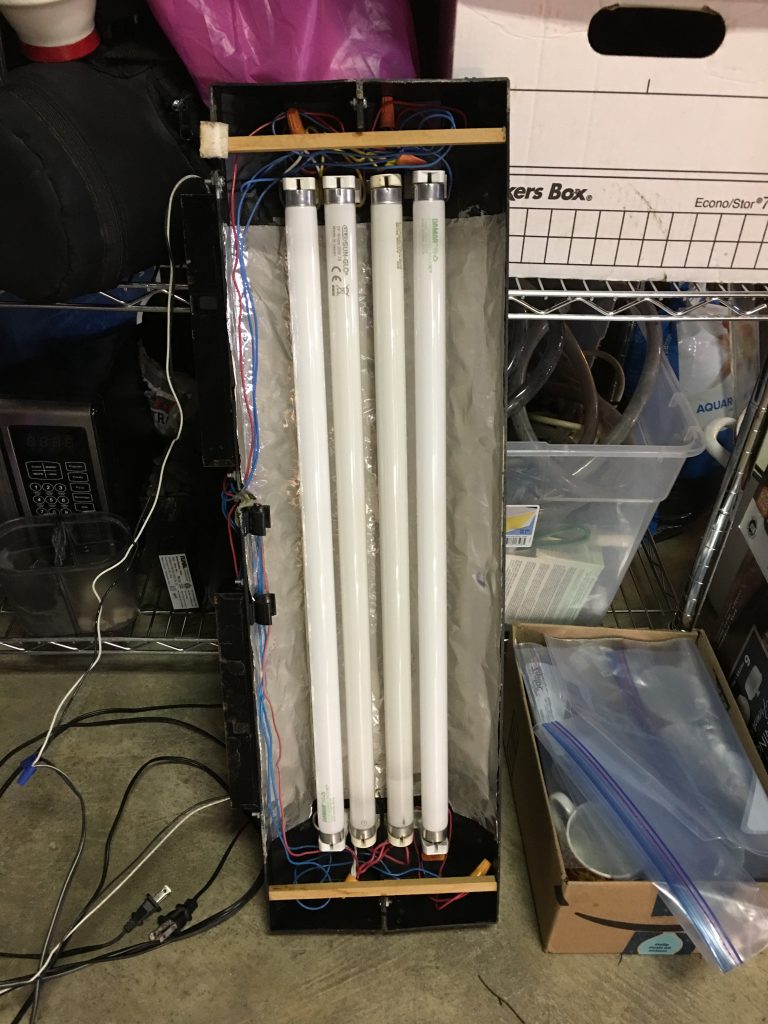
For example, one day I read an article on indoor farming, wherein was explained an experiment to extend the number of consecutive hours of lighting the plants were exposed to, essentially artificially changing the day/night cycle. For whatever reason, that sounded cool to me at the time, and I wanted to share what I read with mom. But I made the mistake of explaining it as: they give the plants 36 hours of light a day, to which my mother interrupted to explain there were only 24 hours in a day so that didn’t make sense. Further attempts to explain were brushed off with commentary on my intelligence, while my sisters joined in with the jeering. Every morning for months mom recounted that story during the morning drive to school.

But that memory isn’t the focus of this post, because I have a weirder one – also a morning drive belittlement attempt.

One morning my inquisitive mind asked what flour was. As in, the culinary ingredient. I was curious because it went into a lot of meals, and all I knew about it was that it made messes in the kitchen and I’d be assigned vacuuming duty. Cue the lesson on using a dictionary instead of asking mom. A normal explanation would have been something like: “It’s ground grain.” Not a completely accurate definition but close enough for a kid. I had already correctly assumed it was made from wheat (which is the most common type of American flour), but mother simply exclaimed “It’s flour!”

The remainder of the conversation went something like this:

“But what’s it made from?”

“Flour!”

“Okay, but it is made from wheat or something?”

“It’s made from flour!”

“So not ground wheat?”

“Flour!”

“So flour is a plant? Flour comes from the flour plant?”

“It’s flour!”

At this point, as per usual, my sisters starting chiming in with the belittling, chanting “It’s flour! It’s flour!” Thus ended my line of inquiry.

What a bizarre experience to have in the 7th grade. I had deduced the correct answer, but rather than simply affirming it, and by doing so validate me, mother turned the conversation into one of her belittling opportunities by denying me the confirmation. And for years after, I was under the assumption the flour was itself an agricultural crop. And my sisters, who probably didn’t either know or care, probably shared belief in that “knowledge” too.

Why would a parent dissuade their own child from the pursuit of information? Or mock the child for trying to independently learn and discuss knowledge? Or, lead the kid into accepting false information? I still think it was as simple as her hating men, and trying to discourage my own development of becoming an independently-thinking man (Down with the Patriarchy!) Whatever the rationale, the conversation still confuses me to this day.

–Simon