Over the weekend we visited a nursery. The nursery was running a sale on perennials, and with the new house’s yard begging to finally receive some attention, it was an easy decision to pick some things out. As we were doing so, I reviewed my calendar for planting times. In the past, I always aimed to start seeds for the vegetable garden 4 weeks prior to the average last frost date–which would have been last Wednesday. Crap! I had forgotten to mark my calendar.
But a few days’ wait wouldn’t majorly impact the schedule. And I already had the supplies and seeds (courtesy of the seed vault), stocked. And there was plenty of room under the grow lights, so no big deal. Consulting the spreadsheet I had complied months ago (when we had already argued over what to plant), I simply dropped the seeds into the peat pellets and placed the tray.
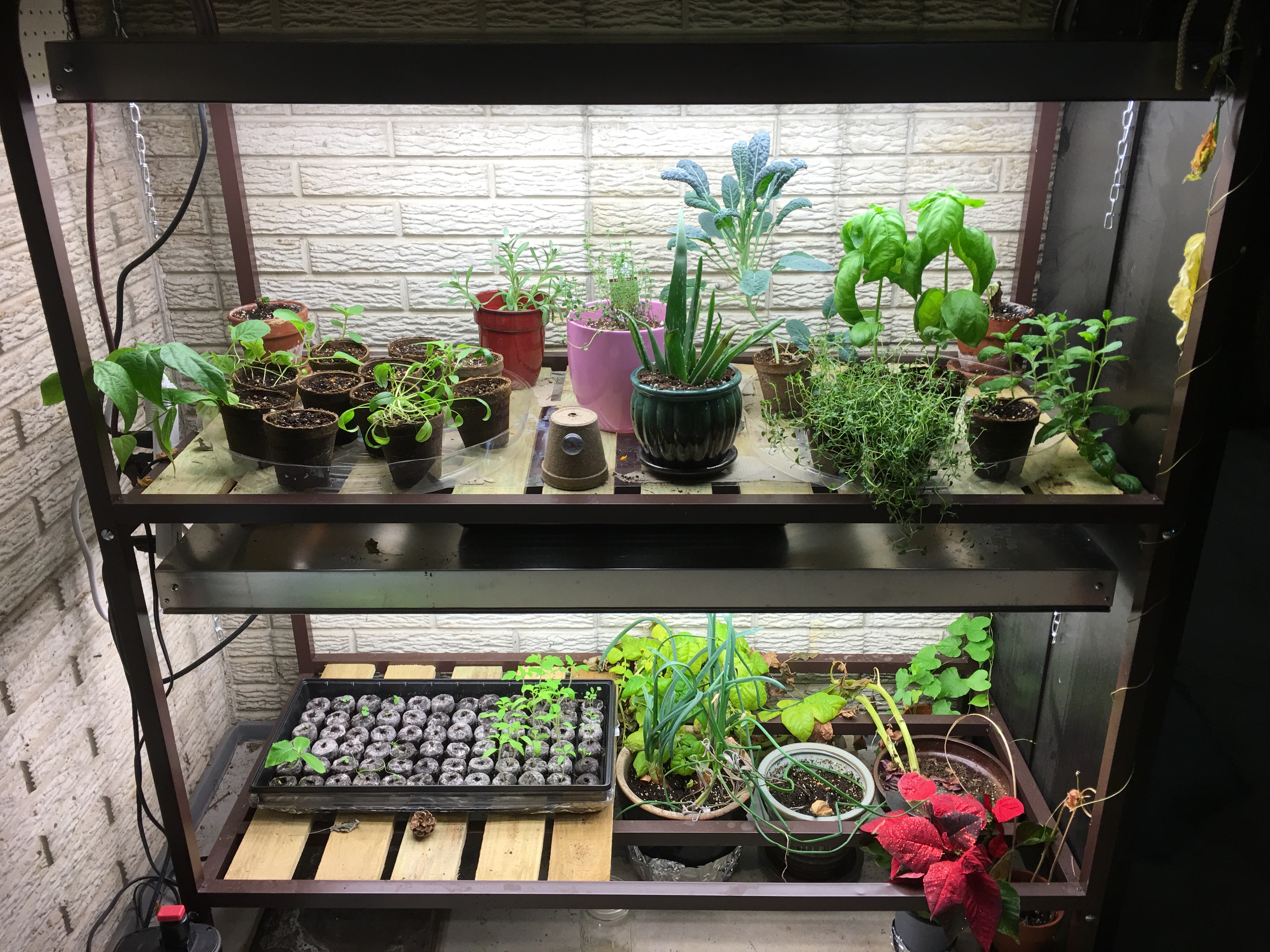
It was then that I took some time to poke around under the grow lights and see how things were doing. The lights had long-since been adjusted to maximum height, and the cosmos were growing into the fixture itself. I pulled the stems out of the lights, and behold!
There were multiple blooms, and I had completely overlooked them as they were stuck in the light. So, cosmos do really well indoors. Also, the moonflower finally germinated, the beans are growing although no more flowers, the poinsettia is hanging on, thyme is taking over, and the mint (despite my wife cutting half of it off for use in flavored water) is sending out multiple shoots.
I was down in the basement, watering the indoor garden and performing a general inspection of which plants are tolerating their work conditions and which are going on strike (flax still has unreasonable requests (I think he’s going to unionize (I should terminate him now))). The pole bean, winding his way up the outside of the structure, also appears to be getting mad, now that he’s reached the top and is realizing that there’s no light up there.
But the bush bean had flowered last week. I viewed this as a bittersweet success, for the flowers were pretty and indicative of adequate growing conditions (I’ll have him pull the flax aside for some coaching), but I knew that it was a wasted effort on his part, for who would pollinate these flowers? In the past, I’ve seen many a bumblebee take on this task, but thankfully I don’t have any bees in my basement. It was still too cold to put the plant outside, so I resigned myself to just enjoying the flowers for what they were–pretty.
But then, this week I noticed something:
I see you!
Now how did that happen? Asking family, the theories ranged from spiders to self-pollination. If the latter is true, this bean plant is a real go-getter: shows initiative, able to work on his own, proven ability to handle multiple tasks in a fast-paced environment. I think I’m going to promote him to garden foreman.
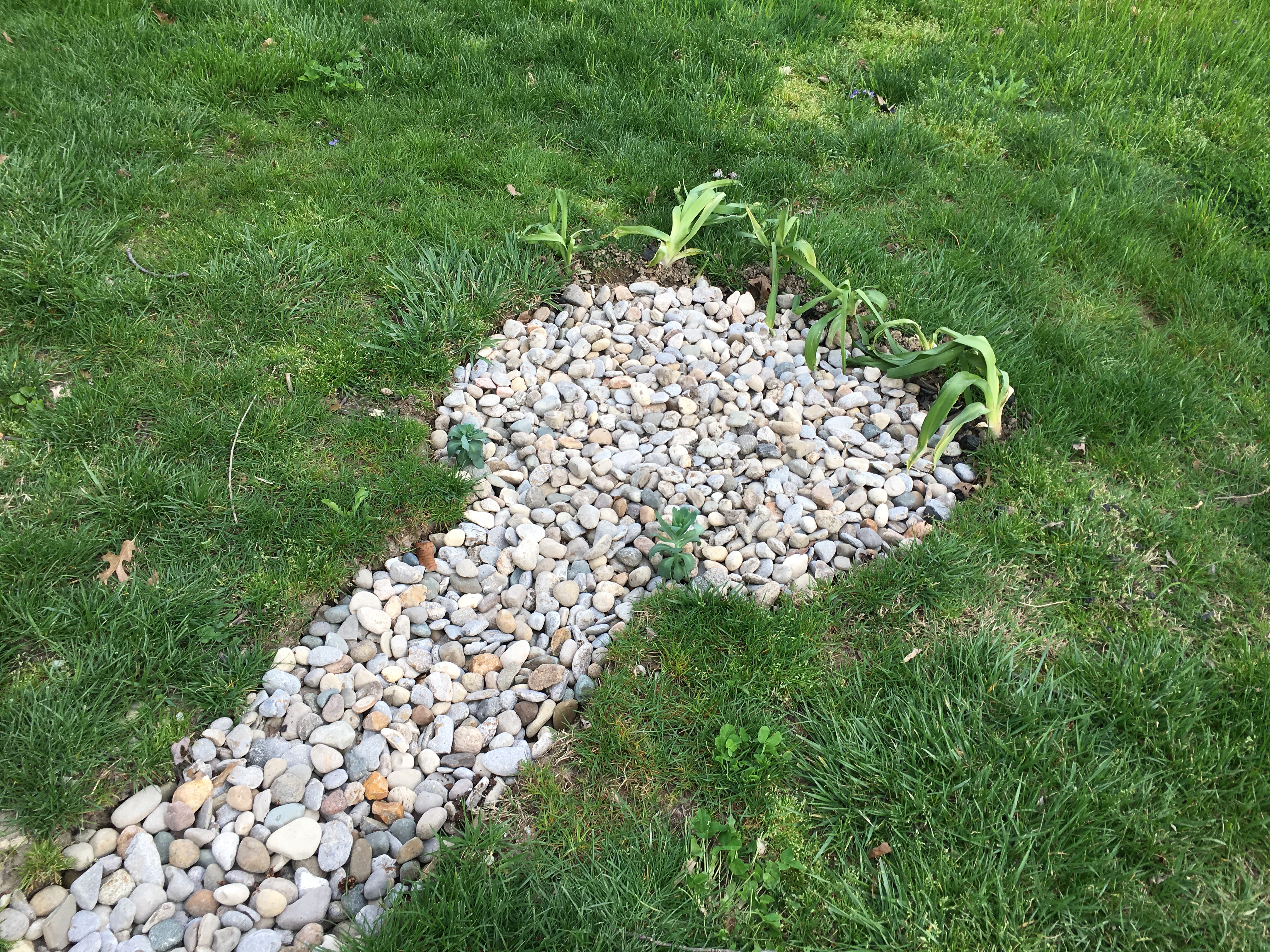
As nice as a pit of gravel looks, I do have loftier plans for the rain garden. In the short time since I dug the trench, deluges of rain have already eroded meandering rivulets through the lawn as it slopes towards the neighbor’s yard. This, I note, will need to be addressed long-term, as looking outside I can see that his yard is flooded (although I don’t think I’m the sole cause of it). Amusingly, as if through divine grace, the pond which has collected thoroughly respects the property delineation, defying the normal expectations of water as there doesn’t seem to be much variation in elevation back there. Surely it’s some form of retribution for his throwing fireplace ashes onto my side, or because his kids use my yard as a highway (see the first post of this project). Thank you, universe.
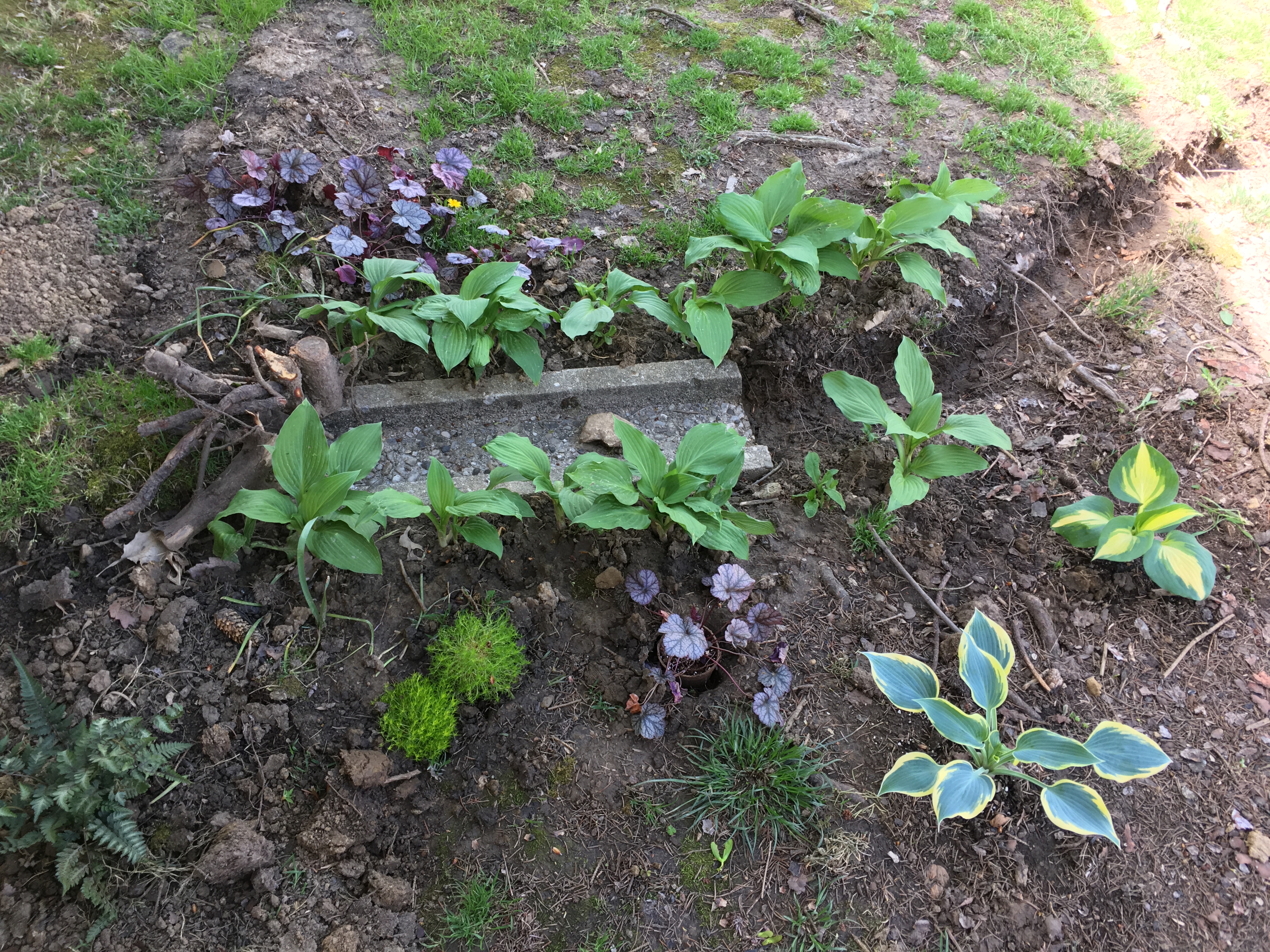
It is for these two reasons: aesthetics and drainage, that I intend to plant things in this rain garden. But what? I could consult my family and their collective expanse of natural science degrees, or I could needlessly peruse the opinions of those whose experience and education level I have no way of verifying. Surely the latter was the better option.
It’s like a dandelion, only cooler
But first, let’s revisit an earlier time, when we had first purchased the property. Being the former home of an elderly woman, the yard and gardens were somewhat neglected. Well, they still are, but I’m getting to it. Anyway, the gardens immediately adjacent to the house and deck were hastily made presentable for showing by someone throwing down inches of mulch. I’m not even certain there were gardens, as every time I dig in one of them I hit concrete and bricks. Three things survived this onslaught of woody biomass: a series of yew bushes, nightshade, and some mystery ugly woody plant that I figured for a weed. I’ve since then ripped out all the nightshade for obvious reasons, once my daughter exclaimed in delight that there were miniature tomatoes growing (however taxonomically accurate–her extended family would be proud). But I didn’t get around to the woody plant. Then winter came and it went to seed. It produced these very interesting looking pods, which my wife harvested and brought inside, mentioning a future arts and crafts project.
Fast-forward back to the present. Ultimately I decided native plants would be the hardiest, and I also wanted plants that would double for a butterfly garden. And what do monarch butterflies like? Milkweed of course, and there it was on the list of native plants appropriate for water gardens. And, my sister had included it in her doomsday gift to me–I mean birthday. It’s a cool gift, though it does kind of looks like the starter kit to a seed vault in my basement (20 different strains of squash, for example). Family was always very important to her, and here she is looking after me for a future apocalypse. They’re also meticulously labeled, consistent with the strain of OCD that plagues our genes (I’ve since catalogued all the seeds in a spreadsheet).
And so, with all the dramatic flair that one can assign to the task of dropping a few seeds into a pot of dirt, I dropped a few of the seeds into a pot of dirt. The next day I was browsing the internet instead of working and I caught a glimpse of an image of a milkweed plant. Specifically, I saw a milkweed seed pod and thought how familiar it looked. It wasn’t until later in the day that I realized the seed pods my wife had harvested were milkweed–the pods which I had ended up moving to the shelf on top of my indoor grow lights, right next to the box of all the seeds my sister gave me.
Milkweed in the winter
Now I debate: was that weed in the garden really as ugly as I remember? It’s only a stick right now so I can’t tell. But it seems pointless to plant milkweed when I already have it growing. Maybe I’ll transplant some jewelweed instead.
I realize now that my attempt for a humorous title renders continuations of that original article incongruous with the actual content. But, it’s too late to change now.
My mudpit had finally dried (after the last rain, drained within 7 days, so safe against mosquitoes), and with the weekend’s temperature once again bearable, and with the arrival of Lowe’s gift cards (courtesy of Bank of America), I proceeded to phase 2 of the rain garden: filling the pit with river stone.
The intent was to replicate the drainage trench in the front yard, with small stones as fill and larger stones as a lining. But upon arrival at said hardware store, I discovered a critical rock shortage in the diameter range upon which I had decided. There were 3 stories of pallets filled with large stones, but only 3 remaining bags of my desired size–all busted. Irritated, I paced the isle, occasionally returning my gaze to the shelves of merchandise, thinking that when I looked one more time, they would be there, me having simply been unobservant (it’s happened quite frequently before).
My daughter then approached and asked why I was standing motionless, staring at the rocks. Upon answering, she then asked what was wrong with the other rocks. I explained that they weren’t the right size. She asked why I couldn’t use them anyway. I responded tersely that I couldn’t use them because they were the wrong size. The discussion repeated itself as one would expect it to, her being a 5-year old.
At this point, my wife approached. I explained, dismayed, that they were out of rocks of the size we needed. After a few moments of reviewing the pallets, she concluded too that they were out of the desired size, validating my assessment of the merchandise, for which I was thankful, because it’s irritating when I look past something multiple times only to have someone else point it out to me.
A moment later she asked could we not just use the larger rocks for the project. I interjected that we could not, as they were the wrong size. She then asked why that mattered. I considered momentarily, then responded that they were the wrong size, and iterated something to the effect that I wanted stone homogeneity across the drainage projects. She made the point that this was for the back yard, and therefore didn’t need to be consistent with the front yard’s stones. I then replied that these stones were unworthy, not conforming to the great Aryan stones we had in our land!
She left to go look at trees, abandoning me once again to the great stone dilemma. She was right though, it really didn’t matter, at least in terms of function and appearance. Appealing to my gnawing OCD however, it would never do. But, I said I would do this project that weekend, and an honor-bound promise to myself won out over OCD. I went to get a utility cart.
Upon returning, I passed my wife at the trees. She inquired as to how many bags I was getting. Considering, I concluded that I had no idea how many I would need. She estimated 6 for the hole, and I figured about 10 for the project. If nothing else, they’d probably be used for something else later, so 10 it was.
I returned to the rocks and began loading, cognizant of the fact that 2 stories of rock pallets sat above me, 50 pounds per bag (I’m guessing–why do bags of rocks list cubic footage but not weight?), ~100 bags per pallet, that’s…5000 pounds per pallet, with 2 pallets immediately above me as I crawled under the metal shelves to retrieve rocks from the ground-level section. Yep–that would kill me.
50-pound bag at a time, I loaded 8, then paused. Our means of conveyance was a 4-cyllinder 160HP Honda Accord. I had just loaded 400 pounds of rocks onto a cart. I grunted as I pulled the ancient rusty device, shooing my daughter away as she insisted on helping with the task. I recalled the car’s manual saying it could pull a trailer, although one of the lesser tonnage classes. But that didn’t say what the suspension of the vehicle could handle. So I chickened out at 8 bags. I loaded the trunk at the garden center entrance, watching as the vehicle sagged a little more with each bag. But it held, and we completed the journey home without snapping a ball joint.
Once home, I carried the bags one by one to the pit. I opened the first bag and dumped the contents, which now looked like a paltry sum of rocks. A half cubic foot of rocks didn’t go far, and after the eighth bag, filled the pit almost full. But there were none left for the trench, so next week, back I go for another 8 bags.
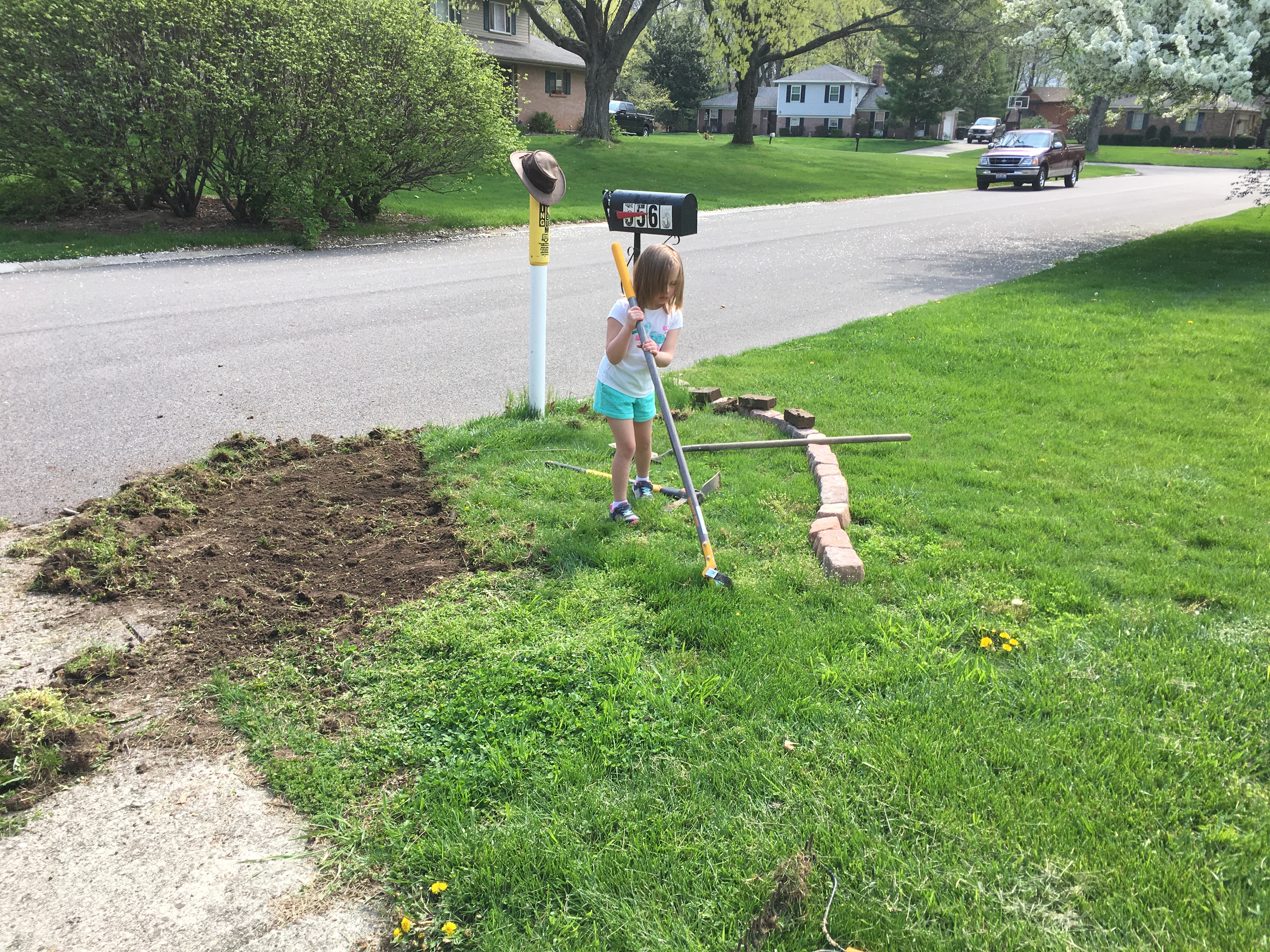
Our house is neighboring the house on the corner. On the perpendicular road from this intersection, one house down from this same house, is a house filled with feral children. These children, in their angst to visit the park, save precious moments by bypassing the intersection altogether and instead blaze a trail through my backyard, driveway, and front yard.
As any self-respecting old man suburban homeowner would do, I’ve conspired in secret to find subtle ways of mitigating the problem. I laughed evilly to myself as I fantasized over hedgerows of blackberries and poison ivy. But these are mere irritations. What I needed was something extreme: Unnecessary escalation to get my point across.
So I pondered the archives of knowledge I spent years of college acquiring–knowledge others have since called useless. I scoff at their uneducated masses of business degrees.
Not on my watch
A vision of Romans and Gauls flashed through my mind, and I recounted the Battle of Alesia–the first major battle to earn the booby-trap notoriety. Introducing, the Lilly. Interestingly, Googling the Lilly Trap returned an odd amount of pornographic images. I perused the thumbnails for a few minutes out of sheer curiosity before returning to my writing, naturally. My point is, I have no appropriate visual aid to append to this paragraph, so I will describe:
It’s a trap!
The Lilly Trap was a small pit with a sharpened stick in the center. The stick was deeply secured, and the pit was either covered with brush or filled with water. The idea was to hide the trap, so that an unlucky infantryman would step upon it, impale his foot on the stick, and be subsequently immobilized. Yes, this would subtly get my point across, muahaha. I began digging.
Okay, enough of that. This is the part where I tell you that maiming children is not my objective, although chasing them away with a 20 gauge certainly has crossed my mind. But I had other problems to contend with, namely the drainage situation from the downspouts.
The prior owner had installed extensive waterproofing measures in the basement. The perimeter had been trenched, and a sump pump installed. And when we were viewing the house, there had indeed been water in the sump. But, that was the last time it’s ever held water.
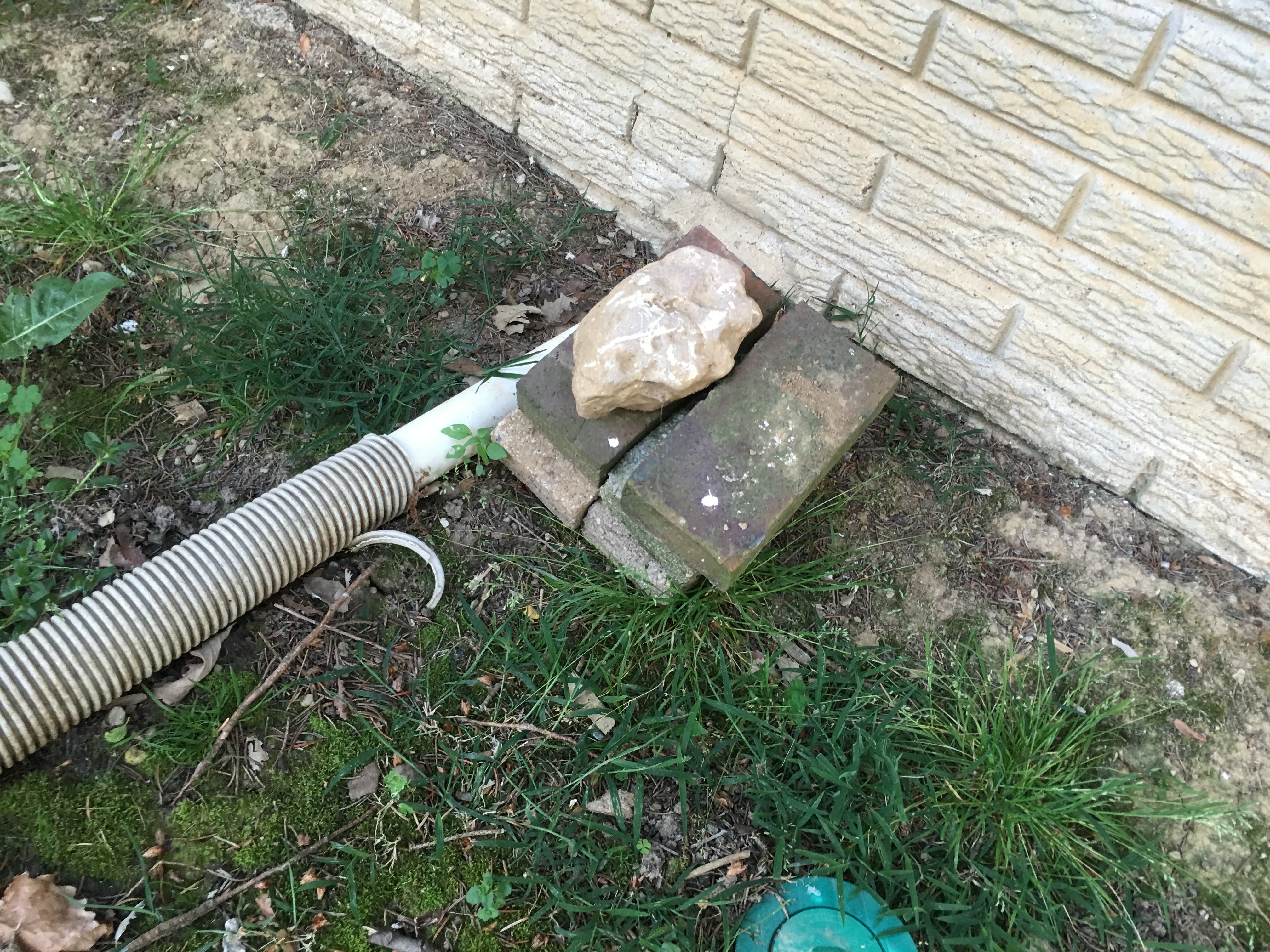
Shortly after moving in, it became obvious that the problem lied in the rainwater’s current drainage paths. Downspouts, dutifully installed, channeled their contents directly against the house. These areas had not been graded, so the water simply sat against the foundation. After the first heavy rain, I deduced something was amiss when I saw the house adjacent to several small ponds. That, I cleverly declared to myself, holding an authoritative finger of pronouncement to the sky, was not right.
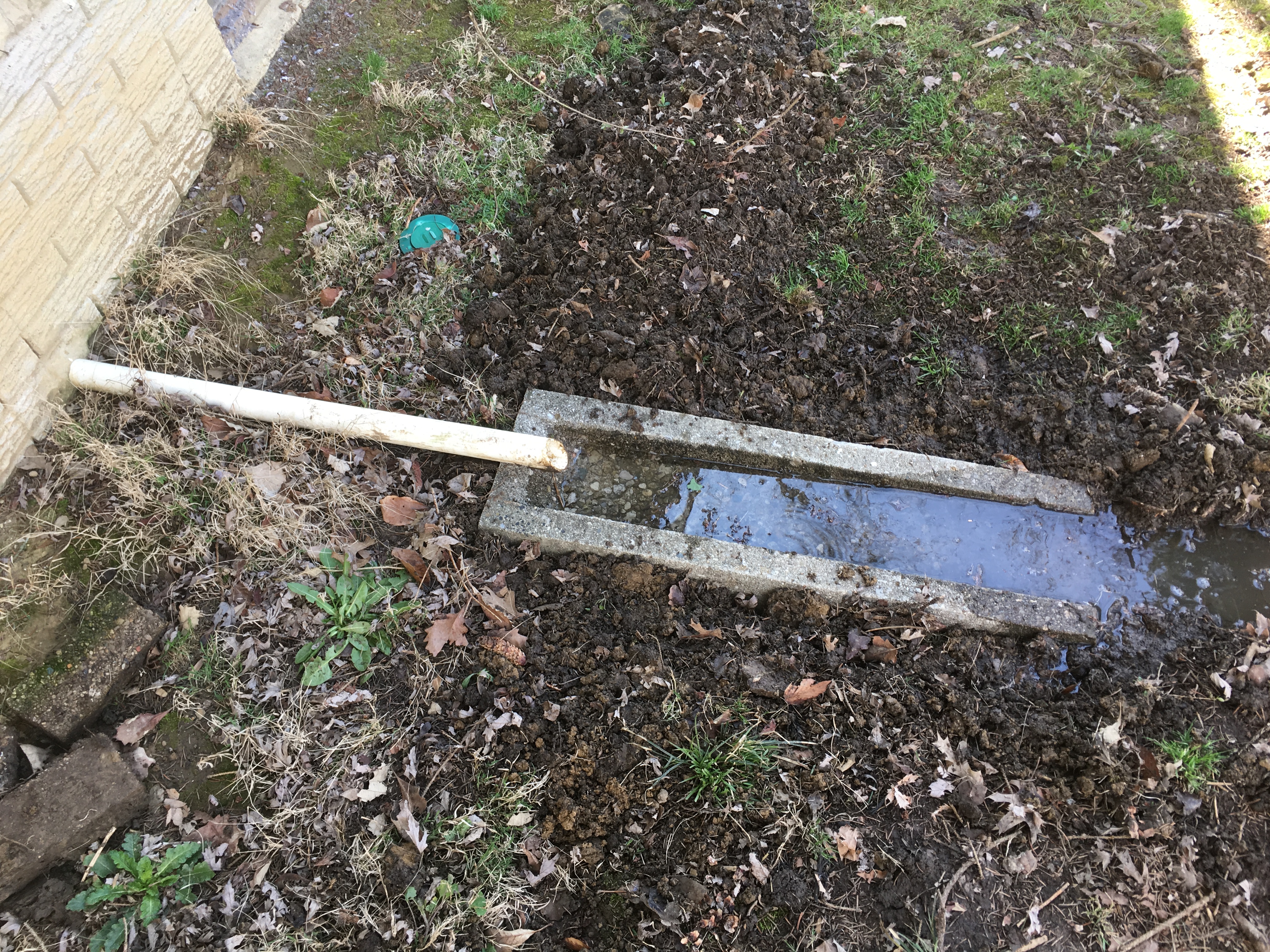
So I began trenching. But the problem with this particular corner was that the grade went up before down. So in order to get the water away from the house, I’d have a very deep trench. Also, the remnants of a stump were between the downspout and the far side of the rise, and I was not keen on chopping through many feet of roots.
Introducing, the water garden. I would trench as far as possible, then dig a deep hole, fill it with permeable material, and surround it with plants that tolerate flood/drought cycles. The cold weather broke and we were blessed with a beautiful weekend.
And sure enough, I started hitting roots, so I ended the trench in said deep hole. I lined the trench with bricks to provide a solid bottom, then planned to fill the remaining trench and hole with river stone, as I had on the drainage trench in the front yard. Then it got really cold again, and we were hit with our first spring storm that flooded the project.
So good news: the water goes where it’s supposed to now and doesn’t pool near the house. When the hole filled with water, it overflowed down the hill and away from the house. Success!
Unfortunately, now the rain garden is a hole of muddy water almost two feet deep. But, I have appeased the laws of hydrodynamics, and hopefully in the meantime I’m frightening the children away with my bizarre hole-digging project. Next step: caltrops!