Feminists often don’t acknowledge the exploitation of men. The assumption that men have always possessed personal agency is in direct opposition to most of our history. Most men did not get to choose their social status or career options. Most men were expected to conform to predefined values and obligations – same as women. I’d even go so far as to suggest that the rift in egalitarianism was fairly recent. When modern western society shifted towards one of individual autonomy, women were excluded – a social problem which has, on paper anyway, since been addressed.
Of course, what’s written and what’s practiced are two different things. And while legal obligations such as, say, equal opportunity in the workforce be enforced – which are dependent upon everyone playing by the rules, shouldn’t so too certain social obligations be governed? A woman is judged by her domestic competence. And men are judged by their physical abilities and willingness to suffer physical injury. Why don’t we as a people change these?
Because they supersede civil law. They long predate civilization. They remain the foundation to our survival as a species in those early days, which paved the way for common law, prior to civil law. I don’t think they can ever be changed. They’re part of who we are.
Point being: as a man who lacks economic and political means, I’m trapped in an exploitative system too.
So it was that 10 years ago I willingly agreed to be the functional mass of man flesh required to maintain an estate…for 10 years. My premonition at the time was that age and injury would compound to ultimately end my usefulness as a man after that timeframe. Such a prediction has turned out to be surprisingly accurate. I’m gradually phasing into a period of needing more hired help, and becoming incapable of tasks which formerly were straightforward.
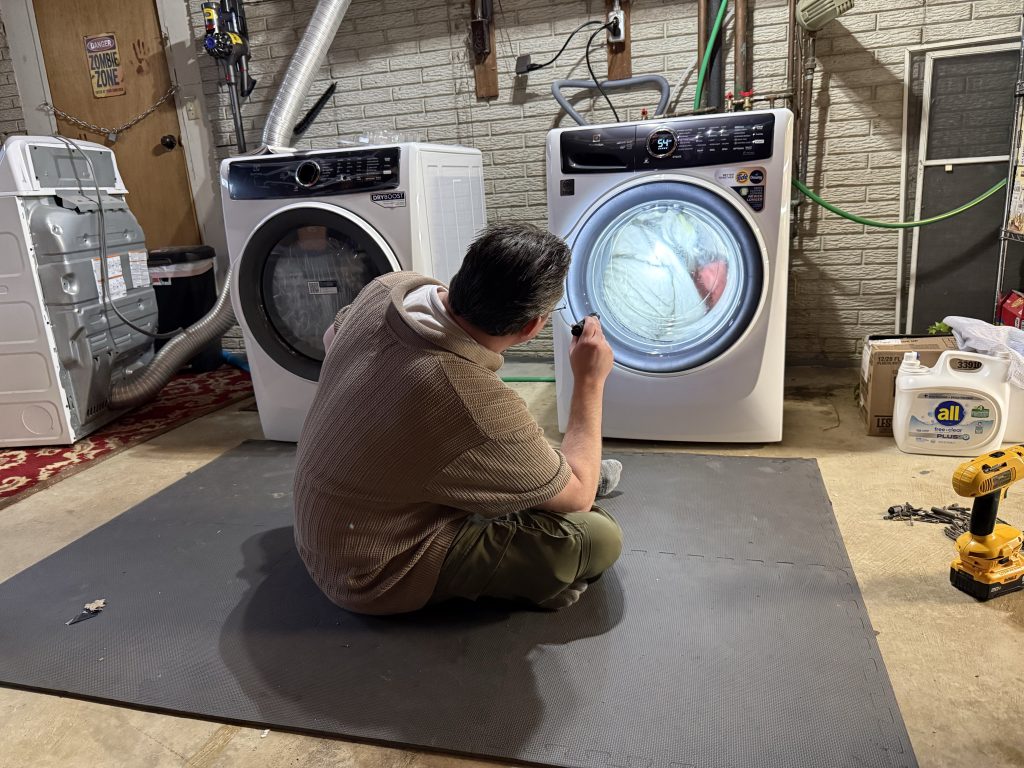
And one such task is moving heavy objects. In this particular case – laundry machines to the basement! Moving these machines was always a bit of a struggle, but no Herculean effort. Then Liz’s new wash machine arrived. It’s the first front-loader we’ve ever had, and as it would turn out, significantly heavier than top-loaders. Its specs weigh in at 217lbs. And the all-steel appliance dolly we borrowed was 50-70lbs. That’s really damn heavy, especially considering that the bottom step of the basement is narrower than laundry machines, requiring one to lift them over the stair ledge on the final push.
We managed it, but I’m paying the price. Next time, younger men are needed.
They’re also entertaining to watch!
Of course, this will be 10 years this summer, at which point I might irreparably break anyway. At least my promise will be fulfilled.
[Note to self: add this to the Quantitative Philosophy Index when it posts]
My personal life philosophy defines an individual’s value on the activities one engages in when in an autonomous state. More simply: what you do with your personal time quantifies your life’s meaningfulness. I don’t see the level of impact itself to be the defining factor, since so few of us are ever granted the circumstances under which to achieve greatness, but that doesn’t preclude us from seeking a virtuous live, even if the tangible results are comparatively minor.
Setting this premise: after a day of my daughter watching anime and binge-eating, I tried to explain that she was, in some non-so-friendly-terms, being a completely self-indulgent and useless sack of loafing teenage flesh. In the aftermath of that conversation, however, I though it more helpful to create some definitions. Here’s how I break them down:
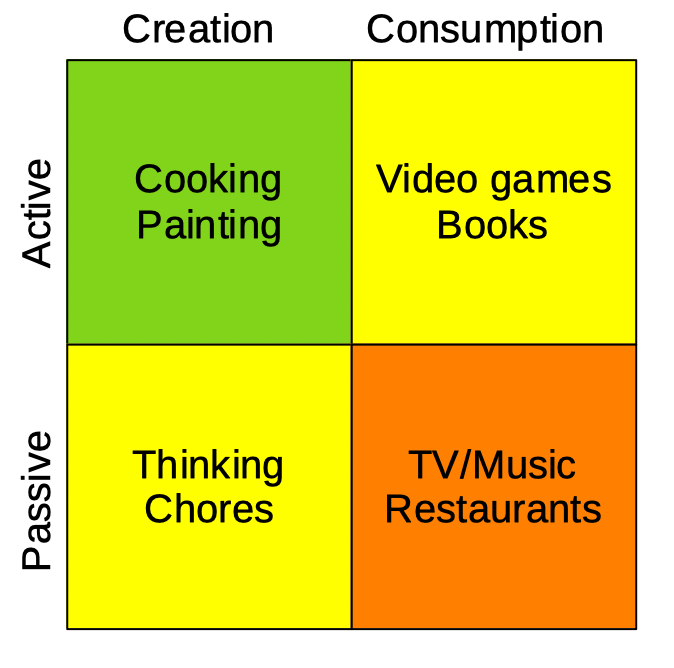
All voluntary human activities fall into one of four categories:
Active Creation (Cra): activities that require direct engagement and production.
Active Consumption (Coa): activities that involve using someone else’s creation, but still require direct engagement.
Passive Creation (Crp): activities that are either a secondary component of active creation, or prerequisites/maintenance activities to support active creation.
Passive Consumption (Cop): activities that involve using someone else’s creation in a manner that is strictly self-indulgent.
These activities are not equal in value. Cra is the highest, with Coa and Crp secondary, and with Cop the least.
As an example, washing dishes and doing some reading rank above watching TV all day, but rank below cooking dinner. Coa and Crp ultimately support Cra – without which Cra couldn’t take place, while Cop remains generally nonconstructive outside some mental health benefits. Obviously these baselines require some interpretation. I’d consider reading a classic novel to be Coa but reading a trashy romance novel Cop – one must be honest with themselves.
This is all fine for abstraction, but let’s quantify. What constitutes a day seized? At what point does one achieve virtue for the day? I’ll assign values:
Cra = 5
Coa = 3
Crp = 3
Cop = 1
This almost works with a Fibonacci sequence. Indeed, Coa and Crp could probably have tier 2 and 3 pointed subsections, but I’ll keep it simpler for the sake of this exercise.
Virtue = Cra + Coa + Crp + Cop
Day’s value = amount of daily virtue.
As for a daily virtue benchmark, here are the highlights from a recent Saturday, which I feel was a notable example of one such virtuous day. I…
Made pizza, made my own cheesey bread, cleaned the kitchen x3, cleaned out the fireplace, started a fire, watched Fallout, took measurements and material inventory for needed house projects.
I’m sure there were more, but these are what I remember. This would come out to:
5+5+3+3+3+3+3+1+3 = 29
It was a busy day, so lets round down to 25 to be more realistic with goals. A virtuous day requires 25 points. For a day off. As for a working day, let’s say 12 – half rounded down.
Now math:
Cra=5,Coa=3,Crp=3,Cop=1
S:=Cra+Coa+Crp+Cop
O = day off
V = day is virtuous
V⟺(O∧S≥25)∨(¬O∧S≥12)
Not having a philosophy background, the concepts of virtue and excellence seem to escape the kid’s comprehension. Maybe this could add context. If not, it’s a good overview and reminder to myself for when I start to feel lazy, now that I’ve thought the concept through. Virtue is universally available. All we have to do is act towards it.
Now that the existential threat as outlined in Part 1 is completed, let’s have some fun. Actually, that’s debatable, as this second journey was somewhat unpalatable in its own right.
I say – would you like a cookie?
To summarize, a female specter visited me in a dream which would have inevitably led to my death (dream death (would that kill me physically too?)). I would normally assume that this was just a random machination from my subconscious. But on the other hand, such a vivid image of a person’s face that I had never met has never occurred before in my dreams. So I proceeded with concerned curiosity, rather than just move on.
To be fair, my mental stability has long been a source of question. At some point the internal monologue became external…in the form of hand puppets. Whippet hand puppets. So this event must surely be a transitioning point. Or perhaps transcendental!
Oi sir! Would bloody love me a good cookie!
But for now, it’s merely an opportunity for exploration. Here’s the question:
If my mind can create people that don’t exist, and Generative AI can create people that don’t exist, then can AI recreate the person in my head that doesn’t exist, which I originally created, into a visual facsimile?
You might think that this is a bizarre an uncanny path to go down. And you would be correct. Here goes!
I had never before used AI for this, and I started rather basic. I asked ChatGPT to generate an image of a redheaded woman in her mid 30s. That seemed like a good baseline. What it gave me was indeed a recognizable female with the proper hair color, which looked like a lawyer character from a 90s TV drama series. In other words, she did not look like someone who was about to kill me in a village ritual. She looked like a mother – someone you’d run into shopping at Target, buying slacks and unscented deodorant. Not that I generally shop at Target, but you get the idea. And that minor smile! It was like a business portrait one would put on their Teams profile. There was nothing scary about this at all. Yes, I will accept your meeting invite to discuss the potential fraud loss benefits and improved user experience if we implement authentication enhancements into your product.
VP, Credit Products Manager of Something
No quite. So what continued was a far too lengthy process of me feeding nebulous adjectives into AI, like I was an eyewitness trying to help an investigator sketch a suspect’s mugshot. “Darker eye shadow.” “Slightly younger”. “Redder lips.” “Fewer wrinkles.” “Messier hair.” “Shorter hair.” “Shorter face.” “Smoother neck.” The outputs ranged from Target Mom to Crack Junkie.
It then occurred to me that this would probably be the future of online dating: Generate some form of an idealized look, then let AI search profiles and line up matches. I felt something die inside me, doing this exercise. I was creating a person that didn’t exist based on designated parameters. And the results didn’t even fall into uncanny valley territory. One day, we as a lonely people, will build android girlfriends this way.
Fortunately for me, I won’t ever have to go through that. No – I was building a model of a memory of a nocturnal tormentor that my mind had created to kill me. That might not sound more well-adjusted, but I think it is.
In the end, the final directive was “Make the eyes more intense.” No really. And it worked. The smile disappeared and the stare turned into something half vacant/half soul-piercing, with just a hint of murderous intent behind a thinly-veiled welcoming interest.
The end result was almost spot on.
This was maybe a curiosity that should have been left unexplored. My own subconscious, which knows all my fears intimately, created a female alchemical homunculus as an object of death, the details of which I’ve now fed into the internet, and which AI was able to flawlessly replicate on demand.
This is what happens in the winter when I can’t go outside to garden, and the shortened days lead to too much introspection.
Most dreams are nightmares. Presumably, when central command shuts down for the night and the brain enters maintenance mode, it’s an opportunity to run disaster simulations and generate contingencies. The trouble is, my dreams rarely generate anything much grounded in reality, and tend to dwell on bad memories instead. All that accomplishes is aggravating my neural sympathetic responses and giving me a bad night’s sleep. I don’t need a reminder of prior bad jobs or states of anxiety.
Common themes include:
I have to go back to work at my college job.
I have to go back to work at my former call center job.
I’m taking the final exam for a college class that I’ve never attended.
I’m trying to find my way through an urban maze, towards some undefined objective, and timing is critical, and I’m lost.
I’m supposed to do something somewhere, and I don’t remember either.
Gone are the days of being hunted by some unearthly monster. At least those were entertaining to some degree. It would appear that once the individual adds life experience to their memory banks, terrors move from the abstract to the contextual.
Additionally, at least in my case, characters in dreams become either people I’ve known or nebulous humanoid entities. I don’t create identifiable people from scratch. If my dream needs a background extra, it’s just a bipedal form, all the while the main characters are past friends or current co-workers, usually delivering bad news in unlikely conditions.
But recently, for the first time that I can remember, a woman I’ve never met appeared in a dream. And she had striking features. I had created a mental image of a person I didn’t know.
The story is as follows:
Yeah, every time something good happens to me in a dream, either I wake up or the dream turns into a nightmare.
I received a notice from some organizational body that I’d inherited property from my late grandfather, in Pataskala. It would not turn out to be on the old family farm. It turned out to be a house – a variant of Frank Lloyd Wright’s Fallingwater – on the rocky banks of a creek, in an unnamed hidden community in some invisible valley. Sounded kind of cool so far.
I spent some days fishing, but noted increasing hostility amongst the neighbors. Eventually, I was summoned to a town meeting at their community center. Once there, I was informed that ordinarily new initiates had to undergo a trial and rite of passage to join this village, but because my grandfather passed his citizenship to me upon his death, I was exempted. What this community was or what the right of passage involved was never clear. I was reluctant to join as a result of this, combined with the general bad vibes I was getting.
Then She appeared – and escorted me to a secluded corner of the building, and sat next to me.
[And now we take a break from this story.]
I jest often about having an infatuation with redheads. True, my earliest years with confusing romantic obsessions involved some of them, but they were hardly the majority. However, the most emotionally intense experiences in those formative times were, coincidentally or not, with redheads. Ergo, classical conditioning has made the permanent association, even though, objectively, those were not good times!
It would seem that as the individual ages and the power of daily emotions fade, the mind still refuses to let go of those moments when we were capable of powerful emotional responses, and it even lies about them having been good. Logic should have me recoil in terror when I see a redhead. Stupid amygdala.
There’s the necessary background for the rest of this story.
[And now back to the story.]
So what did my subconscious manifest for this powerfully strong female presence in what appeared to be turning into a version of Shirley Jackson’s The Lottery? Yes, I knew I was going to die someway terrible, and yes – my courier to the eternal beyond by way of undoubtedly horrific violence would be…a redhead.
Then she put her leg on mine and her arm around me, leaned in close, and whispered comforting words. In a voice that said: “these aren’t comforting words”. Something about this being my place and they were welcoming me in and to give it a try. I protested, mentioning I lived elsewhere and that I had a wife – a very reasonable response rather well grounded in reality to a situation that was anything but. I appear to be boring even in my own delirious mental creations.
Unconcerned, she said that she knew, and to invite her up to the conversation. As in – not that she should drive in. She was already there. In the basement. And she was! Downstairs with some other unwitting victims, sitting on a couch, watching TV, and sipping tequila. Tequila?! Happily, Liz waved to me and pointed to the liquor. And she was wearing another man’s trenchcoat. They had gotten to her already!
Then I woke up.
Heart racing from that ordeal, I began my day in a somewhat rattled state of mind. Then the dream faded from thought, as they all do eventually.
The next day, I lounged on the basement loveseat for the day’s first conference call. It was a division meeting and was two hours, so while awaiting my direct team’s updates and the caffeine to kick in, I dozed off. An offscreen presence appeared directionally behind me somewhere, in the back of my head. She was back! She started to say something but I violently jolted awake.
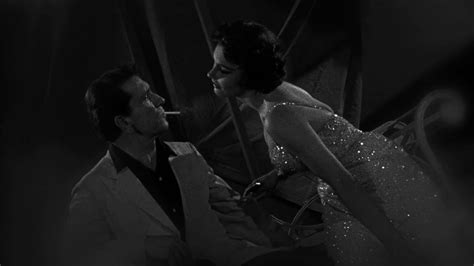
There’s a Twilight Zone episode “Perchance to Dream”, wherein the protagonist episodically dreams of a phantom woman who lures him into exciting activities. As he has a heart condition, he knows that this repeated stress will kill him. So he attempts to stay awake. Things do not work out well for him.
I don’t think anyone’s conditioned from a young age to enjoy clothes shopping. For many, if the cruelty of the hand-me-down experience can be avoided, the alternative is to accompany mother to a store no one wants to be in and waste an entire weekend day arguing over style preferences and cost. The end result is inevitably a wardrobe that’s strictly utilitarian, and doesn’t encourage much in the way of self-confidence.
As an adult, this retail experience is just as bad. My generation may have been raised with digital technology, but it wasn’t always there. The current younger generations weren’t merely raised with it, but fully assimilated by it. Consequently, I notice that they tend to navigate the physical world in a state of non-associated delirium, often blocking entire isles for no apparent reason, because whatever’s being fed into their wireless earbuds has overwhelmed their cognitive processing power, leading to a bodily shutdown. The best case scenario is that they’re a customer, which merely presents a physical obstacle. At worst, that’s the store employee whose attention you need to flag down to complete a transaction. But at least with this group, their response to any forced verbal interaction is general indifference.
A worse group to have to deal with in public is boomers. As customers, they exhibit similar behavior as physical roadblocks, but it’s because their brains have just atrophied naturally. They didn’t need the technology to shut them down, though that doesn’t stop them from trying. If said boomer is also trying to multitask with technology at this moment, well, you’re never getting down that isle. And if the boomer is the store employee, prepare for spontaneous anger and condescension.
A millennial – my generation – tends to want to be as small and invisible as possible when in public space. Just let me shop without attitude. And if the millennial in question is the store employee, well that scenario is increasingly unlikely, because we’ve done everything in our power to avoid that type of work, up to an including suicide. Because when we had to do it, all the customers were boomers, and that relationship collectively broke our souls.
As a millennial, here’s a typical in-person shopping experience:
Employee is a boomer = transaction is outright hostile, always.
Employee is a millennial = unlikely scenario.
Employee is a zoomer = transaction is dismissive or hard to complete at all.
But there’s more to this than generational differences. People, being inherently shallow, immediately judge if someone’s worth their time to interact with. An employee, being forced to interact with customers, modifies their approach to hasten or prolong the transaction based on this superficiality. Specifically, it’s saturated with gender bias, which can’t be escaped when shopping with one’s spouse. If the couple in question is not conventionally attractive (which, to be honest – we’re middle aged now and not terribly athletic, so take that for what it’s worth), here’s the experience:
Employee is male = (looks at the wife of the couple, assumes the man has no taste in nice clothing), transaction is dismissive, or, in my own personal experience, avoided by the employee at all costs.
Employee is female = (looks at the wife and husband as a unit, assumes the man has little money), transaction is completed with a heavy dose of suspicion.
Mix these categories into all their possible combinations, and it adds the anxiety of not knowing exactly how the employee will make the experience unpleasant, but it definitively will be.
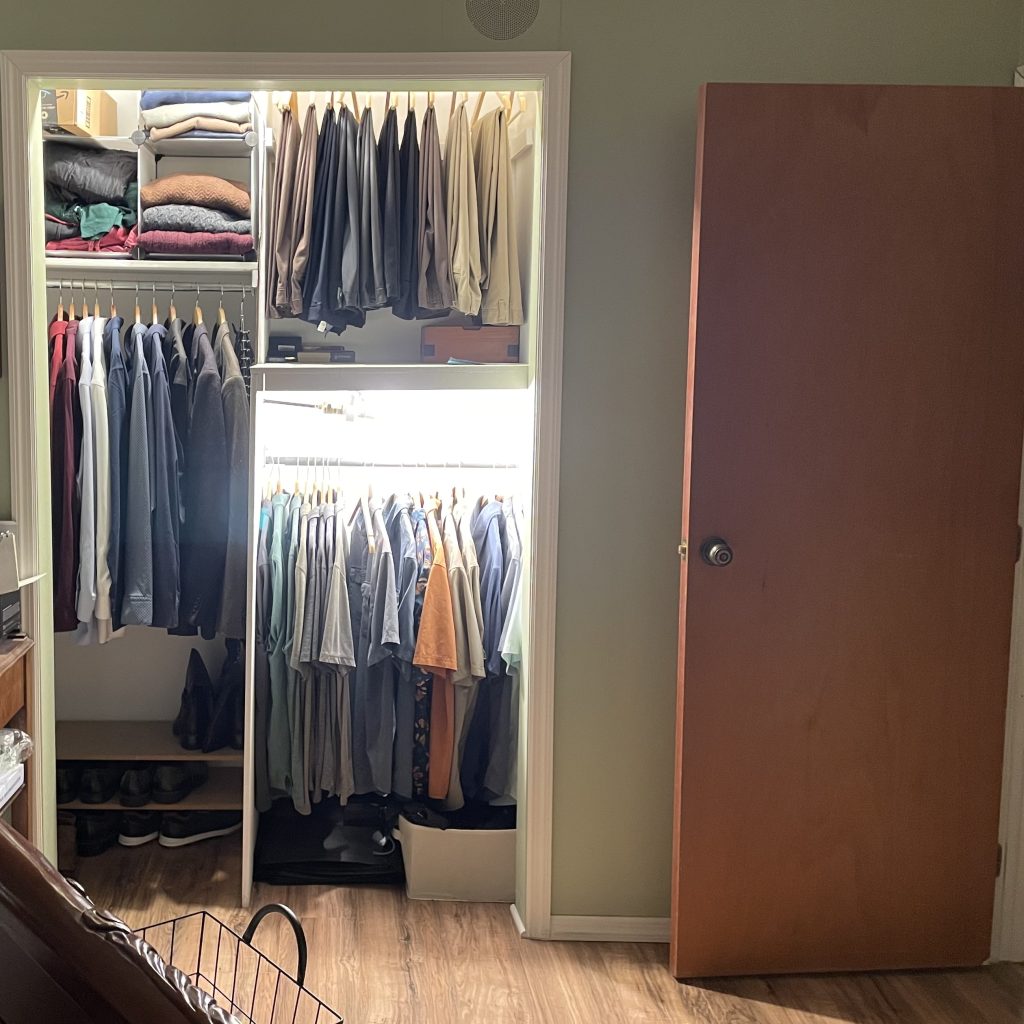
Fortunately, technology – the force destroying both older and younger generations – has once again come to the rescue for a millennial. Mail-order clothing based on user surveys, combined with style recommendations derived from user preference, has delivered unto me designer brands that I would never have considered purchasing before. And now, I have a very nicely-stocked wardrobe, obtained without horrible customer service!
Oooh, look at that closet!
While I have utmost empathy for the service industry worker, there’s something specifically unique about the clothing industry. It’s even worse than the automotive dealership, which in itself is not known for impartiality. Every time a clothing outlet closes nearby, I remember a bad experience and laugh. This is a retail nightmare that can go away, and I’m perfectly fine with being blamed, as a millennial, for one more thing that we’re killing.