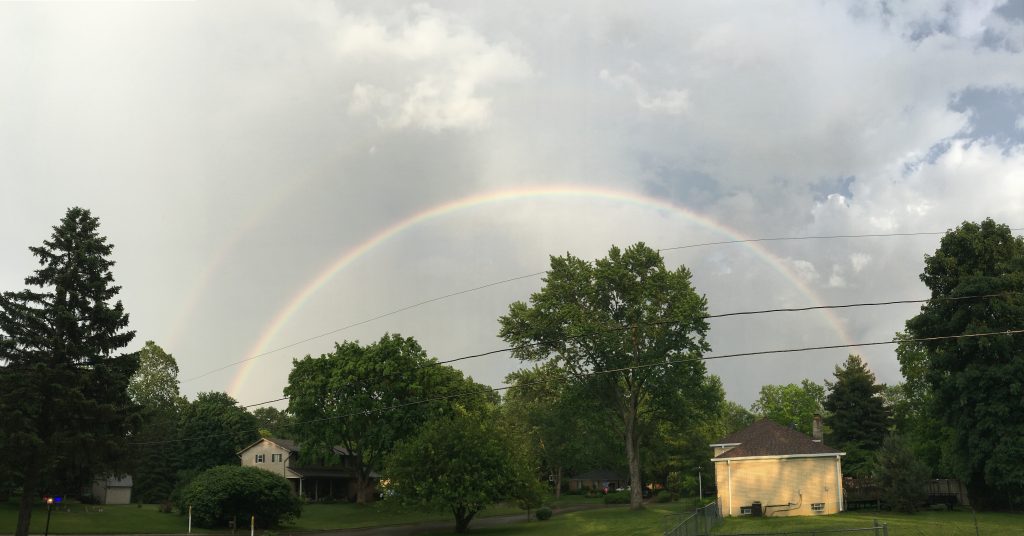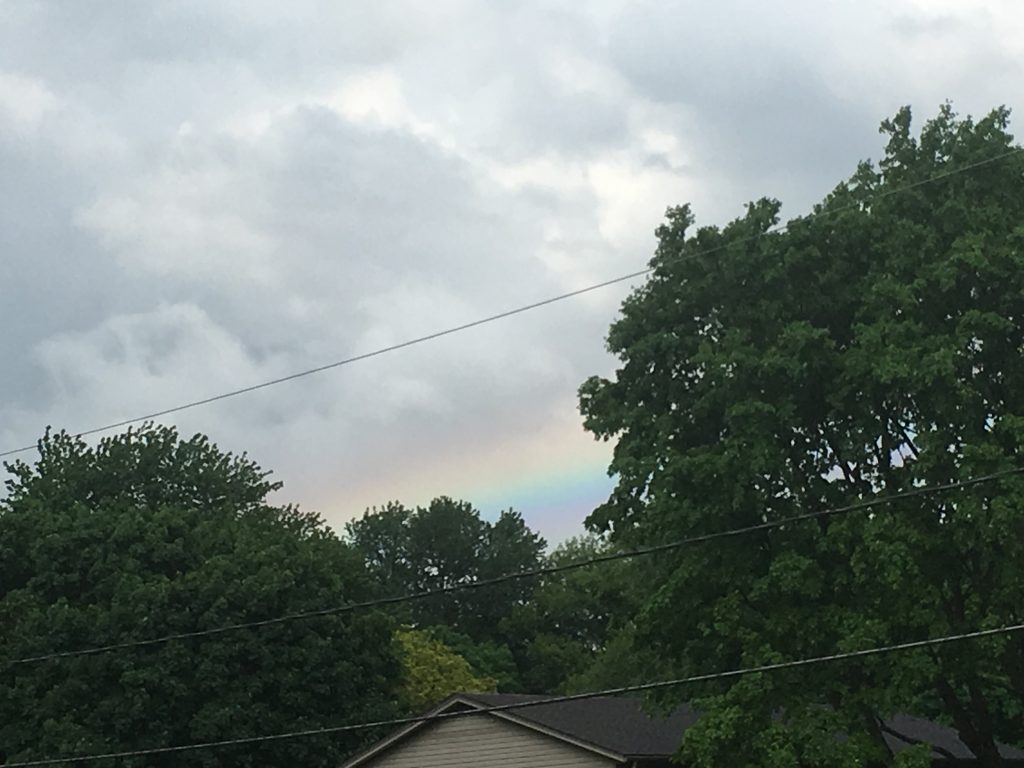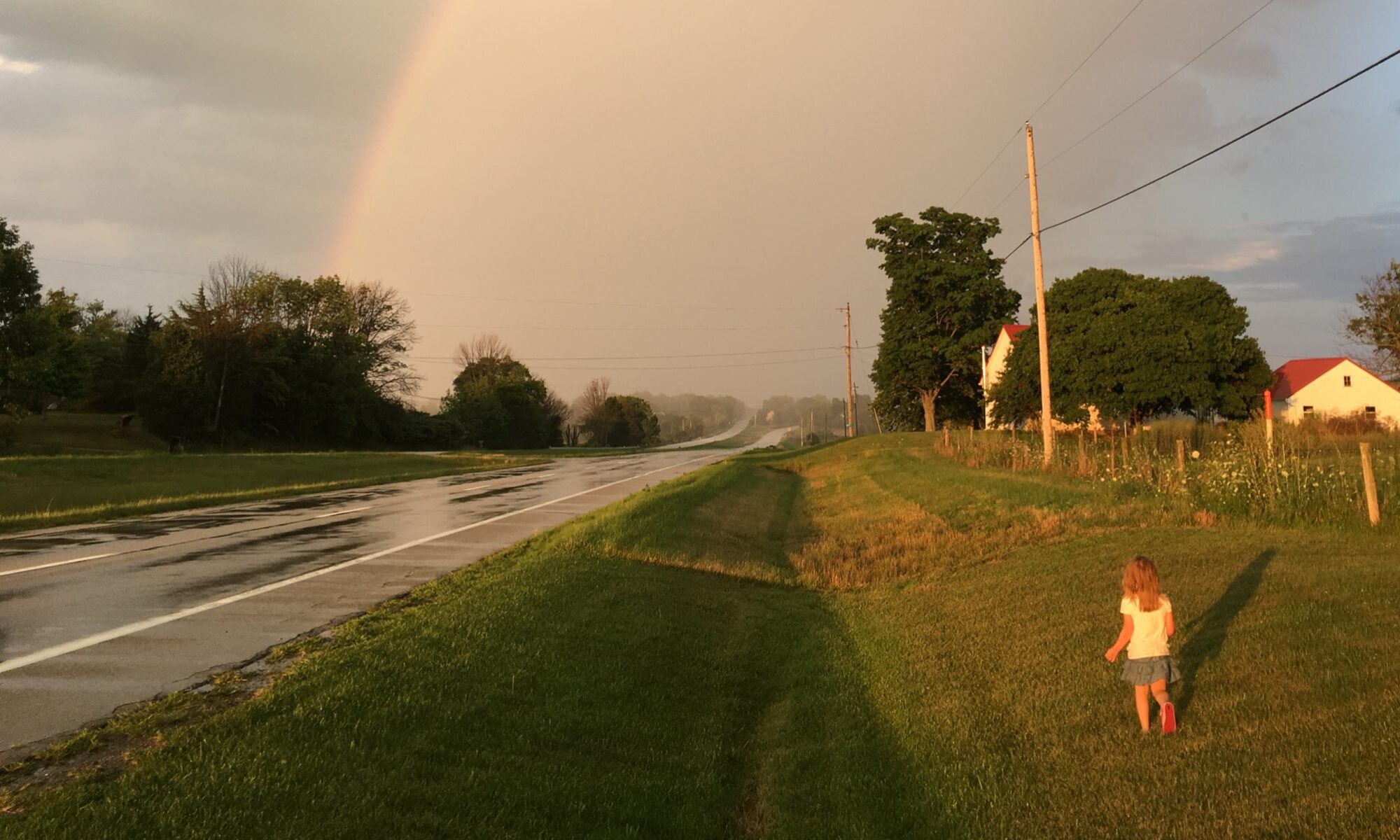
Alas, we’ve received our first Spring rainbow. It isn’t epic–it’s humble and modest, yet bold in stature. Unassumingly low on the horizon, but wide.

–Simon

Tales from Easement Acres
Alas, we’ve received our first Spring rainbow. It isn’t epic–it’s humble and modest, yet bold in stature. Unassumingly low on the horizon, but wide.

–Simon
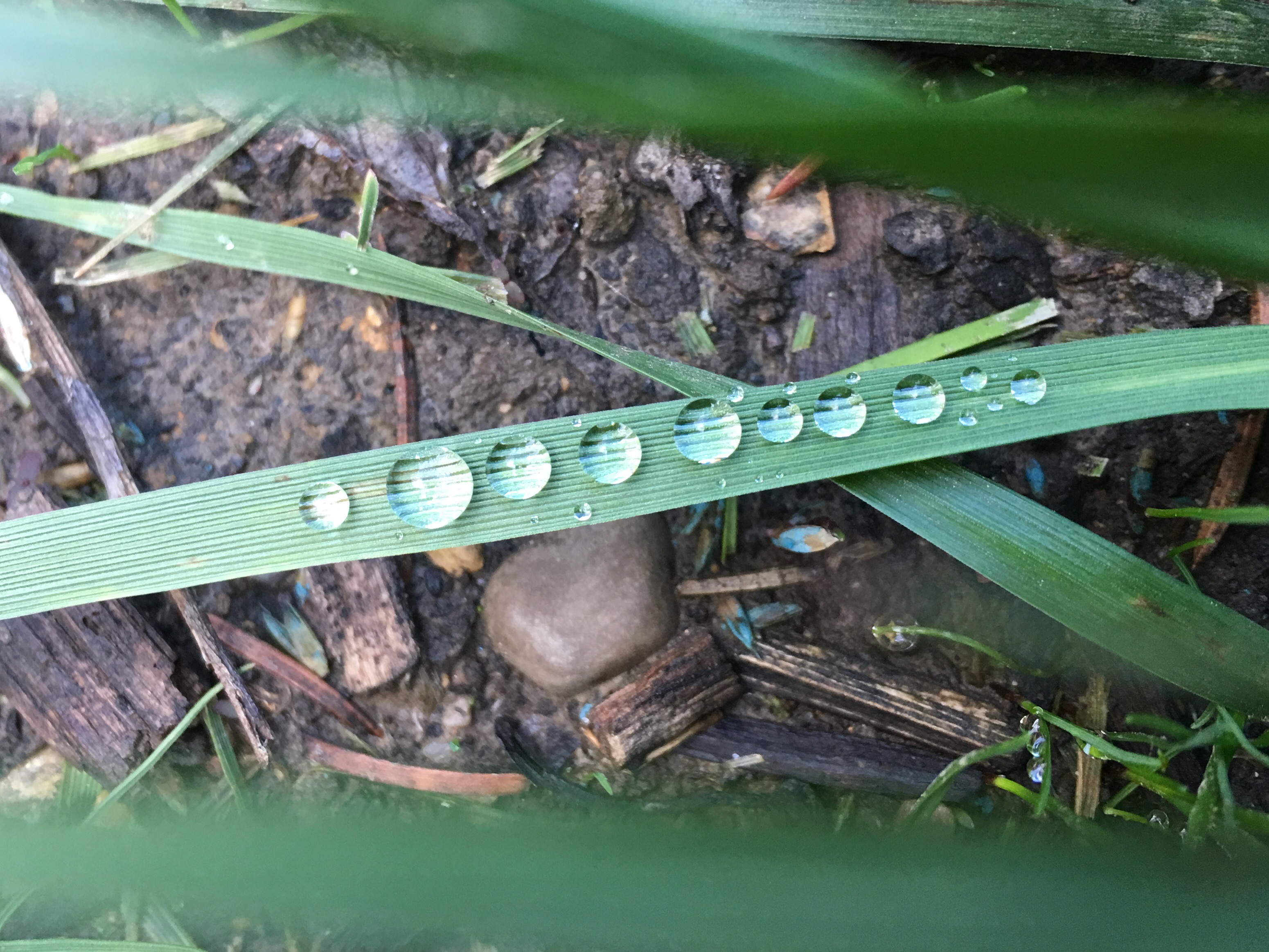
The uniqueness of this molecule is undisputed, from its polarity to its illogical density/temperature relationship. And as I peered down from above, upon this microcosm of natural beauty, I contemplated how such random perfection could allow the genesis of terrestrial life.

The organization and order, juxtaposed to the surrounding chaos!
Okay, it’s just water, but it sure looks cool–enough so as to warrant its own post.
Incidentally, I later researched motion-activated sprinklers in my ongoing non-confrontational cold war against the neighbor and his children.
Water!
–Simon
A colleague recommended the Netflix original Black Mirror. So far, it’s be an incredibly disturbing set of Philip K Dickian-type stories involving humanity’s failures with using their own technology responsibly. And “disturbing” might be a bit of an understatement. I find them to be haunting, like the stuff my subconscious latches onto in order to feed me back nocturnal hellscapes.
So I found the show’s title to be aptly named, as I assumed it was an allusion to “through a glass, darkly”. Despite my growing aversion to organized religions, I can’t escape my exposure to it during my youth, and I had remembered the Bible verse.
![]()
Of course, I didn’t remember where exactly, so curiosity won out and I resorted to the Internet to fill in the information gap. Turns out it’s from Corinthians 13:12. I walked to the bookshelf and retrieved a bible (something we’re certainly not short on–there were 3 (why do we have 3 Bibles?)).
“For now we see in a mirror dimly, but then face to face…” Wait, what? That’s not right. I shelved the Bible, scoffing at its translation. The power of culturally-significant prose can invoke strong contempt when modified, just as my copy of The Divine Comedy pissed me off when I realized it was a more contemporary translation. You can’t do that!
So I pulled out my copy of the Oxford Study Bible, complete with the King James’ omitted texts:
“For now we see only a reflection as in a mirror; but then face to face…” That’s not right either. What the hell? The mystery deepened, and out of stubbornness, so too did grow my resolve.
Eventually, I found a site with the translation I was looking for, and as it turns out, the verse so well-known had been King James’. Go figure, that the version everyone knew was that of the most ubiquitous translation. But this begs the question: why were there so many different translations? The site I found offered over 20. I compared them:
My problem is that a text so important to people that they use it as a moral guide, maybe shouldn’t be translated so lightly. I realize that the attempt is to give an ancient writing modern context, but in so doing, we modify its very meaning. Stop it!
Maybe the glass was just dirty and needs to be Windexed.
–Simon
It is the end of the Faye era.
Faye–whippet prime, succumbed to a digestive problem and had to be euthanized. Being unable to absorb a critical protein, her muscle mass wasted away until she became immobile. It was heartbreaking to watch, as up until the end, she wanted to be a whippety whippet and go running. But as the pain eroded her humor and patience, the whippet we knew had already started to depart.
I buried her during a week of record-breaking rainfall, which seemed appropriate, alongside Tori, who had just passed the prior autumn.

Faye was a symbol, that Liz and I were deliberately choosing a life together. We moved into an apartment, and shortly thereafter purchased Faye. At the time I had no idea what a whippet was, but it sure set a precedent. Faye was amusingly regal at times, yet still doggy at others. And when the kid was born, an innate and deeply-buried instinct kicked in and she became the family guardian, growling at people she didn’t know.


She moved with us through three apartments, and finally got the house and whippet patch she deserved. The timing was fortunate, as we can now lay her to rest in her own land.
So long Faye. Say hi to Tori.
–Simon
I hate what the information age has done to information. By democratizing its access, we’ve devalued it entirely, which in turn has rendered its pursuit a non-viable economic model. Instead, its value is now determined by aggregation. The facts themselves are now worthless, but if one has enough sheer volume of facts, then they can drive traffic and by extension, capitalize upon secondary ad revenue.
So with the information itself demonetized, no incentive exists to analyze it–just to present it in a quickly digestible form. The result is the same sub-1000-word article on every website. Any academic value it originally had is diluted by this copy-paste method. No one’s vetting the research, and very few are doing any original research.
I encountered this phenomenon while indulging in a casual curiosity. The Super Bowl was playing, and there are few things I have less interest in watching, so I ate a can of sardines. (I forced the child to try one for the character-building experience).
Delicious fish having been consumed, I was left with a can of oil. I recalled hearing that the fish/olive oil made a good base for an improvised oil lamp (of course it would, seeing as that was the primary purpose of originally harvesting olive oil, which was a major step for humanity towards achieving ubiquitous and affordable artificial light–facts apparently lost to history). So I rolled up a piece of paper towel into a wick, stuck it in the can, and lit it. And, unsurprisingly, it burned with the steady flame of an oil lamp.

As I watched the flame, I wondered where I had read that article, who’s purpose was to list the unconventional sources of lighting one might find in their kitchen, for use in an emergency. So I took to the Internet.
And this is where I became irritated with the scenario outlined in the first two paragraphs of this post. I wouldn’t have much considered that the lists contained the same substances. After all, there’s only so many combustible liquids in a typical residential building. But what grabbed my attention was that every article added in the little quip about how burning the sardine oil would make the house smell like fish. That was because, it didn’t. The little flame is insufficient to bring the contents of the can to the volatiles’ vapor point, and the oil that was actively combusting was heated to the point where anything which would have smelled was denatured. It was a clean, odorless lamp.
This indicates to me that the original author of the article probably put in the humorous aside, meant to be nothing more than a small joke, and was subsequently copied as a priori fact by content harvesters looking to add information to their own catalogues.
So for fuck’s sake people, do a little bit of original research.
It also bears mentioning that the sardine lamp burned out sometime after I had fallen asleep, so you do get several hours’ worth of illumination from it. And the sardines were good.
–Simon