Joe and I were after a new coop game. I still don’t understand why coop games are so difficult to find. That is, coop campaigns. I’ve shot Joe in the face so many times that continuing to do so would just seem wrong. And while his cries of anguish remain a fond memory, the thrill has cheapened with time, and our collective advancing age. Besides which, every game supports some form of competitive multiplayer now, so while shooting Joe might bring a personal note to the violence, the violence itself is rather devoid of meaning and novelty. I therefore don’t consider this latter game mode to be true multiplayer.
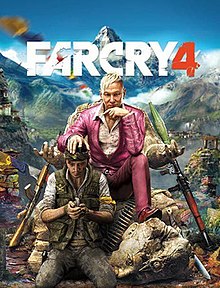 We debated our usual assortment of options, even considering Star Trek Online again. But ultimately, we settled on Far Cry 4–a game Joe had beaten, but I had not. In fact, I had never even played a Far Cry game before, so why not? I purchased the title for $40 (still too high in my opinion given its age), and drank bourbon while I watched the download progress (Yay for the recent 100Mb/s bandwidth upgrade!).
I booted the game and looked for the multiplayer option. As it would turn out, coop mode doesn’t include the main story, but rather all the little side missions. Ah well, at least we had something new to do. But first, I was forced to advance a character far enough into the single-player campaign in order to unlock the coop option. Sigh. I hate when games do this.
[SPOILERS]
So I begin as a Nepalese tourist on a crappy bus in the mountains, carrying out my late mother’s last wish to have her ashes spread in her homeland somewhere. Okay, the game uses a fabricated country for the setting, but the fact that it’s a small country in proximity to the Himalayas makes it more or less Nepal. And really, it doesn’t seem to matter anyway.
I ride in the stinky bus, alongside some stinky locals with a stinky monkey. Our arrival at a military checkpoint raises concern amongst the other passengers. The stinky guy next to me suddenly asks for my passport, and unquestioningly I comply. I admit–I’ve never traveled abroad (Canada doesn’t count), but I understand that it’s bad to lose one’s passport. In fact, people are prevented from leaving a country, pending legal inquiries, by having their passports confiscated. And I doubt that there’s an American embassy in this pseudo-Nepal, so I really think it’d be a bad idea to hand my passport over to some stinky dude I just met on a bus. But, I’m denied the option to exercise my better judgment.
Stinky guy overtly places bribe money in it, and passes it up to the stinky bus driver as he disembarks to discuss his passage of the stinky bus. An argument ensues, for reasons of which I’m not entirely clear. The stinky bus driver pulls a pistol and shoots two soldiers, which seems like a grand idea. As expected, he’s instantly mowed down by automatic assault rifle fire. Serves you right, stinky bus driver.
What’s not expected, however, is that the soldiers then start hosing the bus. Despite my protestations that I don’t know any of these stinky fuckers, they fire on me as well. Against my will, I find myself in bed with stinky fuckers.
I crawl out the back of the stinky bus with stinky dude–the guy who took my passport, flop onto the ground, and am apprehended but not immediately killed, despite the soldiers shooting at me moments ago. Held at gunpoint, I watch as a helicopter lands and David Bowie disembarks. Obviously, his unconventional haircut and purple/pink silk or leather suit (it’s hard to tell the fabric for certain with the graphics), identify him as the ruling despot of the land.
He immediately demonstrates his despotism by having a calm discussion with one of the soldiers about why he was shooting everyone when he was being instructed to stop. His excuse: “Things got out of hand.” No, that’s what you say when you go overboard on a home renovation project and have to explain the state of the kitchen to your wife. That excuse does not apply when you murder a bus’ worth of people (even if they were stinky).
David Bowie, however, calls him on this bad excuse by stabbing him with a pen knife repeatedly. Blood and cries of agony ensue. David Bowie then hands me the pen knife (only then do I realize there was no knife part–it was just a pen–pretty hardcore), and tells me to hold it while he then has a chat with stinky dude. David Bowie and stinky dude obviously are at odds, and stinky dude is hauled away to some unpleasant fate.
Still uncertain why I’m holding a bloody fountain pen, I wait patiently while David Bowie concludes his business and then invites me to dinner. That’s a hard offer to refuse, really, and not because I don’t have a choice. I’ve seen enough James Bond films to know that despots really enjoy the finer things of life, especially when that involves showing other people their accumulated wealth. And I–me, Simon–would readily take any despot up on his offer for dinner. I don’t know who’s going to die afterwards, but I sure as hell know that the dinner itself would be fantastic!
In short order, I find myself an honored guest at a table with a fantastic view. I also note that stinky dude is sitting next to me. Apparently he’s part of a rebellion and David Bowie wanted to taunt him some more. Stinky dude sends a text message for help and David Bowie catches him, mocks him some more, and has him dragged off for torture. David Bowie also fondles my mother’s urn and tastes her ashes, alluding to them having been lovers in a not-so-subtle way. Please let it be so! If David Bowie is my father, then I can inherit all this despotism!
An attack begins, and David Bowie leaves to oversee the defense, giving me instructions to wait for his return. I would, I mean, I certainly would wait were my character really me, but it isn’t and I’m trying to advance the story far enough to unlock coop mode, and besides, I want to shoot something.
So I work my way downstairs to the pleasant sounds of stinky guy being electrocuted, then the rebels burst in and have me taken away in a truck really fast while I spray the landscape with uzi rounds. There’s a crash, I’m separated and alone (a common game plot device), and my driver lies dead beneath a tree (maybe not so common). Then began the tutorial phase, yay.
Tutorial phase is designed to show me all the game mechanics, like sneaking, stabbing, throwing raw meat at bad guys so that wolves will show up and maul them–you get the idea: basic combat stuff. There was a point where I tried to kill a lion trapped in a cage with a throwing knife, but the knife only succeeded in breaking the cage door so the lion was free to attack me. There was a point where an errant grenade killed me instantly. Then I fell off a tower and died. An eagle attacked me. I made an elephant rampage by throwing things at it…
In short, almost none of the combat was really believable, but it sure was funny. Once coop mode had been unlocked, we ravaged the landscape, killing every David Bowie follower we saw, blowing up trucks, driving vehicles at unsafe velocities–interrupted only by moments when I disembarked to shoot deer with assault rifles so that I could collect enough hides to make a bigger backpack.
It’s a pity that I can’t advance the campaign in coop, but the mischief we can cause endlessly in the open world aspect is akin to a team-based Grand Theft Auto rampage. I culminated the evening by trying to bail out of a helicopter onto a tower so I wouldn’t have to climb the stupid thing, but failed and instead plummeted once again to my demise.
Conclusion: this game is fantastic. However, perhaps not by intent, I find myself completely apathetic towards the locals’ plight, and somewhat enamored by the antagonist. I feel we have a mutual respect, he and I. I murder all his minions for entertainment, and he watches with amusement. I guess I just never knew how awesome David Bowie could be.
–Simon