
About two years back I planted sunchoke tubers in the forage patch. I caught on to the idea after reading some random gardening article during the height of the Ohio winter season and thought that they sounded like a good idea: native, low-maintenance, pretty flowers, edible tubers, perennial. What’s not to like?
They were also amusingly absent from any commercial catalog, so I had to source some from a fellow gardening nerd. They cleared postal inspection, unlike the black bean seeds my sister tried to send me, and I dutifully plopped them into the ground come early spring. A few plants grew, but I decided to wait an extra year for them to fill out before attempting a harvest.
After two years, they had spread quite nicely.
Now that the growing season is concluded, I wanted to try them. So I shoved a gardening pitchfork into the partially frozen ground at the edge of the patch and ripped up a mass. A surprisingly large mass, in fact. It would seem that they spread quickly.
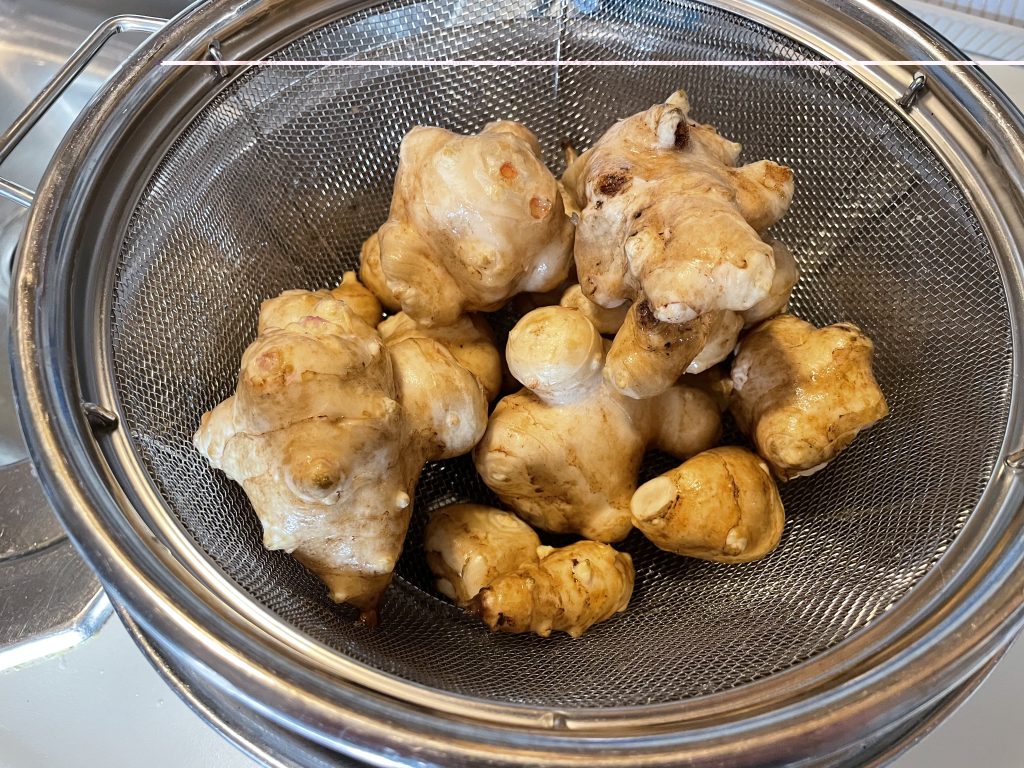
Internet knowledge states that they can be cooked like potatoes. So Liz roasted them. And they were tasty – like an earthy parsnip. But, there were consequences.
Sunchokes store their energy in a carbohydrate very different from potatoes, specifically inulin – a polysaccharide. Polysaccharides cannot be digested (a notable exception being lactose, a disaccharide, though we all know isn’t a universal exception). Potatoes, on the other hand, consist of starch – also a polysaccharide, but upon cooking, breaks down into amylose and amylopectin, which are easy to digest. Inulin, however, does not fully break down into monosaccharides upon cooking, resulting in a food comprised of indigestible carbohydrates.
This leads to large amounts of food for gut bacteria, which ferment inulin into….gas! Lots and lots of gas!
So some more cooking research is needed to work around this better. Or…we eat them raw and have a juvenile fratboy-themed competition on the deck!
–Simon