
[Note to self: add this to the Quantitative Philosophy Index when it posts]
Remember those times when eating at restaurants was fun? I had attributed this to a combination of not having to eat mom’s boiled vegetables and not possessing any financial knowledge of a restaurant’s expense. Childhood, in essence, was the best time to eat out at restaurants.
But now, it’s usually disappointing. And there are so many more dining options out there than what was available to me as a kid! There has to be more to it.
So I sat down and compiled an arbitrary list. Here goes:
Given that the experience quality is defined by 5 operators:
- (A) Base cost of restaurant food
- (B) How much I’m expected to tip
- (C) How good I am at cooking
- (D) Novelty of eating at a restaurant
- (E) Perceived quality of restaurant food
Then:
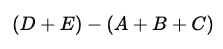
D+E-(A+B+C) = Quality of the experience.
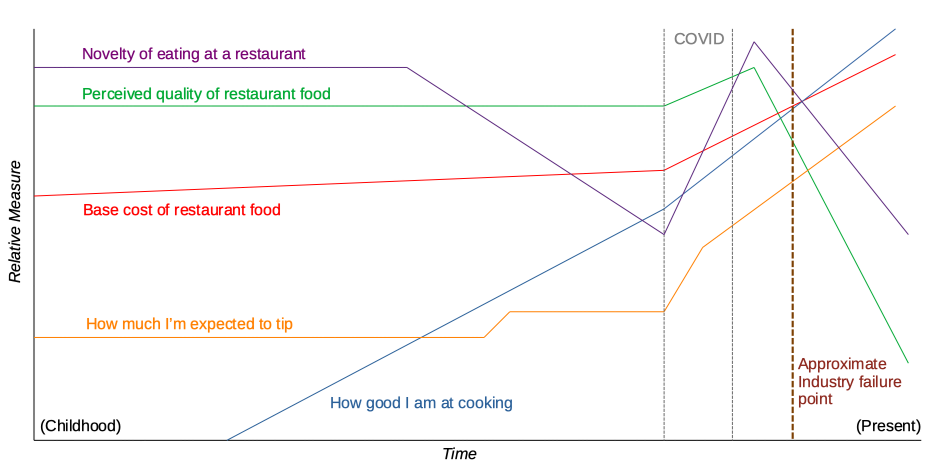
As these are mostly relative measures, attempts at quantification prove difficult. This approach also fails to represent why restaurants were fun before but suck now. No – a timeline representation is needed for this one:
Now I’ll point out some observations having thought back through this timeline:
- The novelty of eating at a restaurant started high as a child, then declined as an adult as I could make the personal choice any time I wanted. This trend continued until COVID lockdowns, when the option was taken away, peaking after places began to reopen, following a drop to prior levels.
- The perceived quality of restaurant food again started high as a child, generally maintained its allure through adulthood, seemed even better when it was less available during lockdowns, then drastically collapsed thereafter, following the industry’s maladaption to post-COVID labor costs and all that it impacts along the way. American businesses never cut profits, so restaurants instead turned to lower quality ingredients and even less-skilled labor.
- Also, to further counter rising business costs, restaurants raised prices, and very quickly indeed.
- Then, restaurants and the dining culture turned to collective guilt and overhauled tipping expectations. The tip itself, based on a percent of the meal’s cost, shouldn’t change if the base meal’s cost is increasing to offset overhead. In theory, the workers would see a proportional increase in their compensation as a result. Yet now we’re expected to give them a greater percentage, out of our own pockets. I don’t need guilt added to my dining experience, nor an additional expense to further raise the final expected cost.
- And all this might be tolerable if I didn’t know how to cook. But I do, and my standards are often higher.
That said, here’s a final observation to further drive home the point: All of these dynamic variables chronologically, mostly, intersected a couple years back, which I’ve visually represented as the “Approximate industry failure point”. This was the moment at which dining out became almost entirely non-viable for me.
Everyone will have their own version of the graph, and perhaps restaurants still make sense to some people. But unless either the quality and novelty of fine dining drastically increase, or costs go way down, I don’t see this industry as a cost-effective source of entertainment for the foreseeable future.
–Simon