Sometimes a random dinner attempt turns out perfect, and I think that yes I should indeed quit my job and open a restaurant. And of course reality sinks in and I remember that I don’t like working those hours, or customers in general. What I’d really like is to own a private supper club and compare notes with like-minded foodie individuals while mutually experimenting – oh, and to deny entry to any boomer clientele (the in-laws can come if they promise to behave). And to have enough personal capital that running such a money-hemorrhaging fantasy wouldn’t matter.
In the meantime, I’ll just have to keep my gustatory glory at home and keep my day job. Oh well. So here’s my recipe:
Top sauce:
Lemon juice
Mayo
Honey
Salt
MSG
White pepper
Mustard powder
Bottom sauce:
Browned butter
Salted butter
Procedure:
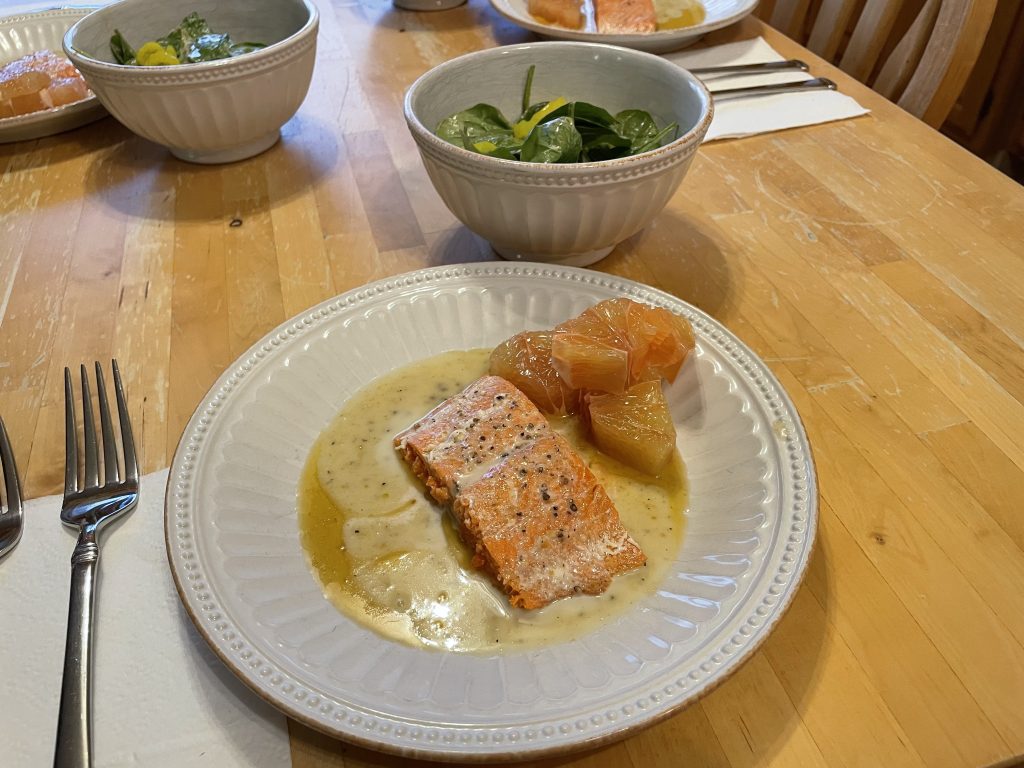
Whisk the top sauce ingredients until smooth and creamy.
Melt the bottom sauce in a steel pan.
Place the salmon (de-skinned) on the bottom sauce on medium heat.
Flip the salmon every 1-2 minutes and shake gently to coat, until the internal temperature reads 115 (see prior posts on freezing salmon properly to avoid parasites). Remove salmon and set aside.
Spoon the bottom sauce onto plate.
Place salmon on plate.
Spoon top sauce onto salmon. Top with ground black pepper.
I garnished with a pomelo, of all things, because I had one on hand that needed to be used up, but I think some mandarin oranges would also work – a sweet/sour citrus to balance the heaviness of the bottom sauce and mingle with the top sauce.
And speaking of balance – the sweet/savory combination with the mild but noticeable spice choice worked just about perfect. So perfect, that Liz said this should be a restaurant menu item. I’ll keep that under advisement while I build out such a menu for the above fantasy supper club. You aren’t invited.
I purchased food-grade poison. Technically, alcohol is just this. And also a toxin. Semantics are fun.
But in this case I refer to lye. Sodium hydroxide. I buy this every few years for clearing drains, heavy-duty cleaning, and disposing of bodies (there’s only so much room in my crawlspace).
Chemically speaking, lye denatures collagen, among other things. It also creates a highly exothermic reaction, especially when mixed with boiling water. It’s remarkably effective at liquefying human…stuff. It’s also the active ingredient in commercial drain cleaners. And purchased in its raw form, is cheap. An 8 pound bulk order would set me back about $30, though I had to find a distributor through some shady websites. This last time though, the prices were beyond silly. I know – “supply chains”, “labor shortages”, and “no one wants to work anymore”. But after some more digging, I found a new supplier for a reasonable price: Walmart Online. Go figure.
And it was only after it arrived that I discovered it was food-grade. This is in contrast to the usual technical-grade product I would normally get. The difference being, the latter has impurities that make it unfit for human consumption, which in the past translated to cheaper. But with this not the case anymore, I ended up with food-grade. Again, amusing in that it’s a poison.
But it’s not a poison in the sense that it disrupts metabolic functions. It’s a poison in that in sufficient concentrations it dissolves organic tissue. But properly diluted, its corrosive properties are minimized, and ideally suited to make flour dough brown and soft.
Which is why it’s traditionally been a key ingredient in pretzels. So no time like the present to experiment! After a couple attempts and reviewing numerous recipes, this is the combination I have determined ideal:
Recipe
Preheat oven to 450 degrees F.
Place parchment paper on a cookie sheet.
Slurry
1.2 cups water, heated to ~115 degrees F.
2 oz melted butter (Note: use quality butter here. I noticed certain budget brands (ahem, Costco) have diluted theirs. This resulted in my first attempted pretzels cracking from the increased internal steam pressure from the added water content. Unfortunately our American food labeling rules allow for some lying wiggle room estimation, so even the calorie count isn’t fool-proof. Pay extra and buy name brand. Go European – 82% butterfat content to be safe.)
1 tablespoon sugar.
2.5 teaspoons yeast (I use active dry as my go-to, and this worked fine).
Let yeast proof in the slurry while prepping the dry ingredients.
Dry
2 teaspoons salt.
22 oz (by weight) all purpose flour (most recipes specify this over bread flour, I think to avoid chewy pretzels).
Combine all ingredients and knead for ~10 minutes. Use your best judgment here. If you can’t figure this part out, then learn some more basic bread-making first.
The Poison
4 cups cold water
2 tablespoons lye
Proof
Proof the dough in a covered bowl for at least an hour. Again, this is a judgment call. See prior comment about gaining bread-making experience first.
Separate dough into 6 portions. I like this size. It’s like those big fluffy fair pretzels, except they’ll be softer because we’re using actual lye and not sissy boiled baking soda.
Shape dough. I went with the traditional string cross shape thing.
Dip dough for 10-15 seconds in lye solution. I used nitrile gloves for the added control. Also using gloves allows for some tactile sensory input. The dough will get noticeably gooey real quick. Place on parchment and repeat for each pretzel.
Sprinkle with salt. The salt will stick nicely to the treated dough. I prefer sea salt, but kosher will work. Personal preference here.
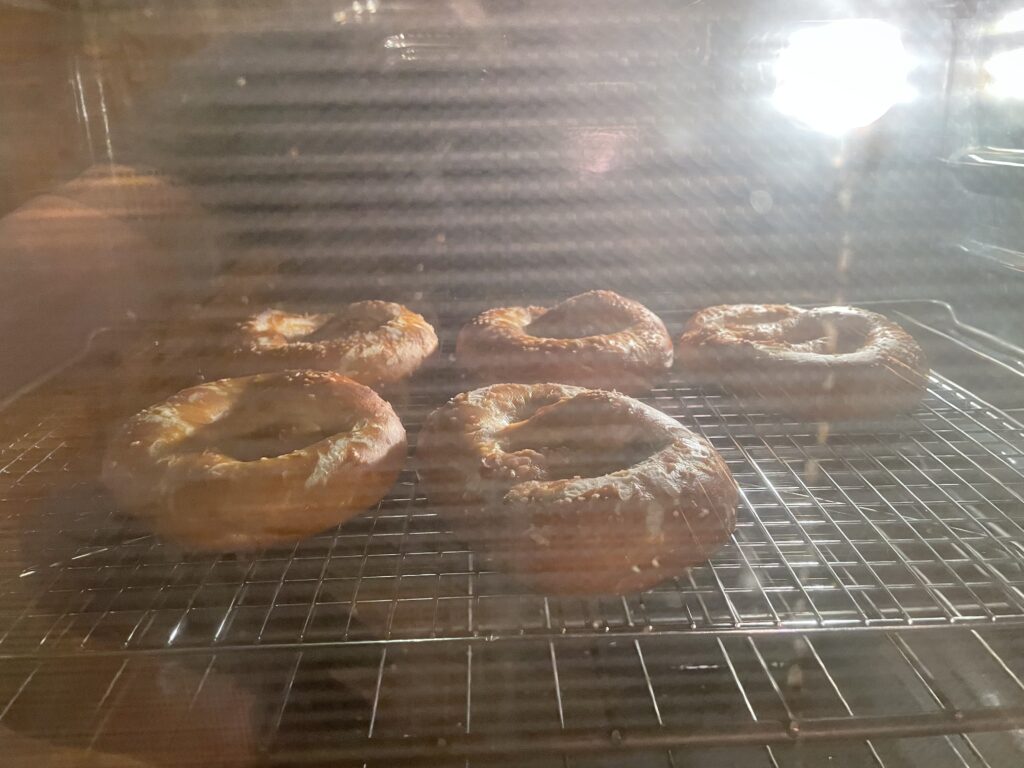
Bake for 14 minutes. This is oddly specific but does appear to hit the perfect spot.
My first attempt. See those cracks? Fuck you, Costco.
And there you have it. It’s somewhat laborious, but they beat out any pretzel I’ve ever purchased. I’m sure street vendors don’t use lye, and no form of chemical stabilizer magic can beat that fresh-from-the-oven texture. So don’t be a goddamn coward, and use some lye!