Solitude (or, Leave Me Alone!)

I’ve always possessed a rather high tolerance for solitude. And often, I’ve been mislabeled as “antisocial” as a result. But time gives one opportunity to self-reflect, and I have since concluded that this accusation is unfair. I’m not antisocial. Rather, I possess a lack of tolerance to associate with people who don’t contribute to my happiness, well-being, or personal/professional goals. It’s not being self-centered, it’s being pragmatic; and it’s a natural progression into the latter stages of life (I’m middle-aged now I hear!)

It’s probably a very late realization, for I was raised to be the people-pleaser. Parental upbringing, an oppressive educational system, a social system that rewarded agreeableness, and the supremely draconian punishments for upsetting customers in service jobs (the only jobs available to a 16-30 year old) – all contributed to the “be nice and indulge everyone” philosophy that dictated my social interactions throughout my formative years. As a result, this “antisocialness” was instead a tendency to avoid all people, because I was conditioned to have to like all people, and lacked the backbone to be more selective.

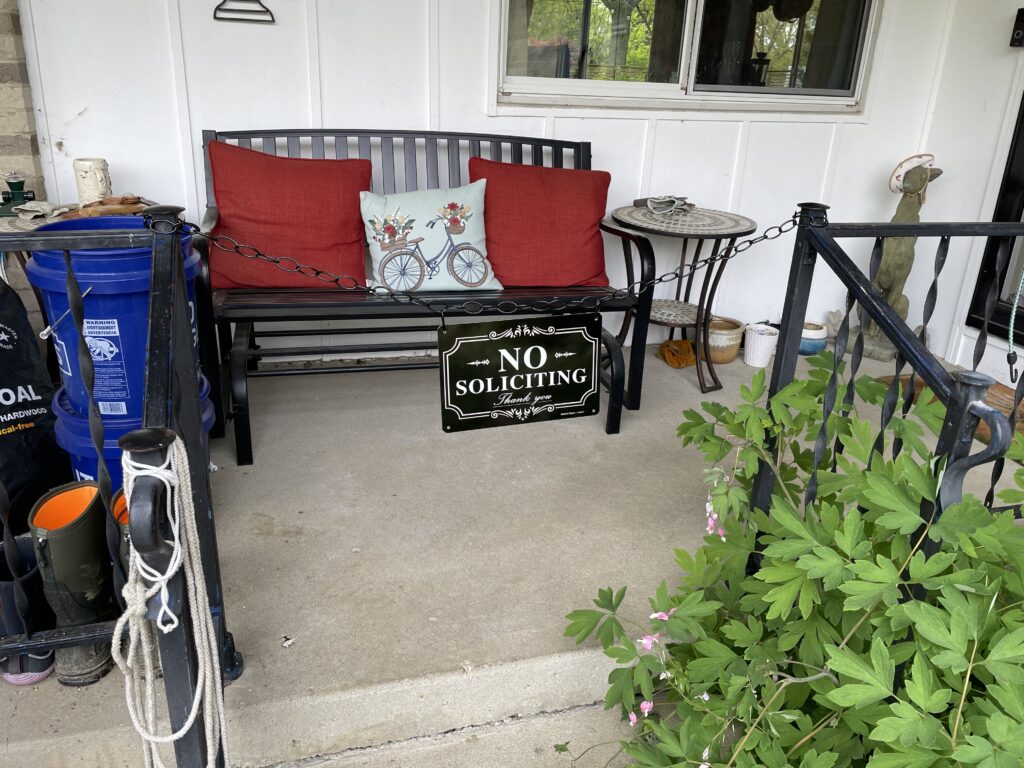
Now I’ve realized that I don’t have to do that. And it started with this:

If people obey the fuzzy ropes at public venues, then a chain should accomplish the same. My apologies to USPS and any package couriers. I try to remember to take this down if one of you is coming that day.

Granted solicitors are the most aggravating of the lot. When I checked back on surveillance footage and saw the same guy from 2018 who comes back every year to try to sell me a bug-spraying service, my patience hit an end.

Add to that a stereotype Republican boomer neighbor with a litany of conspiracy theories (government is spraying the atmosphere with COVID vaccines, Michelle Obama has a penis…you get the idea), street missionaries trying to get me to join their church, and political activists asking how I plan to vote; and while not true “solicitors”, I’m hoping the chain will send a message.

So far so good, though I haven’t captured anyone on camera yet to draw a correlation.

More importantly, the symbolic gesture has finally emboldened me to become more self-serving! I view this as a good thing. Being a doormat only leads to a life of quiet desperation. That was the lesson that George Bailey should have learned.

Here’s some examples:

  • I hung up on someone! I had to disable blocking unknown callers for a time during that HVAC adventure, and I got another call asking for Dustin Werner. When I said they had the wrong number they proceeded to ask if I knew him, and I just hung up and blocked the number instead. Damn was that liberating!
  • I send my new doctor a letter outlining his incompetent staff (4 weeks and I still don’t have my medical records available). I never “broke up” with a physician before.
  • I stopped engaging with my sister over pointless and hostile “discussions”. Actually, I do feel a little bad about this one, but it’s the similarly politically-charged points as the aforementioned neighbor, albeit not totally unhinged and far left instead of right and dripping with pseudo-intellectualism (the world’s entering environmental collapse, you planted the wrong tree, you interpreted that book/movie wrong, The Patriarchy and men are all overly-confident know-it-alls (why would you even have this as a conversational point when calling your own brother?) I still talk to her in chats though.

This almost sounds like a bad motivational speech, but if you don’t add any value to my life then I’m not going to talk to you!

I mean, within reason of course. I’m not a psychopath. I’ll still help people and do nice things for family, but I won’t tolerate them thinking I owe them my time.

–Simon

Pander to Me

While I consider myself to be inter-generational, my year of birth does place me into the Millennial bracket, technically. Consequently, I’m no stranger to the accusations of snowflake-dom by the older crowd. It gets a little irksome, considering the now well-studied economic disparity between the age ranges. To be labeled as sensitive and possessing an intangible need to be acknowledged for my individuality as compensation for a presumed overly-comfortable upbringing and fragile ego shows a very limited viewpoint. Also perpetuated is the false notion that Millennials are poor because we lack motivation, which is of course the result of these stereotypes. If I worked harder and didn’t whine so much then I would have money I guess.

And yet – call a Boomer out on any argumentative fallacies and all too often the backlash is exactly what would be expected of one with such a fragile ego themselves. Even my father, who’s in comparison not overly Boomer-y and seemingly rather self-reflective, throws down awfully quick if poked too hard in generational jesting. As a whole, they do love to cast the gauntlet, but respond in outrage if someone picks it up, as if they never expected anyone younger to defend their own honor. I would hazard to guess this is because they’re used to being customers to a Millennial-staffed service world who weren’t allowed to defend themselves on threat of losing their already meager financial situation.

But just as Boomers couldn’t fathom a world in which Millennials could stand up for themselves, I, who for his adult lifetime has been part of this marginalized age-based demographic, couldn’t fathom what the counterattack represented: the power dynamic had shifted – where significant financial assets were now in the possession of a younger generation – a world that began to pander to me. When did that happen?

I think it began a long time ago, but with subtle change: with Apple’s iTunes store and Netflix’s video streaming service. With music albums and bundled cable packages being cost-prohibitive to the financially disadvantaged, Apple saw an opportunity for an a la carte option, and Netflix for what was essentially an on-demand bulk movie rental service. There was a market opening for cheaper ad-free curated media devoid of time slots, built for a customer base that couldn’t commit to penalty-laden contracts, daily prime time TV-watching availability, and with an unwillingness to buy more than what was wanted. The industry in its raw Capitalism indirectly gave power to those it sought to exploit – by giving them what they wanted. Intentional or not, they acknowledged Millennials.

And then things got even better once Millennials acquired money and property – another change that Boomers couldn’t mentally digest. I’ve noticed a trending alignment between what I want and what the world around me wants, and I can only assume that this means that the people in control have an increasing motivation to give me and my generation what we want (again, because we have money now). Some things are more observational than measurable, so this is far from scientific. But the general feeling is there. Here’s some recent local developments:

  • Increasing closure rate of local big box chain stores.
  • Increased pressure to improve city aesthetics.
  • Influx of independent restaurants and bars.
  • City veto to approve a new gas station builds.
  • Failed passing of state amendment increasing majority vote to 60%.
  • Successful passing of state amendment protecting right to abortion.
  • Passing of municipal park levy.
  • Marijuana regulation and decriminalization.
  • …And a sidewalk was installed in my neighborhood.

These items correspond exactly to my last cast ballot, but they also demonstrate a significant shift away from the world I knew just 20 years ago. Back then, the ethos was more big business, more cars, bigger roads, and being tough on crime. Not to mention the constant excuses to budget cut anything in the public sector. Boomers love budget cuts.

Now it would appear that we’re moving away from a philosophy of authoritarianism, uncontrolled growth, and monetary pursuit; and into a world that’s more aligned with improving the general quality of life for everyone, rather than fetishizing Reagan-ism and Gekko-ism.

The shift itself has increased Boomer hostility, and it’s not that younger generations are being sensitive. It represents what they can’t accept – impending Boomer obsolescence, and Millennials finally getting a say in shaping the future. It’s a power dynamic that Boomers are losing, and few have ever been eager to relinquish that power willingly, least of all the Boomers.

But at long last, I can sit silently and smugly watch the inevitable.

“You can’t stop what’s coming. It ain’t all waiting on you. That’s vanity.”

–Simon