The Need for Speed

During Covid lockdowns our internet was remarkably devoid of problems. No random outages, slowdowns, or hiccups. My theory is that ISPs wisely stepped back on their “network management” (what normal people call brazen violations of net neutrality) in order to avoid massive backlash with the country’s entire office worker and school childr base now dependent in full on network connectivity. Collapsing the American economy must have come up in some board meetings, with perhaps the conclusion that doing so wasn’t the best idea for longterm company financial goals. Whatever the rational, internet access was smooth.

Post-Covid, the shenanigans started to trickle in again. But by that point it was clear that my overall internet speed needed revisiting anyway. The increase in total devices started to eat into available bandwidth, even when idle. And high-bandwidth devices were growing increasingly hungry as accessible content was also growing in fidelity. So finally, I called our ISP for a tier increase.

Naturally, they were quick to take my money. What they neglected to tell me, however, was that they had already grandfathered my plan in to their new base tier. They also failed to mention my modem, which granted I own but they’re still able to see, was incapable of not only the grandfathered speed but also of course the new speed tier. My modem, which supported 100Mb/s, was already obsolete with the upgraded speed of 300Mb/s (which I didn’t know I had), nevermind being incapable of the new speed tier I had just signed up for of 500Mb/s.

I discovered this with a speed test and a quick search of my equipments’ stats. I needed a new modem.

My old modem, the Motorola SB6121, which had replaced a previous Motorola, had served quite faithfully for years. Enough so that, having owned at least 4 Motorola cable modems over the years, I had become brand loyal. However Motorola had since been acquired by ARRIS, so I purchased the ARRIS SB8200. This model supported 1Gb/s with dual gigabit ethernet ports for link aggregation. I was attempting to future-proof.

I also chose this model because it was explicitly listed on the supported modems by my ISP. I also discovered during this research that ISPs now require modem activation. I assume this is to curb stealing cable. That makes me wonder if someone spliced into my coax, could they have plugged in a modem? No doubt that would have caused some IP conflicts, but I guess it would have been possible. So the policy itself didn’t bother me in theory, but it turns out that this security measure would cause some other problems.

Mostly that the activation process failed. In hindsight, I shouldn’t have attempted a hardware upgrade on a Saturday night. Experience has taught me that tenured and/or high-performing customer service reps earn the best schedules, and no one’s going to want to work on a Saturday night, but after the automated activation failed, I didn’t have much choice but to ask for an agent. 6 hours later and I was struggling to get the old equipment running. Eventually I succeeded (but not before having to hard reset my router and do a complete network reconfiguration) and, figuring the modem to be at fault, sent it back. It was months before I attempted another upgrade.

Eventually, the irritation of paying for an internet plan I couldn’t fully use, along with some spousal nagging, build up my courage to try again. This time, I ordered the NETGEAR CM1100. Also a 2-port model, but this one supported 2Gb/s. Again-more future-proofing.

I called on a Thursday afternoon, before 5. Again I attempted the activation through the automated system. And again, I couldn’t get internet despite my router showing connectivity. So I called an agent.

The agent completed a manual activation, and within a few minutes, I was online with full speed. Wondering why the automated activations had failed, he informed me that the automated process is rarely successful. I assume then that the prior agent on my last attempt didn’t know this or simply didn’t bother to push through a manual activation, leaving me with the only remaining possibility that I had bad hardware.

Four months and two modems later, I finally have upgraded speed and I can at long last close this saga. Until the next time I need to upgrade. Because if I ever get beyond gigabit speed I’ll have to buy new switches and a router. So goes the tech race.

–Simon

U-Pick Apple Edition

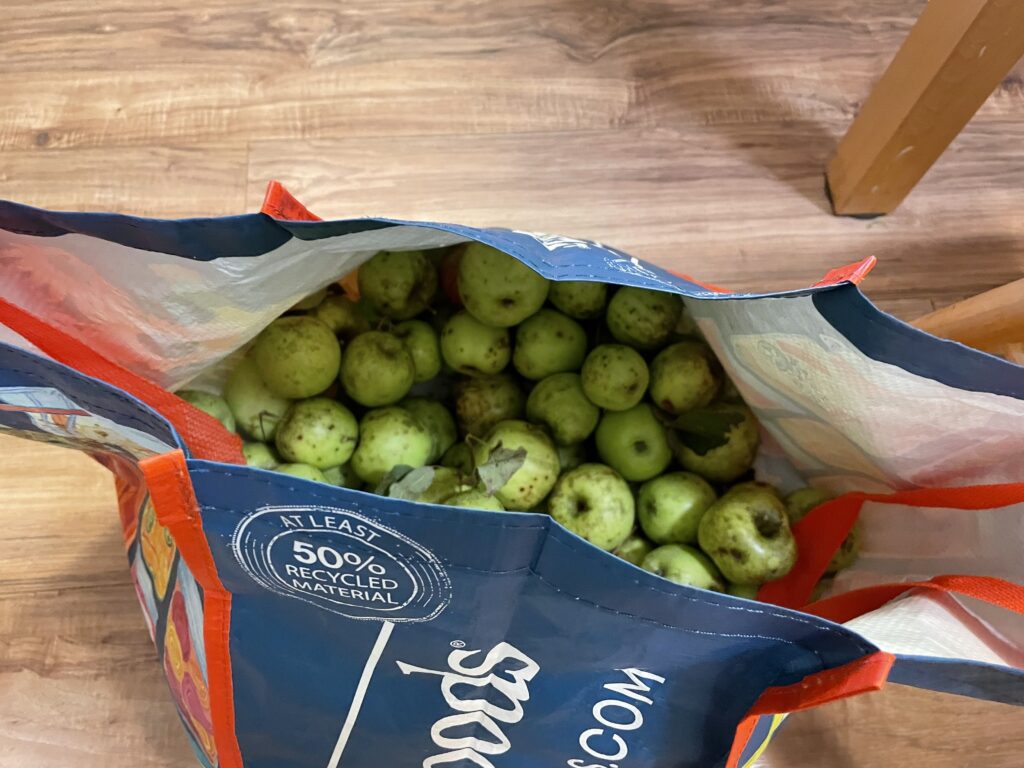
More Liz U-Pick adventures. This time, for apples.

Haunted by childhood memories of picking up rotten wasp-covered apples, Liz has adamantly resisted “branching” our gardening interests into orchards. So instead, we visit commercial operations for fruit. Fine, I’m game. More character-building for the kid.

When I was a kid, we had two kinds of apples: red and green. These taste a lot better than the ones I remember.

She whined appropriately.

Character-building in progress

But I’m always up for a canning operation myself. Each year Liz makes applesauce, and while tasty, it’s hard to mix with bourbon. I wanted to try my hand at juice. A quick internet search revealed reliable extension-office guidance on safe canning (apple juice is oddly omitted from the usual booklets).

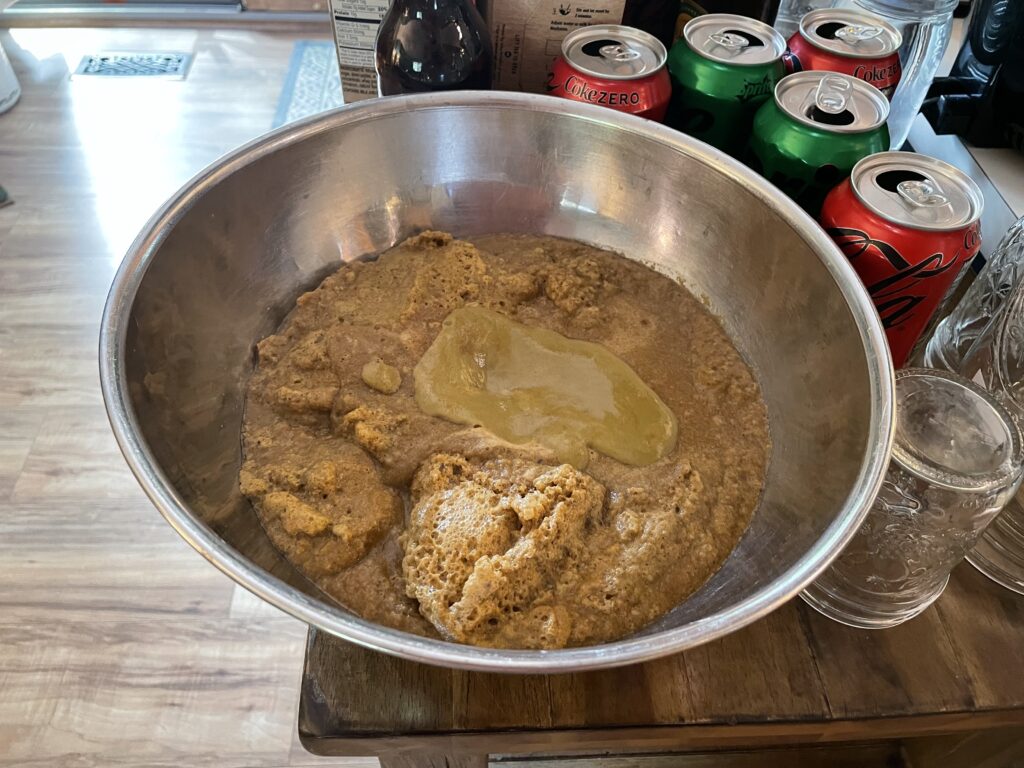
I quickly discovered why small farming operations stick to cider: pulp.

Yuck

So here’s the method:

  1. Run apples through juicer.
  2. Refrigerate resultant slurry overnight.
  3. Skim off the floating pulp.
  4. Pass remainder through chinois until nothing else filters out (4-5 passes).
  5. Bring juice to boil.
  6. As the juice heats up, more pulp will coagulate and float up. Skim this as it appears with a fine skimmer spoon.
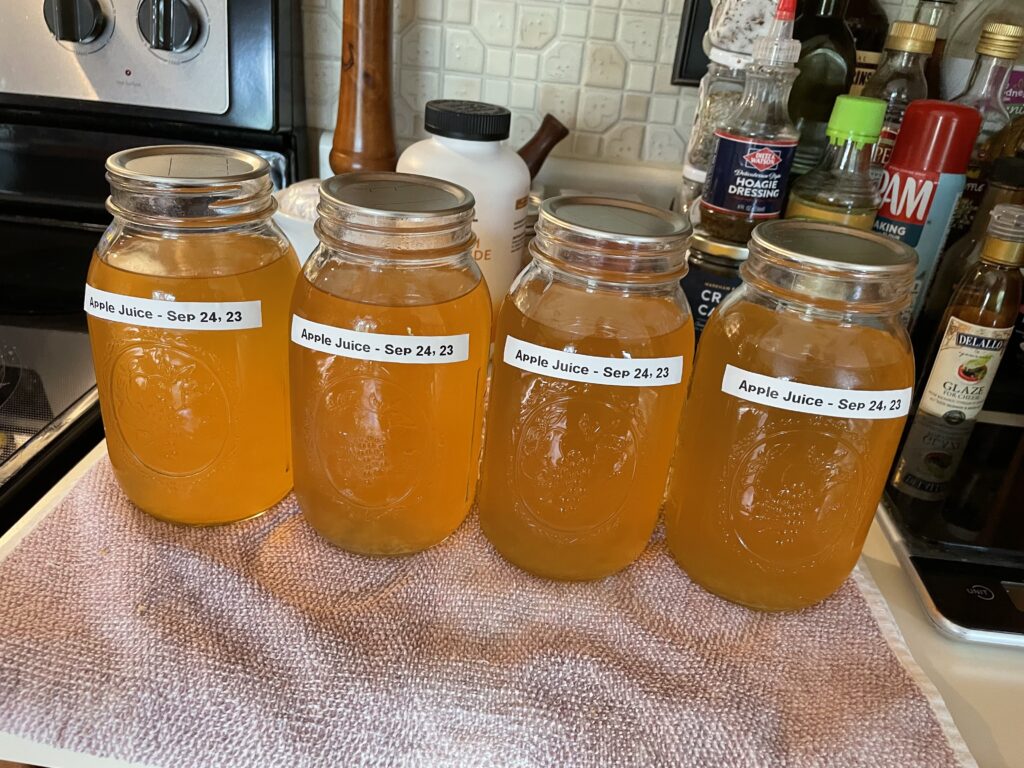
  7. Once boiling, ladle juice through cheesecloth-lined funnel into jars and process according to current standards (as of the time of this writing, the accepted method is water-bath canning for 10 minutes).

Was this a pain to do? Absolutely. But, the results were a significant step up from grocery store juice. It actually tasted like apple, not sugar water! (Why must every processed good contain so much sweetener?)

It was almost a shame to mix with bourbon – almost

I’ll be adding this to our fall canning ritual. Highly recommended.

–Simon

Brisket

More smoked meat pics inbound. This time a brisket!

It follows, more or less, the same procedure as pork shoulder.

The main difference being the intramuscular fat content. I don’t think there was much advantage to wrapping it in foil for the collagen liquefaction stage. It didn’t give me a system purge, but was definitely too rich. I also don’t think it would have dried out, and needed that extra rending. And I left out all seasoning, save the initial brine, so as not to overwhelm the smoky taste (which I wouldn’t do for pork as it needs the added moisture and flavor).

So here we are:

Wood chips courtesy of the kid’s gift to me: Jack Daniels whisky barrel wood.

–Simon

Double Determinates

Who doesn’t love a home-grown tomato? Well, I’ve met people who don’t, but I personally think they’re not people but rather some type of The Omen devil-spawn, and no one can change my mind. I am fully prepared to debate this.

So to increase my production of delicious produce and repel demons at the same time, I planted a second row of determinate tomatoes this year, bringing the total to 18, and to compliment the 12 indeterminate tomatoes on the trellis, and the volunteers that pop up throughout the gardens, and the two extra I put in a pot on the deck. I really like tomatoes.

So standby for a selection of seductive solanums! (AKA, tomato porn):

Here’s a glorious picture!
And another!
And another!

On a more informational note, this was the first time I tried broiling the tomatoes for sauce. The standard blanching/skinning/de-seeding applies, but the flesh is then slightly browned before being added to the pot. I also included a full mirepoix this time too.

Before the stick blender
And after

I think the broiling somehow also brightened the red color, as my sauces are usually more muted, so bonus. I’ll definitely be taking this approach again.

I usually prefer rigatoni or radiotori for red sauce, but I tried bucatini this time

And I won’t have to wait long. In one week’s time, the bowl has filled again. Pizza sauce next!

–Simon

Smoked Pork Butt

After some trial and error, I have finally nailed a pork butt.

No you freak. The devil did not appear to me in a porcine guise with an offer.

Thick and juicy

Although it was smokin’!

So here’s the trick, as I see it. May the internet BBQ community explode in outrage at what they think I did wrong:

  1. Brine meat for a minimum of 12 hours. Just a standard salt and sugar brine here – nothing fancy needed. The flavor will come later.
  2. Place meat unwrapped in smoker cold – both meat and smoker. No preheating.
  3. Smoke at 170-200 degrees until internal meat temperature reads 160. Temperature is based on preference – colder smoking gives more contact time with smoke and therefore has a more smoky taste. Also I like cherry wood for pork so far.
  4. Pull the meat at 160 (at this point, much of the water and most of the fat will have rendered out, and the collagen will start to liquefy, which you want to stay in the meat). Cover with rub. My rub base is ketchup, mustard, apple cider vinegar, and brown sugar. As a self-proclaimed pitmaster though, I won’t tell you my spice mix. But I will tell you that the rub shouldn’t taste very good on its own (like a marinade). If it makes you wince, you’re good to go.
  5. Wrap meat tightly in aluminum foil. I prefer to remove the thermometer probes first and then punch through the foil. It’s easier, and creates a tighter seal.
  6. Put the meat back in the smoker and cook at 275 until the internal meat temperature reads 205. This is the stage at which most of the collagen is liquefied. The next day’s leftovers will be a mass of meat and gelatin, which indicates successful collagen breakdown. This is good, even if it doesn’t look like it. Wiggle wiggle.
  7. Place the meat, still wrapped and with meat probes, in a cooler. There’s no real reason to rest it as you would a steak, since the collagen isn’t significantly redistributing as water would. But resting it at this point will allow the collagen to continue to liquefy if any hasn’t yet, and it will gradually cool to a touchable temperature for pulling. More importantly though, this gives you a buffer by which you can finish smoking prior to dinner and time the preparation of side dishes. You could technically wait as long as you want until the temperature hits 140, at which point you’ll be in THE DANGER ZONE! OOOOOOOO!
  8. Shred, stuff in face, and wait for your well-deserved adoration.

And you’re done! And it only took me 15 hours for an 8 pounder. It was, however, gone in 4 days. And now I know why you can’t get good BBQ at a restaurant. It just isn’t economical to spend that many man hours in our present day of Boomer chains (i.e. Applebees, Chili’s, Outback…)

But before I go old man ranting on you, get to the store and buy and pork butt!

–Simon