Ring 2

Not the “Ring 2”–I mean part deux of the Ring products saga

A year ago we got the Ring doorbell.

Thankfully, it hasn’t been instrumental in solving any crime, but it definitely brings peace of mind.  And, it’s very convenient to see who’s walking up to the door while I’m in the basement working.

But paranoia has no terminus, and I found myself eyeing Ring’s line of cameras for the back door for the same reason: I want to see if anyone’s walking up to it.  Not that anyone has, but I often leave the dog in the back to run while I work, and with reports of dog-snatchers, I wanted to keep an eye on things.  I decided upon the Stickup cam wired.

My reasoning was thus:

  • I don’t want a floodlight back there, so no-go on that model
  • I wanted wired, as I always prefer to run dedicated lines to unreliable WiFi
  • It supports PoE, which would not only allow a single cable run, but the PoE injector could then be plugged into my UPS, thus keeping the camera online in the event of a power outage

The only thing left to do then, was actually run the cable.

But the drawback of cable is that it limits placement of jacks, due to the simple matter of me not being able to squeeze into tiny places (unlike my father, I don’t have a son to task with those jobs).  I had wanted to run the cable to the attic and down the eaves and into the middle of the deck, but as I attempted to do so it became very clear that if I actually managed to drop down through the attic and into the eave space, Liz would have had to call the fire department to chop me out.

So I would have to drill through the outer wall–which was brick, so no easy feat.  But there is a pointlessly-placed back window into the garage, with a wooden frame.

The wood posed little challenge, and in short order I had a 3/8 in hole from the garage to the back yard.

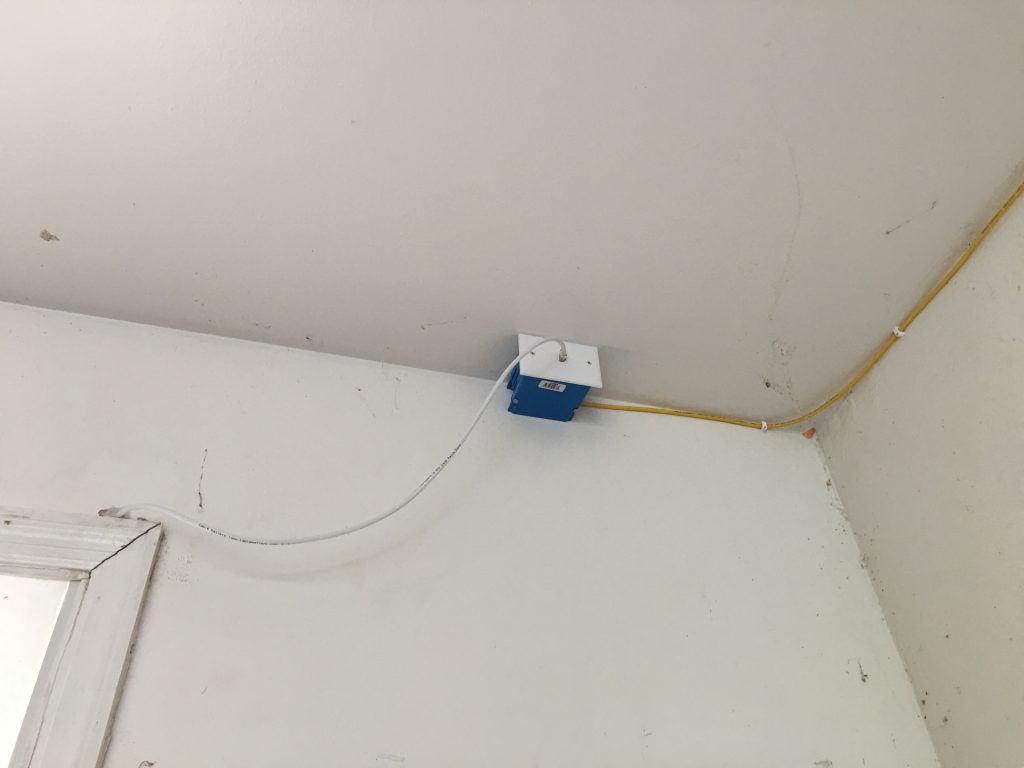
From there, I ran a patch cable connecting the camera to an electrical box I installed on the garage ceiling, which housed the cable termination and ethernet jack.

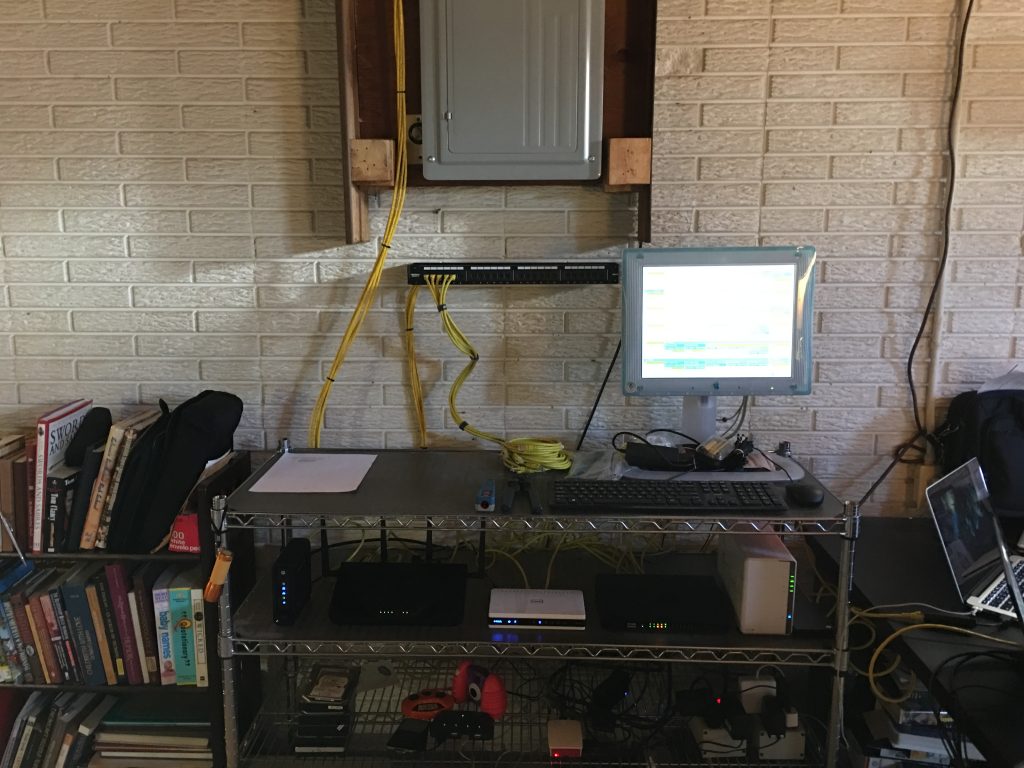
From there, the cable ran into the attic and followed the path of a prior cable install for the garage hotspot, ultimately terminating in the patch panel.  Then it was through the aforementioned PoE injector, then to the switch.

Voila: my longest cable run yet.

Now for some thoughts on PoE:

I noted that after all was up and running, the switch indicated that the connection was not gigabit.  All the equipment was rated for it, including the injector, but the amber light stubbornly refused to turn green.  Concerned that one of my punchdowns was bad (as was the case in a recent project–totally not my fault), I disconnected the injector and tested the line with a laptop.  All connections were confirmed gigabit, so I researched how PoE operates.

Surprisingly, I couldn’t find any bandwidth figures for the various specs, maybe because PoE isn’t in itself a form of data transfer, but rather a means of transmitting power over a data cable.  Still, the lack of discussion on the matter was not encouraging.  I concluded that what was happening is that I had one of the specs that sacrificed two of the 8 CAT6 wires for power, thus dropping the connection speed to Fast ethernet.  Apparently, therein lies the PoE tradeoff.

But the speed seems adequate, and while live view appears somewhat grainy, the recordings are perfectly clear.

I’m still pleased to say it hasn’t recorded any crime either.  And, apart from some rabbit-chasing videos, it’s dutifully served its primary function–notifying me when there’s backyard movement I should know about.

Recommended.

–Simon

Patch Panel

A while back I offered my thoughts on the benefits of wiring devices rather than relying on WiFi, and my efforts with installing Ethernet drops.  The system worked well, but I had nagging doubts about my install.  Specifically, my jack punchdowns were not up to spec, my patch cables were self-made, and my drops terminated in the basement with RJ45 connectors.  In short, it was an amateurish install and didn’t look good.

After re-punching my wall jacks with the proper method, I decided that I would finally bite the bullet and buy a patch panel.  The only thing that had been holding me back was the price, and the fact that I lacked a networking rack to hold it, but these concerns were alleviated with a little bit of searching.  I decided upon these two items:

TRENDnet 24-Port Cat6 Unshielded Wallmount or Rackmount Patch Panel, Compatible with Cat 3/4/5/5e/6 Cabling, TC-P24C6
Monoprice 1.75 by 19 by 4-Inch 1U Wall Mount Bracket 108623

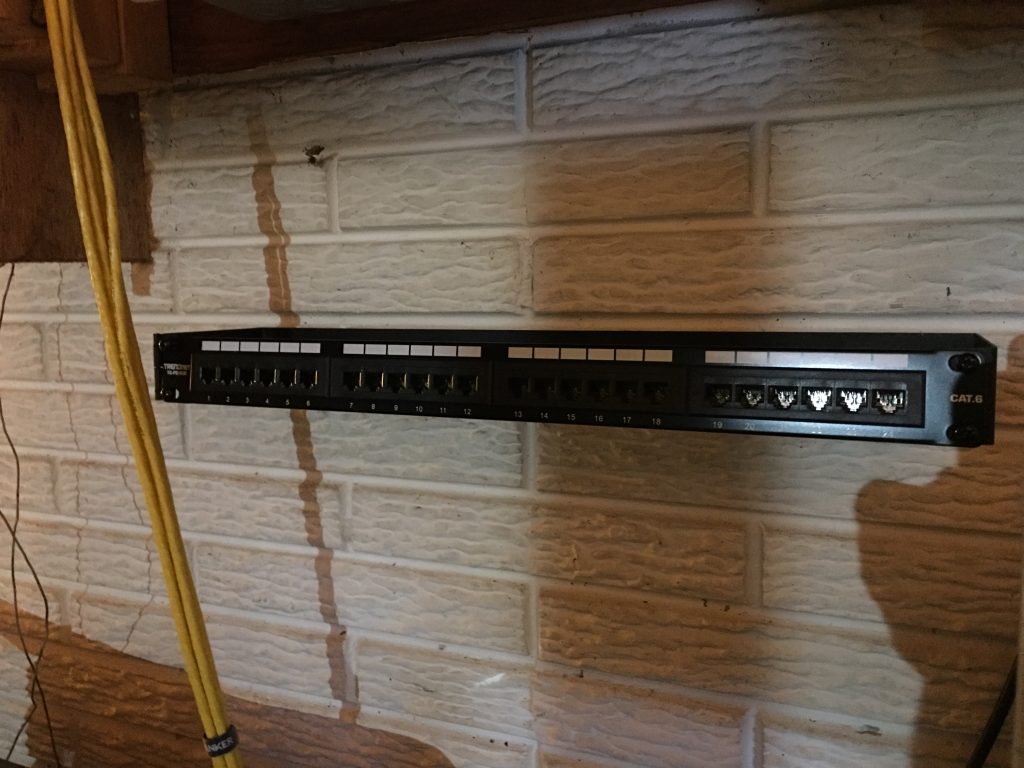
The intent was to mount the patch panel in the bracket on the concrete wall in the basement.  And, despite the irritations involved with drilling concrete, this idea played out perfectly:

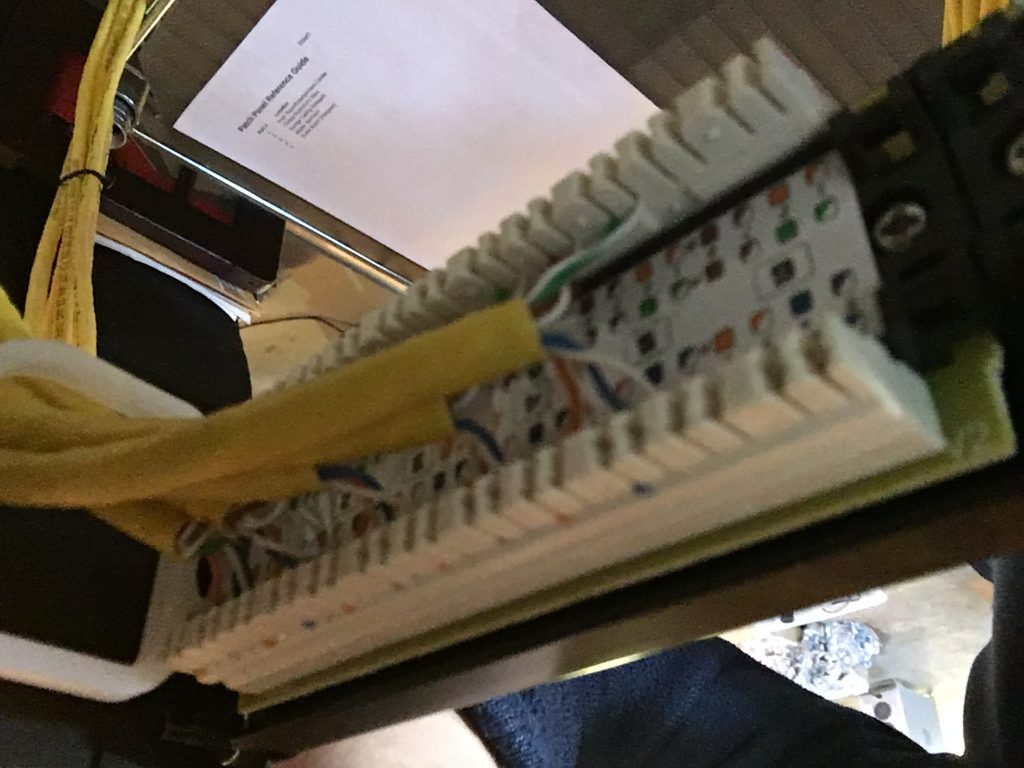
It was also much easier than crimping.  A simple punchdown tool secured the wires and clipped the excess, and in short order I had secured my existing 5 drops.

For the record, I chose T-568A.  Although now, having purchased patch cables all configured in B, I probably should have chosen B.  Ah well, the difference is pretty negligible.  Regardless, though I haven’t benchmarked anything, the network does seem a little snappier now.  The previous RJ45s were properly rated for solid-core CAT6, but I still don’t think it’s possible to manually crimp a connection as well as punching.

And besides, it looks much cooler now.

–Simon

Elusive Photogenics

A couple weeks back, I bought a new aquarium.  This reminded me that my main aquarium really needed a pruning, especially so as it was starkly contrasted to the Amano-style tank in the basement.  And a pruning is really not an arduous undertaking, so I finally forced myself to do it.  Behold:

I’ve always struggled to get a good close-up photo of that tank.  I think digital consumer camera technology finally advanced enough to make it possible.  Oooo, purdy.

–Simon

Laminate (Part 2)

I heard a theory once that mothers, having endured the pain of childbirth, cope with the trauma through selective amnesia.  The theory posits that, were the memory’s vivid details to remain, no woman would ever subject herself to a second pregnancy.

I don’t know if it makes a good metaphor, but I’ve found a similar effect in husbands who undertake painful home renovations, for 6 months is apparently the point at which I forget anguish and willingly subject myself to the original task which caused the anguish.  Of course, once I begin the task, I quickly remember.  But by then, it’s too late.  Much like pregnancy.

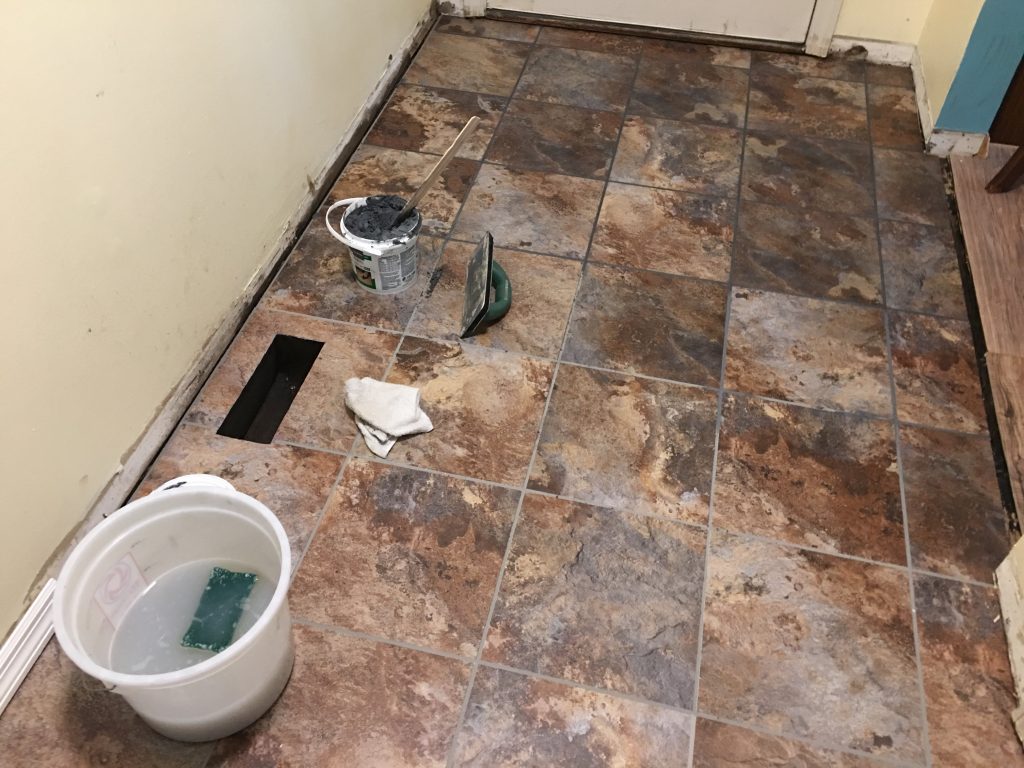
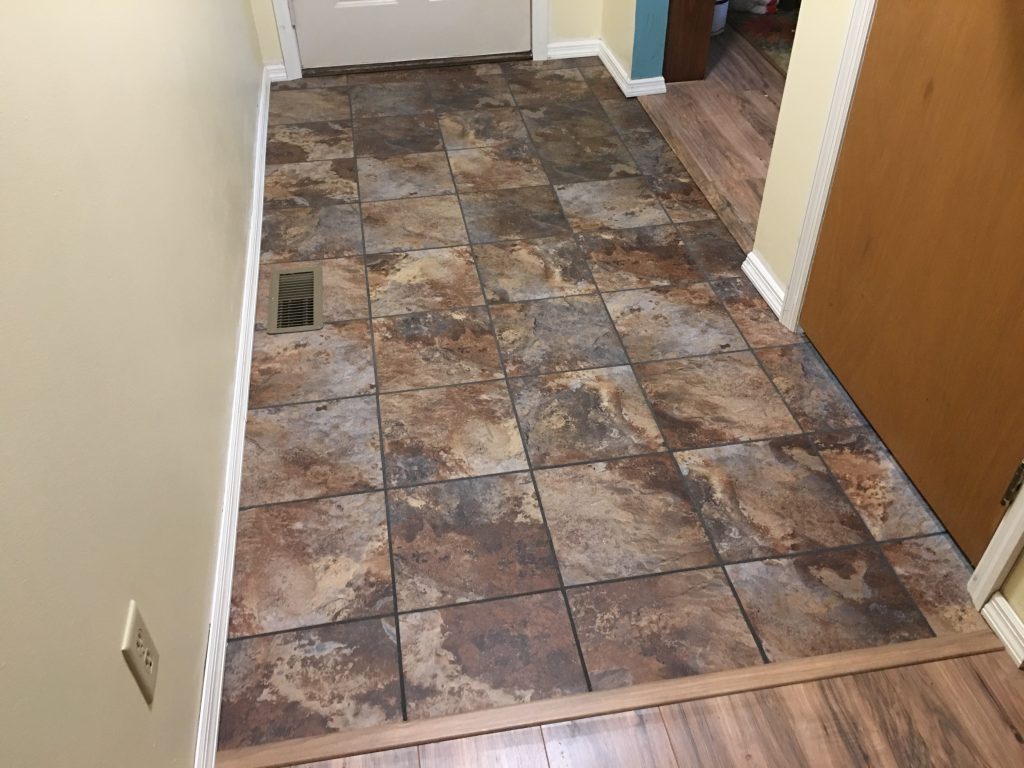
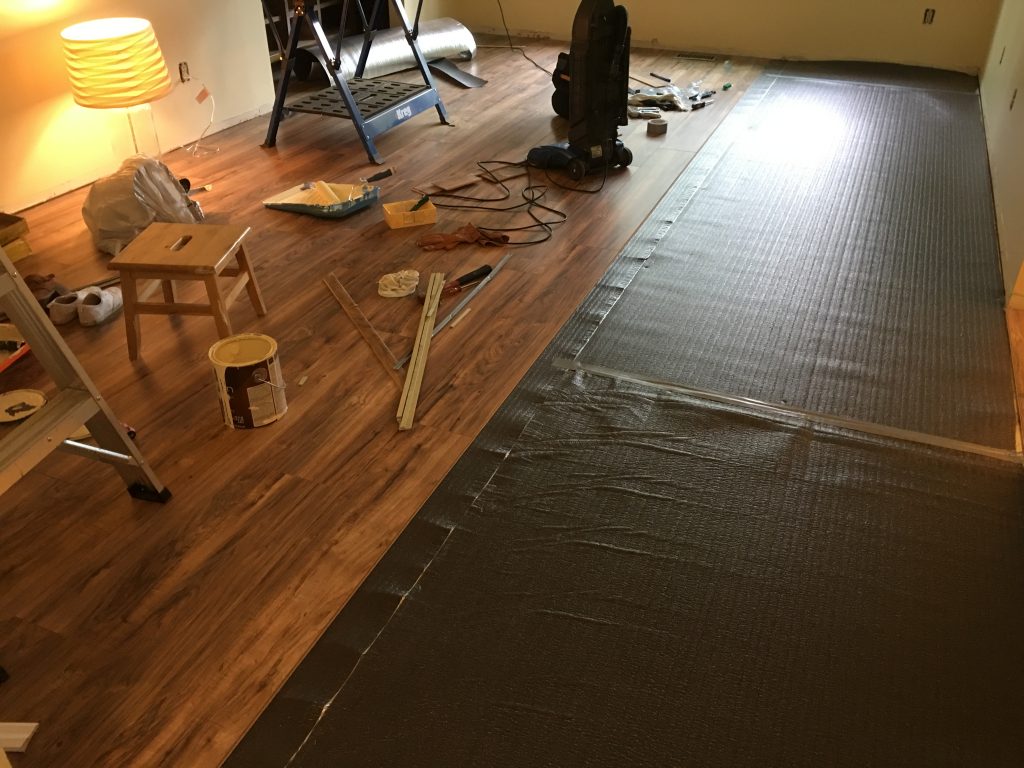
This past Spring, I replaced the hallway carpeting with laminate.  The horrors which lay below were unmentionable (so I mentioned them).  And the end result was well worth the effort, for no longer did navigating the hallway require a temporary hiatus from normal respiration.  Ahh, I love the smell of offgassing formaldehyde in the morning.

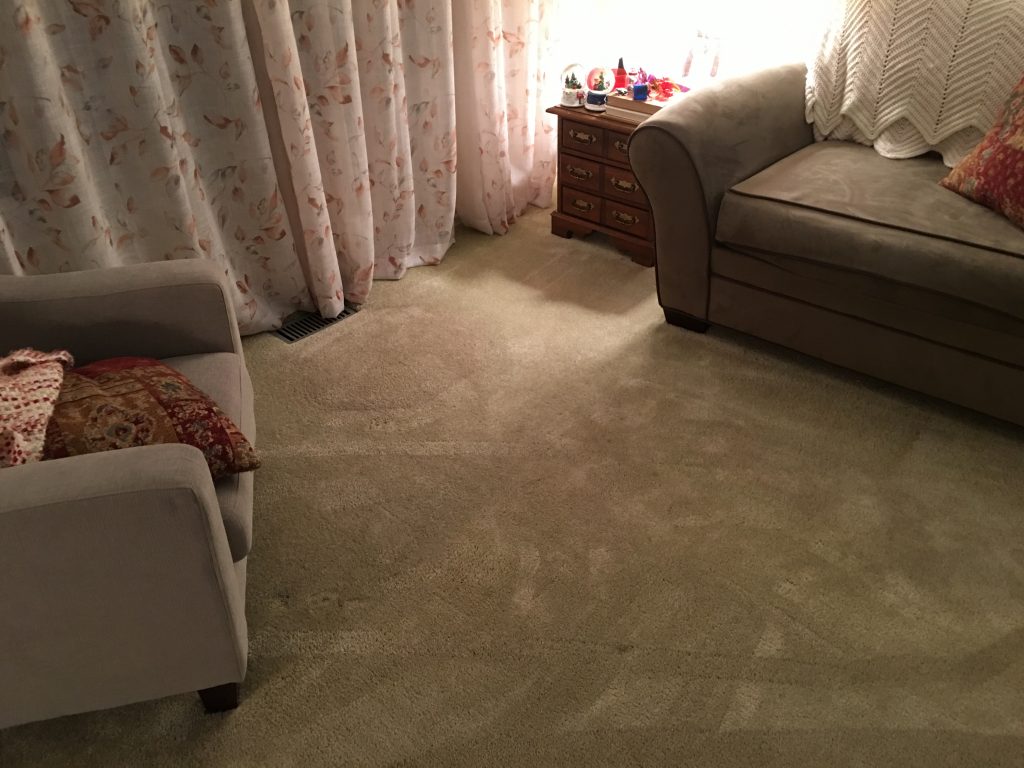
The subflooring of the dining room wasn’t nearly as bad, but the carpet was equally rank.  Cut into strips and awaiting their gradual disposal, they pollute the garage with the musty fumes of an old lady and a dying dog.  I’ve taken to running the ozone machine out there regularly, where it works much better than my original intention.

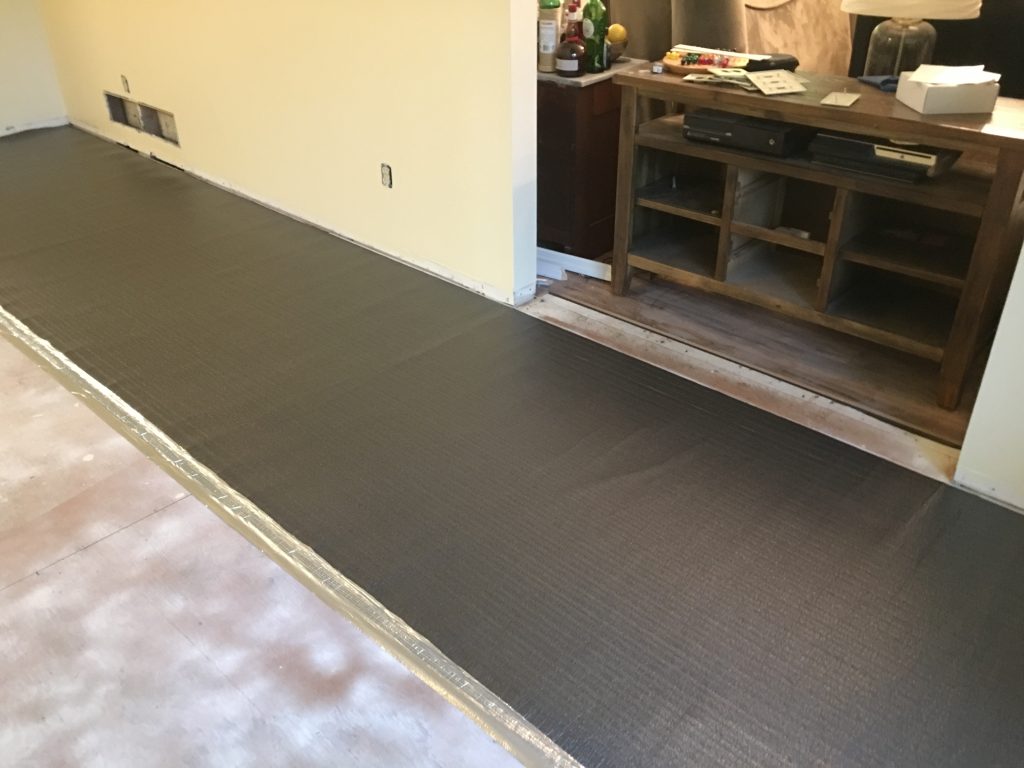
Floor stripped and vacuumed, the real work began.

I was faced with a quandary.  When we bought the house, the kitchen and front room had fresh laminate.  The problem was, the slats interlock in a certain direction, and unless I removed areas of the transition zones, I had no way of knowing which direction the slats had been laid.  When I re-floored the hallway, I hadn’t checked, but at the time it didn’t matter because it wouldn’t connect with the existing laminate.  But now, with the dining room, I needed to know.  But I didn’t consider this ahead of time and began work.  It would come down to a 50/50 chance.

I had already laid the first board.

As the work progressed, the dilemma gnawed.  Could I live with the two rooms not matching?  Would I be content to leave a junction strip between the two?  If I could, would the misalignment forever torment me?  And what if I eventually joined the living room?

So I ripped out the kitchen’s terminal boards and hammered in replacements.  I then shifted my prior work to match, but it was only until the work had advanced sufficiently as to be irreversible did I discover that the two rooms were not perfectly matched in linearity.  No, by mere millimeters were they bent.

Well, if intellect and proper anticipation would fail me, I could always use brute strength and violence!  At least I would have, had my strength been sufficient, but ultimately I had to use a 2X4 and the wall to force things into alignment.  And cursing.  Lots of cursing.  The boards matched closely enough so as to be convincing, and only a very close inspection would betray the slightest of error.

As proof of my efforts, I paid The Blood Price.

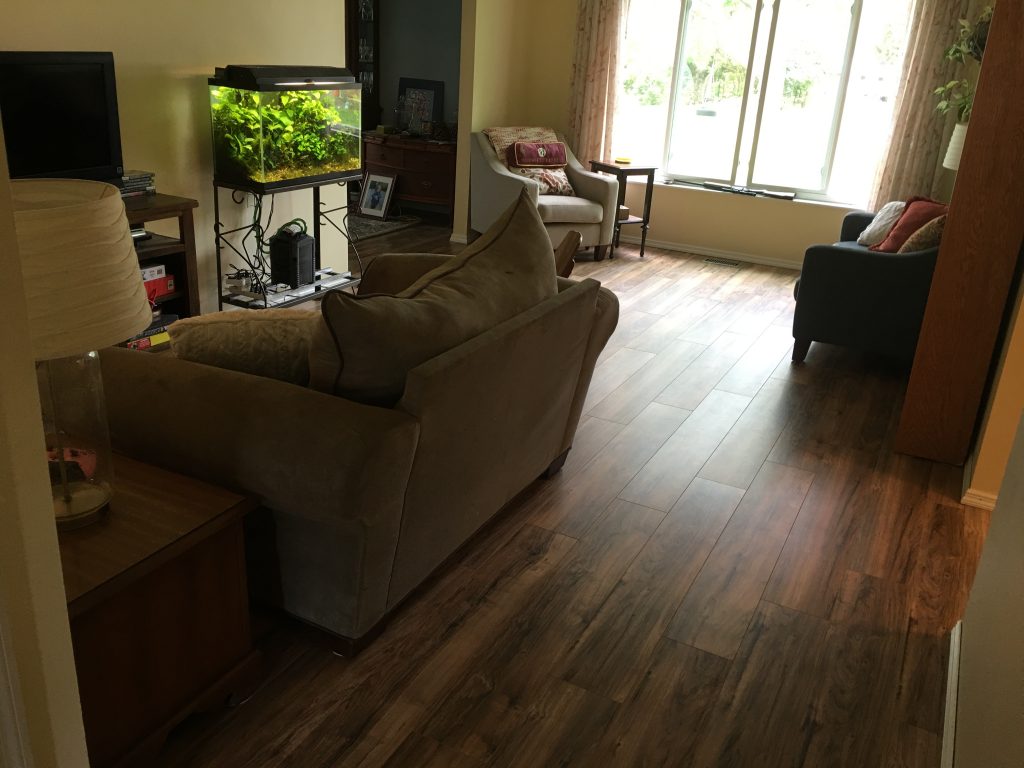
Once everything was aligned with the kitchen, the remaining work was more tedious than noteworthy.  I installed the border strip and replaced the molding.

We now have what I call the most adult room in the house, since no one’s allowed to use it.

I did so well in fact that Liz was immediately ready to pull the carpet out of the living room, but I required that the home renovation amnesia set in first.

She set a calendar reminder 6 months out.

–Simon

One Door Leads to Certain Doom

Well, maybe not doom, but the usual mix of anger and irritation.

Liz wanted a storm door on the front, as she had long complained about the lack of airflow north to south through the house, which is mostly because there’s no south-facing window (aside from the bedrooms).  So, in theory, the front door could be left open to aid this pneumatic conundrum were a screen to be installed there.

I liked the look of our front door, as it sported a rather medieval type of aged bronze handle upon dark maroon paint, so I was reluctant to hide that behind my outdated vision of a screen door: the Lubbock house’s back door–an exposed aluminum frame with a screen that was always torn and popping out.

But there have been some design updates in the last 20 years, and the modern iterations are coated aluminum with hybrid glass/screens.  They also mount into frames with enough clearance so as to avoid doorknob complications, and they can accommodate the ever so important seasonal wreath which hangs from the main door.

That’ll keep the storms out!

Nevertheless, it wasn’t as straightforward as IKEA furniture.  In fact, depending on its desired orientation, the screw holes had to be manually drilled out first.  This process required some spacial orientation, and therefore concentration, to do correctly.  But at this critical moment, Poppy attacked the mailman, and after I corralled the whippet any such concentration was shot, and of course I drilled out the wrong side.  Sigh.  At least the holes are small.

I also had to drill out rather large holes to attach the doorknob and deadbolt, during which the battery in my drill went dead, so the project experienced a rather unfortunate delay.

And there was no gentle way to drill out 3/4 inch holes in plate aluminum

But alas!  We now have a storm/screen door.  I admit that it does look nice, and it’s convenient to use it throughout the day instead of the large wood door–mostly because the kid either slams it, or won’t close it at all.

As to whether or not it helps with ventilation–I don’t know yet, because since I installed it it’s been about 90 out and humid.  Ohio weather (kind of makes me wonder again why we bothered with this).

I’ll just be content in that it looks nice.

Nose prints within minutes

–Simon